




 Ask an Expert


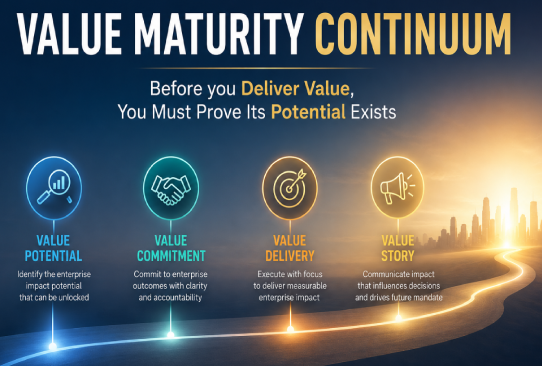
GCCs have been talking about enterprise value for years. But most have skipped the most critical step –establishing what is ‘the value potential ‘before they claim to have ‘delivered ‘it. The journey from intent to commitment to delivery demands a different discipline entirely, which only a chosen few have been able to achieve.
A. What Enterprise Value Actually Looks Like
Enterprise value is impact that registers at the level of the organisation’s strategic outcomes. It shows up in revenue lines, in competitive positioning, in risk registers, in product roadmaps, in the speed at which the enterprise can move against market opportunities.
Enterprise value does not refer to operational outcomes. They may be prerequisites for enterprise value. They are not, themselves, enterprise value.
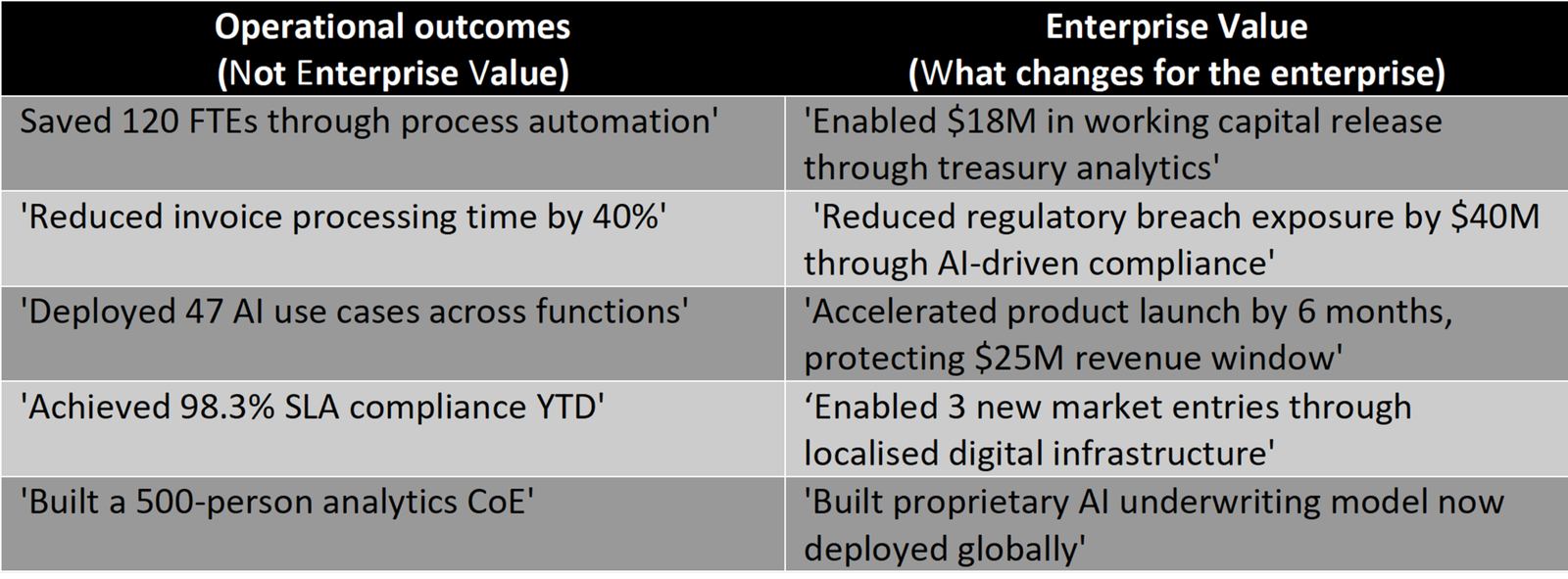
Having met several Heads of GCCs over the last 6 months, today’s GCCs tend to use three terms – Deliver Value, Create Value and Unlock Value – as ‘interchangeable’ in achieving what we call as “Capability to Value’ continuum. This lack of clarity, by itself, demonstrates the limited understanding of GCCs about how Enterprise Value arises!
Enterprise Value arises at three different levels of Capabilities:
Level 1: Utilizing Capability: When the Value arises from effective planning & actions by utilizing existing capabilities of the GCC, through analytics of operational/ available data, process, information etc., it is the base level capability and referred to as ‘Delivering Value’.
Level 2: Connecting Capabilities: When the value arises from plan & actions by connecting capabilities of the GCC and the Enterprise Processes beyond the GCC through upstream-downstream linkages, it is the next higher level of capability and referred to as ‘Creating Value’.
Level 3: Expanding Capabilities: When it arises from plan & actions where the GCC is expanding the capabilities of the Enterprise as a whole and takes the lead for strategic partnerships or even the full/ partial GCC carve-outs, spin-offs, hybrid models etc., with a view to collaborate with external capabilities (like AI, Platform Management, Registrable Ips, Scalable Talent etc.), it is the highest level of capability and is referred to as ‘Unlocking Value’.
The translation from operational outcome to enterprise value requires a clearly articulated causal chain that shows how the GCC’s capabilities influenced the enterprise outcome. The intellectual application for the most GCC leaders seems to be still at the base level and are yet to move up the ‘Collaborative Capability Chain’ of Enterprise Value’!
It is the design and work that, once initiated and done, changes the nature of the GCC’s relationship with its Enterprise, and becomes the real ‘Enterprise Hub’, much beyond a Center!
B. The Confession Most GCCs Wont Make Out Loud
Ask any GCC leader whether their centre is delivering value, and the answer is invariably yes. Ask them to quantify it in terms how the enterprise CFO would recognise, not operational efficiency metrics, not process cycle times, not FTE ratios – and the confidence begins to erode.
The confusion is logical. GCCs evolved from cost arbitrage models where the value equation was simple: labour costs there versus labour costs here, multiplied by headcount. For the first decade, that framing worked, for the second, the framing started shifting. But the GCC mandate has evolved faster than the value measurement infrastructure surrounding it. Today’s centres are expected to drive product velocity, accelerate AI adoption, build proprietary capabilities, and create competitive moats – and the metrics for these simply don’t exist in most GCC scorecards.
For instance, what GCC typically measures is not aligned to the enterprise goals:
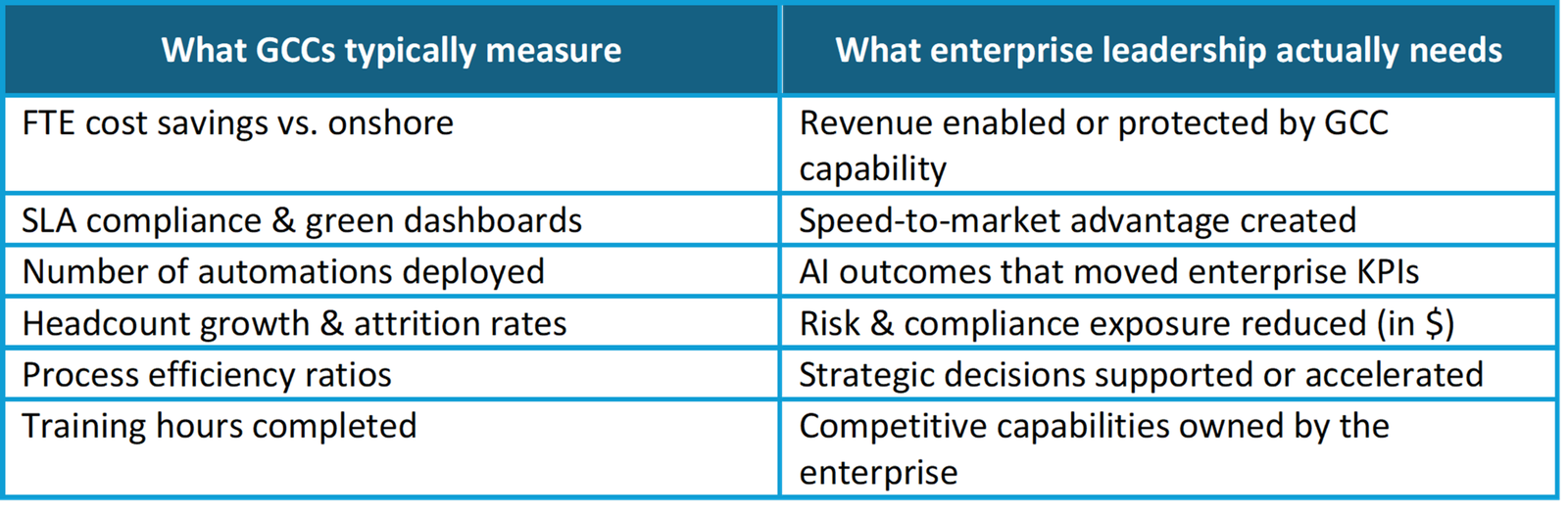
The gap between operational excellence & cost arbitrage and enterprise value focused models is not merely a reporting challenge – it is a commitment challenge. As long as GCCs continue measuring what is easiest rather than what matters most, strategic indispensability will remain elusive.
A GCC that cannot articulate its value potential has no locus standi claiming to deliver it. The proof of potential must precede the promise and delivery.
C. Value Potential First: The Step That Cannot Be Skipped
Value potential is the enterprise-level impact that a GCC is capable of achieving by design grounded in the specific strategic context of the parent organisation. It is not an aspirational indicator It is a rigorous, bottom-up assessment that answers a single question: “If this GCC performs at its optimal designed capability, what changes for the enterprise?”
Establishing value potential requires three things most GCCs have never formally done:
- mapping the GCC’s capabilities to enterprise strategic priorities
- quantifying the gap between current performance and what the best-in-context would produce,
- securing explicit confirmation from enterprise that these are the right outcomes to pursue
A GCC serving a financial services enterprise should be able to articulate its value potential in terms of regulatory risk reduction, capital allocation acceleration, customer retention improvement, or revenue enablement, not merely in terms of FTE savings by automation.
Value potential must also be contextualised by what the enterprise is actually trying to achieve in the next 18-36 months. A GCC that has mapped its capabilities to a three-year-old strategic plan is, at best, accidentally relevant. The value potential assessment must be a living document, refreshed as the enterprise’s priorities evolve, and owned jointly by the GCC leader and the relevant enterprise CXO/ Management sponsor.
D. Moving from Intent to Commitment
The word ‘commitment’ carries weight that ‘intent’ does not. Intent is a direction. Commitment is a contract/ accountability. When a GCC says it intends to deliver enterprise value, it is expressing an aspiration. When it commits to it, it is accepting accountability – for outcomes, for timelines, for the enterprise consequences if those outcomes are not delivered.
This shift is uncomfortable because it exposes GCC leadership to a form of accountability most have been insulated from. Operational metrics have a comforting quality: they are largely within the GCC’s control. Enterprise outcomes – revenue, risk and competitive position – are not. They depend on execution across the entire enterprise ecosystem, on factors the GCC cannot unilaterally control and has to collaborate to deliver.
But this is precisely the point. Strategic indispensability requires shared responsibility .
The GCC that accepts responsibility for enterprise outcomes – even partial responsibility – earns a seat at the table that no operational excellence programme can ever secure. It becomes, in the truest sense, part of the enterprise rather than like a ‘vendor’ to it.
Commitment also requires a fundamental rethinking of the GCC planning cycle. Annual budgets built around headcount and operational cost have no mechanism for capturing enterprise value commitments. The GCC of the future requires a parallel planning track, which is a Value Commitment Plan, that explicitly identifies what enterprise outcomes will be influenced, by how much, by when, and what the GCC will do differently to make that happen.
E. Capturing Value Delivered: The Discipline of Evidence
Establishing potential and making commitments is only two thirds of the equation. The third act, and the one most GCCs finds challenging, is capturing evidence of value actually delivered. Not in the form of a post hoc narrative constructed for the annual leadership meeting, but as a continuously maintained, enterprise-auditable record of impact.
Value capture is a discipline. It requires the same rigour that finance teams bring to revenue recognition:
- Agreed methodologies
- Clear attribution rules
- Continuous measurement
- Independent validation where possible
Three steps matter:
01 Establish the baseline → Agree starting-point metrics with enterprise before any initiative → Joint sign-off on measurement methodology with sponsor → Document what ‘good’ looks like in enterprise outcome terms
02 Track the delta continuously → Real-time or quarterly measurement vs. committed outcomes → Distinguish GCC-attributable impact from broader execution → Surface variances early with root cause analysis
03 Validate and crystallise → Independent validation of material value claims → Convert soft impact to economic proxies → Build an evidence library for the value story
The evidence library is not a PowerPoint deck. It is a structured repository of value instances, each with a clear before/after, a mechanism of attribution, an enterprise stakeholder who will validate the claim, and a financial or strategic quantification. Built over time, this library becomes the most powerful asset a GCC leader possesses when making the case for investment, expanded mandate, or strategic elevation.
F. The Value Story: Communicating to Earn the Mandate
Even the best-captured value will remain invisible if it is poorly communicated. The value story is not the same as the value report. A report is a document. A story is a narrative that changes how an audience thinks, feels, and decides. For GCC leaders, mastering the value narrative transforms standard stakeholder updates into powerful drivers of organizational alignment.
“A report informs …….A story influences decisions”
The value story should be communicated on a rhythm, not on demand. GCCs that communicate value only when challenged – in budget defence season, during leadership reviews, when a senior executive questions their mandate – are always playing ‘catch-up’.
The value story has three audiences with three completely different needs. The enterprise board and C-suite want strategic narrative – how the GCC is making the enterprise stronger, faster, more resilient, more competitive. Business unit heads want case-by-case outcomes: what we did for your team, what changed, what comes next. Operational sponsors want predictability with evidence that commitments will be honoured.
The GCCs that waits to be asked about its value have already missed the opportunity. The GCCs earning strategic elevation are telling the story before anyone thinks to question it.
G. Call to Action – From Intent to Indispensability
The GCCs that will define the next decade will not be the ones with the largest teams, the most automation programs, or the highest number of AI pilots.
- They will be the ones that have institutionalized Enterprise Value as a discipline.
- They will establish value potential before claiming delivery.
- They will commit to enterprise outcomes rather than operational metrics.
- They will capture evidence with rigor.
- And they will communicate value in a way that influences enterprise decisions.
This is the difference between a GCC that is relevant today and one that is indispensable tomorrow.
The Three Acts of driving Enterprise Value
- Act I – Establish value potential: Map GCC capabilities to enterprise strategic priorities. Quantify the gap between current state and full potential. Secure joint commitment on the right outcomes to pursue.
- Act II – Commit and capture: Build a Value Commitment Plan or Tracker. Measure continuously against enterprise outcomes. Maintain an evidence library with attribution, quantification, and validation.
- Act III – Create and communicate the value story: Tailor the narrative to each audience. Communicate proactively, on a rhythm. Connect every GCC initiative to an enterprise outcome. Do not wait to be asked.
The GCCs that earn the next wave of strategic mandates will not be those that simply report activity. They will be the ones that can quantify value before they promise it, commit to enterprise outcomes before they report them, and demonstrate impact before they tell the story. In the coming decade, the most successful GCCs will be measured not by what they do, but by the enterprise advantage they create.
From seeing the Partner Network as a Competition to a possible Collaborator to Unlock Value:
- Clarity of Point of Departure (POD) and Vision of Point of Arrival (POA)
- Evaluate and compare the Speed, Value, Investment and possibilities of front ended benefits
- Differentiate between traditional Outsourcing and Hybrid GCC / Partner Operated GCC (COCO to COPO)
Driving enterprise value is the core of the Quintes Value Maturity Framework, which focuses on:
- Defining Enterprise Outcomes across Growth, Financial Impact, Governance, Risk, and Stakeholder Experience
- Moving systematically from Value Potential (VP) to Value Delivery (VD), Value Capture (VC), and Value Story (VS).
- Building maturity across Delivering Value, Creating Value, and Unlocking Value.
The conversation around GCCs has shifted from cost efficiency to true value creation. But the execution remains a challenge. If you are a GCC leader exploring more effective ways to measure, commit, and scale Enterprise Value, let’s connect. Feel free to DM me directly. I would love to exchange notes on your journey.