



1. Executive Summary

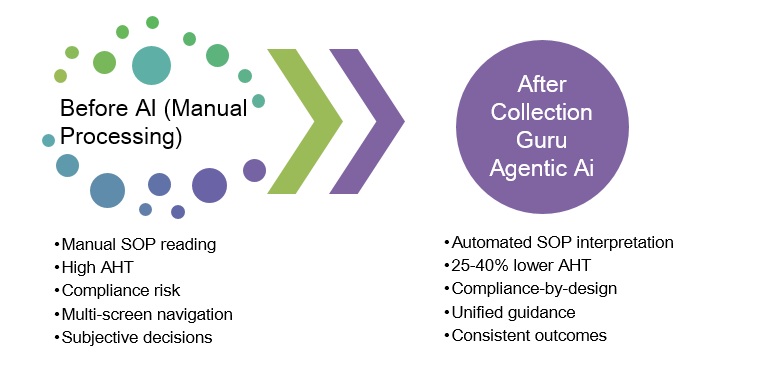
Financial institutions today face the perfect storm of rising arrears volumes, tighter FCA regulatory scrutiny, increasing operational complexity, and continuous pressure to deliver empathetic, consistent customer outcomes. Traditional approaches depend heavily on human advisors manually reviewing dense SOPs, navigating 20+ systems, executing FCA/CONC/MCOB-compliant procedures, and making subjective decisions—leading to inefficiency, inconsistency, and risk.

Collection Guru, an Agentic AI solution co-delivered with AWS, is designed to solve this industry-wide problem. The solution autonomously interprets operational manuals, applies rules, recommends next steps, generates compliant rationales, orchestrates multi-system workflows, and guides advisors in real time.

A large UK financial institution, Target UK, achieved:

  • 25–40% reduction in Average Handling Time (AHT)
  • ~40% reduction in manual effort & system toggling
  • 60–95% accuracy in decisioning support
  • Significant FTE optimisation & cost reduction
  • Markedly improved compliance traceability and advisor confidence

This case study explains the problem, challenges, solution complexity, and the universal applicability of Collection Guru across regulated financial services.

Industry Problem: Why Debt Collection Is Harder Than Ever

2.1 Operational Complexity

Financial institutions must handle high-volume arrears cases daily, fragmented legacy systems (often 15–25 platforms), manual cross-referencing of detailed SOPs, multi-path call flows and decisions driven by root-cause analysis, affordability assessments, and forbearance logic.

2.2 Regulatory Burden (FCA / CONC / MCOB)

Institutions must demonstrate consistent, fair customer outcomes, they should apply or provide the right options: forbearance, breathing space, repayment arrangement, litigation decisioning, maintain auditability at every decision point and identify and treat vulnerable customers appropriately. It has to ensure compliance with CONC 7 and MCOB 13, including mandatory communications, pre-action protocols, and litigation-eligibility rules.

2.3 Advisor Burden

Advisors face cognitive overload interpreting multi-chapter operational manuals, subjective application of nuanced rules, stress of making high-stakes decisions in real time and frequent errors due to information scarcity and multi-system navigation.

2.4 Customer Expectations

Customers expect fast resolution, empathetic handling, clear guidance, transparent outcomes and reduced friction. Institutions struggle to deliver all these consistently through manual processes.

3. Core Challenges in Arrears Management Today

3.1 Manual SOP Interpretation

The Arrears Management Procedure Manual spans customer contact rules, affordability procedures, forbearance frameworks, litigious pathways, debt-solution frameworks (IVAs, DROs), vulnerability protocols, escalation & recovery processes and breathing space moratorium rules. Sometimes, advisors must interpret these rules in real time during a call—a near-impossible task.

3.2 Compliance Sensitivity

Each case demands strict adherence to contact windows, call-frequency rules, correct decision sequences, mandatory documentation, evidence-based rationales, suitability checks, forbearance criteria and litigation triggers & exceptions.

3.3 Variability in Decisioning

Subjective human judgement often results in inconsistent customer outcomes, risk of mis-treating vulnerable customers, misapplication of repayment plans, and poorly documented rationales affecting audits.

3.4 Lack of Unified Information View

Advisors toggle through Core banking systems, CRM, Payment history, Case notes, Manual calculators, & Policy documents this creates time loss, stress, and errors.

4. Why Traditional Automation Fails

Rule-based automation cannot handle multi-path case flows and ambiguous situations, here it needs interpretation of CONC/MCOB rules, human-like judgement, contextual understanding, exceptions & edge cases, parallel system orchestration & continuous compliance assurance. Debt collection is inherently cognitive, requiring contextual reasoning, not robotic automation. It involves multi-level planning and critical reasoning in order to execute an outcome via a strategy.
5. Solution Overview: Collection Guru (Agentic AI for Collections)

5.1 What Is Collection Guru?

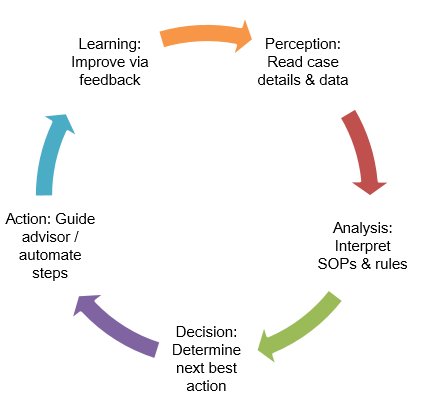
Collection Guru is an Agentic AI system that reads & interprets operational SOPs, including full arrears manuals, reviews case data across systems, provides recommended next steps, generates FCA-ready rationales, conducts multi-system orchestration, remembers context & learns continuously and guides advisors step-by-step in real time.

Agentic AI Reasoning Loop

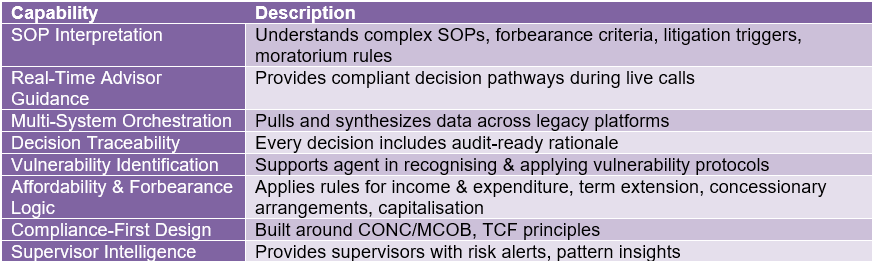
5.2 Key Capabilities

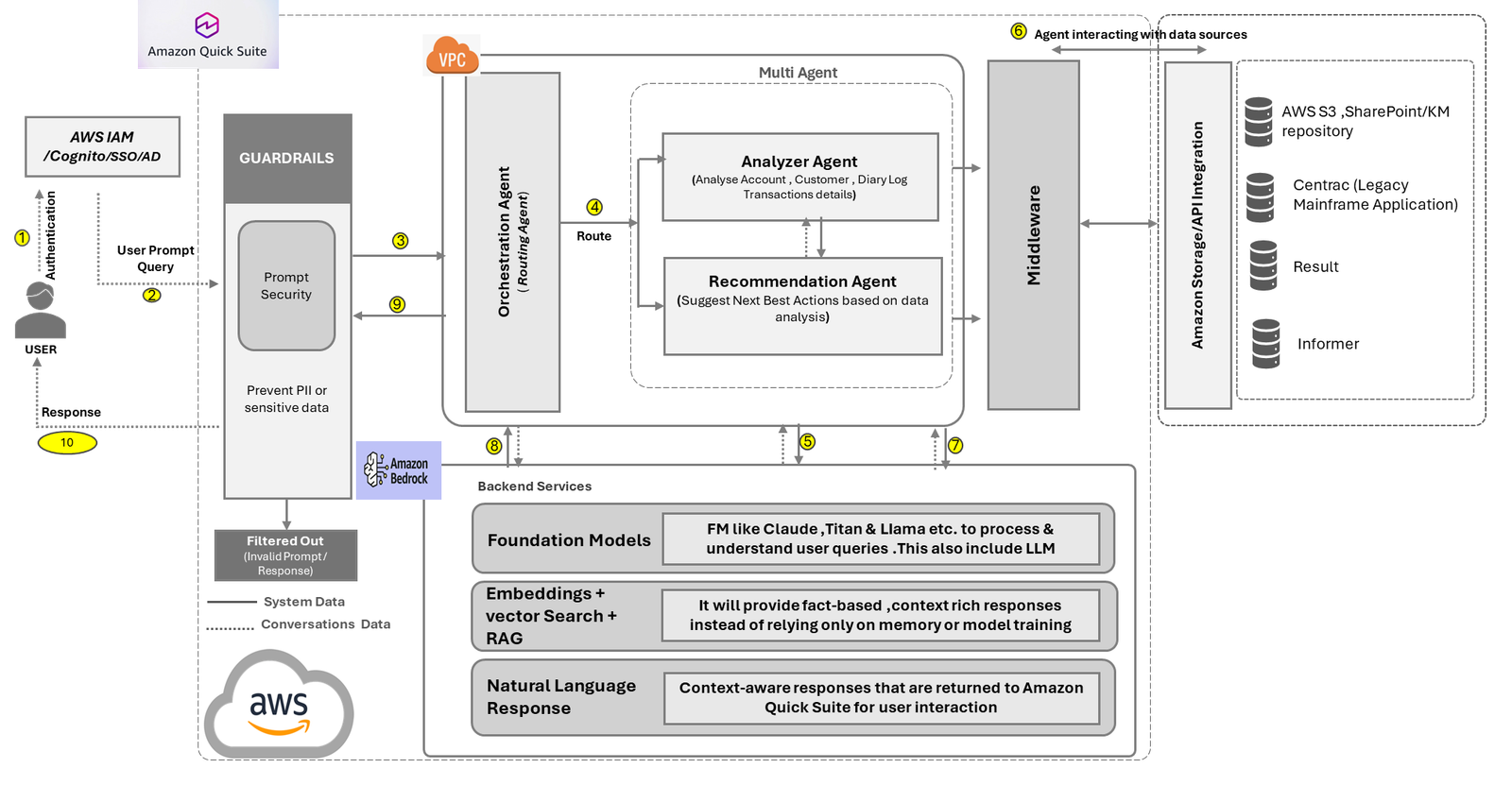
5.3 Co-delivery with AWS

AWS Architecture enables:

  • Secure LLM hosting
  • Enterprise guardrails
  • Scalable inference
  • Integration via private cloud
  • Audit logging & encryption

How Collection Guru Works

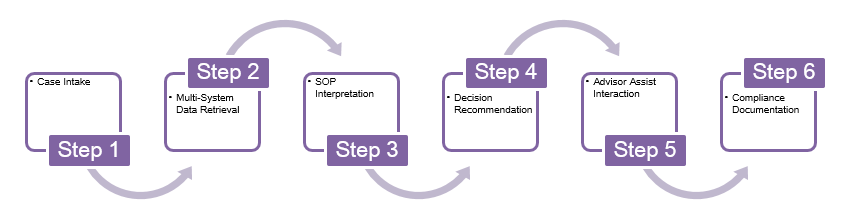
6.1 Step-by-Step Flow

  1. Case Intake – Auto-reads case details, transaction history, previous arrangements.
  2. System Data Orchestration – Fetches supporting data from multiple platforms.
  3. SOP Interpretation – Applies relevant policy sections based on case context—contact rules, affordability triggers, moratorium status, etc.
  4. Decision Engine – Recommends next best step against contact, forbearance option, term extension, capitalisation, litigation eligibility, referral to debt advice and payment arrangement structure
  5. Advisor Assist Interface – Presents natural-language guidance, rationale, and customer scripts.
  6. Compliance Generator – Produces documentation for audit trail and ensures mandatory communications.

7. Embedding Domain Proficiency

Collection Guru has been trained on;

  • Full Arrears Management Procedure Manual (over 100+ rule sets)
  • Affordability & forbearance formulas
  • Vulnerability decision trees
  • Litigation pathways
  • Customer-contact rules
  • Regulatory frameworks (CONC/MCOB, TCF outcomes)
  • Historic case outcomes
  • Multi-client operational patterns

This level of depth enables human-grade judgement, consistent regulatory alignment, rapid handling of exceptions, empathetic customer conversations and reduced operational errors.

Real-World Impact: Target UK Case Study

KPI Improvement
AHT per case 25–40%
Screen navigation 40% reduction
Hands-off/manual activity 40% reduction
Accuracy of decisioning Consistent, compliant outcomes
FTE optimisation ~40% operational uplift
Advisor adoption High early trust

Non-financial benefits:
  • Advisor confidence & satisfaction improved
  • Lower cognitive burden
  • Higher compliance with CONC/MCOB
  • Lower customer friction
  • Uniform application of affordability & forbearance logic
  • Better documentation for audits

Universal Applicability Across Financial Institutions

A Universally Applicable Transformation Engine

Collection Guru is industry-agnostic, product-agnostic, and geography-agnostic because the most challenging aspects of collections—regulation, complexity, inconsistency, and manual dependence—are universal across financial services. Wherever organisations require better compliance, reduced cost, faster case processing, empowered advisors, improved customer outcomes and automated reasoning, collection Guru delivers measurable, repeatable value.

While the solution delivered measurable results for Target UK, the design principles behind Collection Guru are intentionally universal. The challenges faced by Target—high manual load, regulatory pressure, inconsistent outcomes, fragmented systems—are common across banks, lenders, servicers, fintechs, credit unions, and debt-management organisations worldwide.

Collection Guru addresses structural, industry-wide problems, making it directly applicable to a broad spectrum of financial products, customer journeys, and operational environments.

9.1 Applicability by Type of Financial Institution

  1. Retail Banks – Retail banks manage millions of accounts with diverse delinquency triggers. Collection Guru supports early arrears due to missed payments, persistent debt in revolving credit, multiple concurrent products (loans, cards, overdrafts), complex affordability and vulnerability checks and high demand for standardised, audit-ready decisions.
  2. Mortgage Lenders & Servicers – Mortgage arrears require high compliance precision (MCOB). Applicability includes pre-arrears and early missed instalments, vulnerability identification (health, income shock, life events), forbearance decisioning (term extension, payment holidays), litigation readiness and pre-action protocol compliance and end-to-end case reviews for secured lending.
  3. Auto & Asset Finance Providers – Collections decisions must consider vehicle recovery, asset value, and regulatory fairness voluntary termination/voluntary surrender workflows, arrears management for HP, PCP, lease agreements, asset risk scoring, repossession eligibility decisioning and settlement figure calculation support.
  4. Credit Card & Revolving Credit Lenders – High-volume, fast-moving delinquency portfolios benefit greatly from automated reasoning, persistent debt detection, step-up repayment plans, interest relief eligibility, hardship and affordability reviews and targeted engagement scripts based on behaviour.
  5. Fintech Lenders & BNPL Providers – Digital lenders often face explosive growth and require instant, compliant decisions automated soft-collection pathways, AI-based Nudge frameworks, high-volume payment reminders, early intervention and hardship support and rapid cycle of SOP and product changes (which AI handles well).
  6. Collections Agencies (DCAs) – Agencies working on behalf of clients require consistent, client-specific SOP adherence enabled by multi-client SOP switching, automated compliance call flows, audit-ready documentation, improved queue prioritisation and higher productivity across agents.
  7. Debt Management/Advisory Firms – AI helps interpret eligibility for formal debt solutions for instance, IVA/DRO/DMP suitability, affordability review automation, risk-mitigation pathways, client-specific relief options and consistent advice recommendations.

9.2 Applicability Across Product Types

Collection Guru supports diverse financial products, a non-exhaustive lit below: 

  1. Unsecured Lending – Personal loans, Credit cards, BNPL, Overdrafts, Retail financing
  2. Secured Lending – Mortgages, Home equity loans, Auto/vehicle finance, Asset-backed loans
  3. Small Business / SME Lending – Commercial loans, Equipment finance, Merchant cash advances
  4. Specialised Products – Student loans, Government-backed loans, Leasing products

For each category, the AI maps operational SOPs, regulatory rules, and business logic to deliver consistent outcomes across case types.

9.3 Applicability Across Operational Areas

Collection Guru enhances outcomes across the entire collections’ lifecycle:

  1. Early Arrears / Pre-Delinquency – Missed payment detection, nudge-based treatment, early-stage customer engagement and payment arrangement setup.
  2. Core Arrears Management – SOP-driven case review (the core pilot scope), eligibility checks for forbearance, income & expenditure assessments and alternative repayment options.
  3. Vulnerability and Hardship Management – FCA-aligned vulnerability scripts, identification and classification, customised support measures and sensitive handling guidance.
  4. Forbearance Decisioning – AI provides contextual recommendations on payment holidays, term extensions, interest rate reductions, concessionary arrangements and capitalisation (where regulatory permissible).
  5. Medium and Late-Stage Collections – Broken arrangement reviews, escalation triggers, queue prioritisation and automated case summaries.
  6. Litigation Decisioning – Collection Guru interprets litigation SOPs and rules to support pre-action protocol compliance, CCJ readiness checks, asset evaluation, repayment capacity assessment, suitability of repossession (secured)
  7. Recoveries and Write-Off Support – Final-stage settlement guidance, risk-based write-off rules, and complaint handling logic.

9.4 Cross-Functional Applicability Beyond Collections

Collection Guru extends value to multiple business functions:

  1. Customer Service – Accurate guidance for non-arrears queries, rapid access to account policies and next-best-action recommendations
  2. Quality & Compliance – Automated rationale documentation, standardised rule application and reduced audit findings
  3. Operations Leadership – Workforce optimisation insights, root-cause identification (AI explains bottlenecks) and demand prediction support
  4. Training & Onboarding – AI acts as a real-time coach, reducing training time by 40–60%.
    New advisors no longer need to memorise 200-page manuals.

9.5 AI-Driven Use Cases Enabled by Collection Guru

  1. Autonomous Case Review – Fully automated reasoning of cases requiring human-like judgement.
  2. SOP Interpretation & Update Automation – When SOPs change, Collection Guru updates its internal reasoning instantly — eliminating SME dependency.
  3. Predictive Customer Outcome Guidance – Advisors receive insights such as likely payment success, risk of hardship and best communication strategy.
  4. Hyper-Personalised Repayment Options – AI recommends options based on customer history, financial behaviour and vulnerability patterns.
  5. Multi-System Orchestration – Collection Guru becomes the “brain” connecting CRM, core banking, and collections systems.
  6. Compliance-by-Design Workflows – Every decision includes an FCA-ready rationale.
  7. Unified Advisor Assist – One interface replaces SOP manuals, system flipping, knowledge searches and SME dependency

9.6 Why This Approach Works Everywhere

Collection Guru succeeds in diverse institutions because it is built on these universal enablers:

  1. Works on Top of Legacy Environments – Does not require replacing existing systems.
  2. Trained on SOPs, Not Code – SOP-driven reasoning makes the AI instantly transferable across organisations.
  3. Compliance-First Design – Traceability, rationale generation, and rule alignment are baked into the core.
  4. Advisor-Centric Experience – Designed for human workflows, improving satisfaction and reducing churn.
  5. Supports Cross-Regulatory Frameworks – CONC, MCOB, CFPB (US), APRA (AU), EBA (EU).
  6. Modular and Reusable – Can be deployed product-wise, team-wise, or enterprise-wide.

10. Universal Business Benefits of Collection Guru

10.1 Financial Benefits
  • 25–40% AHT reduction
  • 30–40% FTE optimisation
  • Reduced compliance risk exposure
  • Fewer litigation delays
  • Lower operating cost per case
  • Reduced training time for new hires
  • Faster time-to-resolution improves recoveries

10.2 Non-Financial Benefits
  • Better customer experience
  • Advisor empowerment
  • Improved compliance adherence
  • Consistent TCF outcomes
  • Better documentation & audit readiness
  • Lower operational stress and attrition
  • More empathetic interactions
  • Minimised subjective bias

11. The Strategic Advantage for Institutions

Deploying Collection Guru positions lenders to build resilience in a rising arrears market, demonstrate compliance defensibility, shift from reactive collections to proactive risk management, reduce dependency on scarce SME talent, modernise operations without replacing legacy systems and elevate customer trust and institutional reputation. This is not just automation—it is operational intelligence for regulated collections.

Tech Mahindra Advantage

An Agentic AI Marketplace (Orion)

Pre-Built AI Agents across Verticals – Solving Real-World Problems

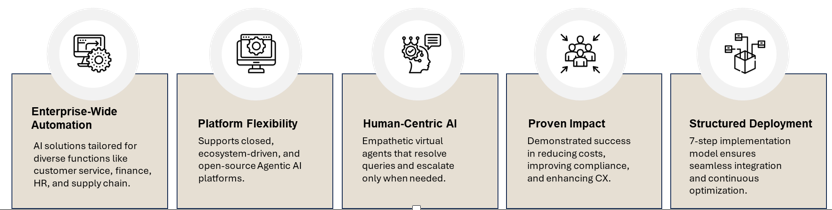
TechM Orion Marketplace is our next-generation Agentic AI marketplace that offers a robust ecosystem of intelligent, autonomous and platform agnostic agents. These agents collaborate, adapt, and scale to deliver bespoke solutions for the full spectrum of enterprise use cases. It is engineered to help organizations unlock new levels of efficiency, intelligence, and scalability in their digital operations.

Conclusion

Debt collection in regulated environments demands nuanced judgement, regulatory adherence, empathy, and precision. Manual models cannot meet modern expectations. Collection Guru, powered by Agentic AI and AWS, elevates enterprise capabilities by interpreting complex manuals, guiding advisors, enforcing compliance, and optimising operations at scale.

The success at Target UK establishes a clear blueprint for any financial institution seeking transformation.

Collection Guru is not an AI tool—it’s a new operating partner for the modern lender.

Lexicon

  • AR – Arrears
    Overdue debt or missed payment status.
  • BS – Breathing Space
    A legally mandated moratorium period during which collections activity must pause for eligible customers receiving debt counselling.
  • CONC – Consumer Credit Sourcebook
    FCA regulatory rulebook governing consumer credit collections.
  • DRO – Debt Relief Order
    A formal insolvency solution for customers with low income and qualifying debt levels.
  • FCA – Financial Conduct Authority
    UK financial regulatory body overseeing conduct, consumer protection, and compliance.
  • FOS – Financial Ombudsman Service
    Independent service resolving disputes between customers and financial firms.
  • I&E – Income & Expenditure
    A full affordability assessment capturing a customer’s financial circumstances.
  • IVA – Individual Voluntary Arrangement
    Court-approved debt repayment agreement between customer and creditors.
  • MCOB – Mortgage Conduct of Business
    FCA regulatory rulebook for mortgage lending and arrears handling.
  • TCF – Treating Customers Fairly
    FCA principle requiring equitable, fair, and consistent customer outcomes.
  • VUL – Vulnerability Indicator
    A marker identifying customers with characteristics requiring special treatment and protections.

ABOUT THE AUTHOR

Dr. Neeraj Parashar

Dr. Neeraj Parashar

Principal Consultant, Business Transformation Consulting – Tech Mahindra

Dr. Neeraj Parashar is Practice Lead of AI, BFS, Process Mining, Global Risk & Compliance, Digital and Design Lab for Tech Mahindra, and has also worked as business success and growth partner for Tech Mahindra clients. He has a PhD in Digital Transformation (authored digital performance management standards), an MBA (Information Systems and Marketing) from IMS, Indore, M.A. & M.Phil. in Economics, Certified DPO, Six Sigma MBB, Lean Master, Design Champion, Certified Analytics Professional, PMP, CIO Said-Garter Certified Professional, and an alumnus (Diploma in Software Engineering) of Carnegie University of Pittsburgh, USA.

With over 25 years of experience in consulting (operational, architecture and advisory), and managing delivery of Digital and Intelligent Automation (Ai, RPA, etc.) based organization excellence projects i.e., focusing IT and business outcomes, especially in the domains of banking, financial services, telecom, and insurance. He has managed client engagements in RSA, Singapore, India, UK, EU, and US. The solutions developed by Dr. Neeraj Parashar have benefited customers not only in seeking financial impacts but also in effectively developing digital & disruptive business strategic capabilities.