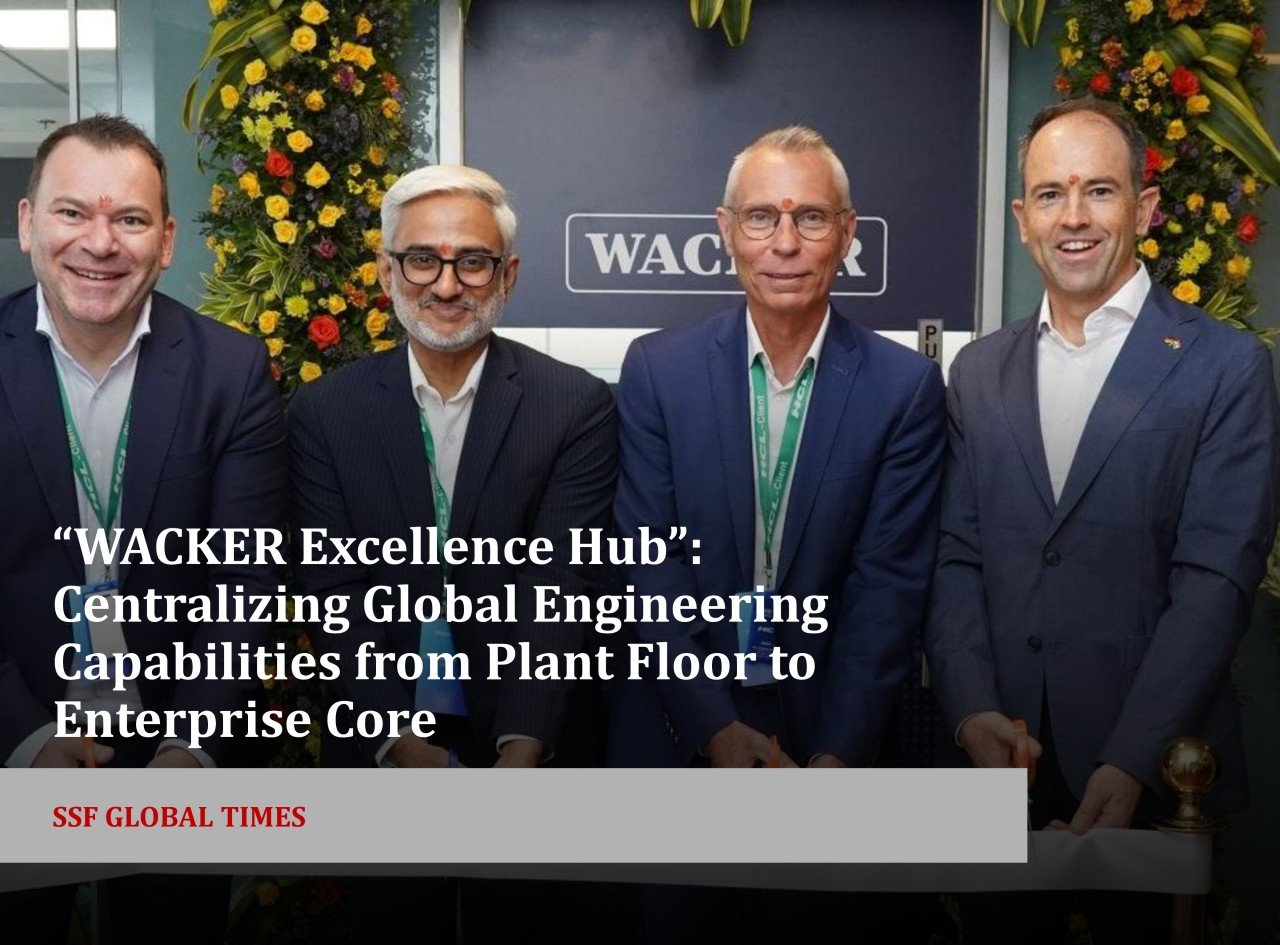




PUNE | 22 June 2026: German multinational chemical enterprise Wacker Chemie AG has officially operationalized its new WACKER Excellence Hub in Pune. Located at the World Trade Center (WTC), the facility marks a strategic structural evolution in the company’s global operating model. The launch convened approximately 60 global representatives, bringing together leadership from Wacker’s German headquarters, Wacker India, and strategic technology partner HCLTech. The new capability node signals a definitive shift toward centralized, highly efficient global delivery for the €6-billion industrial giant.

Headquartered in Munich, Germany, Wacker Chemie AG is a highly R&D-intensive, global specialty chemical company operating across four key business divisions: Silicones, Polymers, Biosolutions, and Polysilicon. Generating annual revenues exceeding €6 billion, the enterprise manufactures highly specialized products serving critical industries including automotive, healthcare, construction, and semiconductor manufacturing. Wacker sustains its global market leadership through a sprawling international network of over 25 production sites and a dedicated global workforce.

Operating for decades in the subcontinent, Wacker India manages an extensive regional footprint, including state-of-the-art production facilities, specialized technical centers across major metros, and a corporate headquarters in Mumbai. The newly launched WACKER Excellence Hub in Pune functions as the enterprise’s dedicated digital and engineering capability node, supporting the global Group’s IT modernization, process standardization, and international collaboration initiatives.

Inside The Pune Hub

Designed to function as the digital and engineering backbone for the broader Wacker Group, the Excellence Hub explicitly moves away from fragmented regional IT management. The core operational mandate requires the local talent pool to take direct ownership over the following critical domains:

  • Process Standardization: Designing, auditing, and scaling unified operational frameworks to eliminate redundancies and optimize enterprise workflows across Wacker’s global network of over 25 production sites.
  • Enterprise IT Architecture: Managing the complex digital transformation of the company’s core operations, overseeing the integration of advanced Enterprise Resource Planning (ERP) systems, and deploying resilient internal data networks.
  • Advanced Engineering Support: Bundling highly specialized technical engineering services that integrate directly with Wacker’s international manufacturing plants and R&D centers to accelerate product deployment and facility optimization.
  • Global Service Bundling: Acting as a centralized nerve center for shared corporate services, ensuring seamless cross-border collaboration and dramatically improving overall operational cost efficiency.

The integration of HCLTech within Wacker’s proprietary capability center highlights a highly sophisticated evolution in enterprise capability design: the Hybrid-Captive Co-Creation Model.

Historically, large European manufacturers relied heavily on pure-play outsourcing for IT modernization, transferring both execution and process knowledge to third-party vendors. Wacker is bypassing this vulnerability. By establishing a proprietary WACKER Excellence Hub while utilizing HCLTech’s local operational expertise for the ramp-up phase, the chemical giant secures the best of both architectures.

This hybrid structure provides the sheer velocity and talent-sourcing power of a tier-one IT services firm, while ensuring Wacker retains absolute governance, data security, and intellectual property (IP) control natively within its own corporate walls.

Engineering IT-OT Convergence

While standard Global Capability Centers (GCCs) typically focus on back-office software, Wacker is deploying the Pune hub to solve a highly complex industrial challenge: the friction between Information Technology (IT) and Operational Technology (OT).

Historically in heavy manufacturing, corporate data systems (ERP, cloud architecture) operated completely isolated from shop-floor physical technology (SCADA systems, sensors, and chemical reactors). The Excellence Hub is engineered to bridge this gap. By housing software developers alongside chemical and mechanical process engineers under one roof, Wacker is building the architectural foundation for Digital Twins– virtual, real-time replicas of its physical manufacturing plants. This IT-OT convergence allows the enterprise to run predictive maintenance algorithms from Pune that directly monitor and optimize physical equipment in a German or American production site. This capability drastically reduces unplanned downtime and optimizes chemical yield on a global scale.

Industry Insights

The establishment of Wacker’s capability center in Pune reveals several deeper structural realities regarding how global heavy-industry giants are currently utilizing Indian engineering talent:

  1. The Evolution of German Engineering Culture: German industrial conglomerates (the Mittelstand and DAX giants) have historically been highly protective of their core engineering, preferring to keep technical execution strictly centralized in Europe. Setting up a core hub in Pune shows a structural break from this traditional “Germany-first” mindset. Wacker is deliberately distributing core capabilities to ensure 24/7 operational velocity and access a scale of tech talent that is fundamentally constrained in Western Europe.
  2. Pune as the Indo-German Industrial Anchor: The geographic selection is highly deliberate. Pune is the undisputed epicenter for German industrial manufacturing and engineering capability in India. By anchoring in the city, Wacker taps into a deeply entrenched ecosystem of professionals who possess the exact convergence of mechanical engineering expertise and complex IT infrastructure skills required by a heavy-industry conglomerate.
  3. Hedging Against Sector Volatility: In the highly volatile global chemical sector, protecting profit margins requires ruthless internal efficiency. Standardizing global IT isn’t merely an administrative upgrade; unifying digital workflows and automating supply-chain data directly offsets the brutal raw-material cost fluctuations and geopolitical supply disruptions currently impacting European chemical manufacturers.
  4. Industrial GCCs Are Moving Beyond Support Functions to Enterprise Capability Ownership: The WACKER Excellence Hub is not designed as a traditional shared services operation. By taking ownership of enterprise IT architecture, engineering support, process standardization, and global service delivery, the Pune center demonstrates how manufacturing GCCs are increasingly becoming custodians of critical enterprise capabilities rather than execution-focused delivery centers.
  5. The Hybrid-Captive Model Is Emerging as a Preferred GCC Design Strategy: Wacker’s collaboration with HCLTech reflects a growing trend among global enterprises to combine the governance, IP protection, and strategic control of a captive center with the speed, scalability, and talent access offered by ecosystem partners. This hybrid approach enables faster capability build-out without compromising ownership of core business knowledge.
  6. IT-OT Convergence Is Creating a New Category of Manufacturing GCC: The Pune hub’s mandate extends beyond enterprise IT into operational technology and plant engineering. By integrating software, data, and engineering talent, Wacker is building capabilities that directly influence manufacturing performance, predictive maintenance, and digital twin deployment across global production facilities. This represents one of the most significant shifts in how industrial enterprises are leveraging GCCs.
  7. Pune Continues to Strengthen Its Position as India’s Industrial Engineering Capital: Wacker’s decision reinforces Pune’s growing importance as a destination for engineering-intensive GCCs. The city’s deep concentration of manufacturing expertise, industrial technology talent, and established German enterprise presence makes it uniquely positioned to support next-generation industrial capability centers.
  8. Global Manufacturers Are Using GCCs to Build Resilience, Not Just Efficiency: In an environment marked by supply chain volatility, geopolitical uncertainty, and margin pressures, centralized digital capability centers are becoming strategic assets. Wacker’s investment highlights how global manufacturers are leveraging GCCs to standardize operations, improve agility, accelerate digital transformation, and strengthen enterprise resilience at scale.

Concluding Remarks

Wacker’s Pune Excellence Hub exemplifies the evolution of manufacturing GCCs from process-centric support organizations to enterprise-integrated engineering and digital transformation hubs. The expansion amplifies the current trend that operating a centralized digital capability center is a structural baseline for elite industrial manufacturing. The combination of IT-OT convergence, hybrid-captive operating models, and global capability ownership signals the next phase of industrial GCC maturity, where centers are increasingly responsible for shaping enterprise competitiveness, innovation velocity, and operational resilience worldwide.

To navigate complex global supply chains and drive enterprise-wide efficiency, maintaining absolute control over IT infrastructure and engineering processes is non-negotiable. By establishing the Excellence Hub in collaboration with trusted technology partners, Wacker secures the operational density and technical agility necessary to standardize its global footprint and accelerate its digital transformation journey.

Curated by SSF Global

Tracking the shifts shaping GCCs, enterprise ecosystems, and the future of global business.

Share on      

SSF Global is a Global Community for Enterprise Function Leaders and serves as a research & advisory platform focused on Global Business Services (GBS), Global Capability Centres (GCCs), and the evolution of enterprise innovation in India and beyond. We track, publish, and partner in narratives that shape how capability centres transform into hubs of trust, intelligence, and sustainable growth. We also evaluate, assess and benchmark the GCCs for their performance, maturity and other parameters using our proprietary tools built from the knowledge gained from direct interaction with our members (GCCs & GBS).