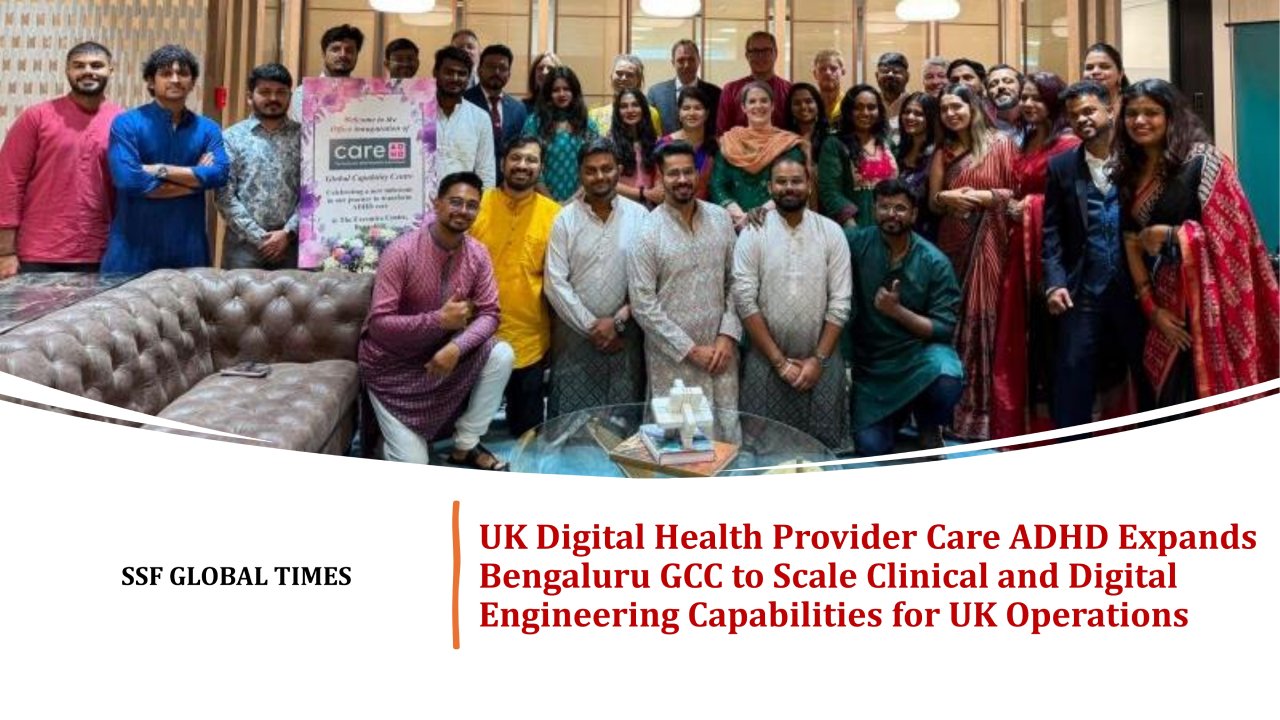
Care ADHD is a UK-based digital healthcare provider specializing in ADHD assessment, diagnosis and patient care through technology-enabled services. The enterprise specializes in providing evidence-based, technology-driven mental healthcare, focusing on advanced ADHD diagnostics, virtual consultations, and patient management platforms. By bridging medical expertise with scalable digital systems, the company delivers accessible and specialized virtual care to patients across the UK.
STRATEGIC BLUEPRINT
Announcing the expansion, James Whitebread, Chief Technology Officer at Care ADHD, noted that the Bengaluru hub has successfully transitioned into a fully integrated organization capable of driving end-to-end product lifecycles. The newly launched facility is designed to support a highly specialized mandate. Rather than separating clinical practice from software development, the GCC brings together multidisciplinary teams comprising:
- clinical & operations integration: embedding trained clinicians and operations specialists directly into the product development cycle to ensure diagnostic tools and patient engagement systems remain medically accurate and compliant.
- advanced digital engineering: deploying data scientists, security engineers, support engineers, and designers to architect highly scalable, secure platforms for virtual care delivery.
- quality & product management: utilizing specialized qa professionals and product managers to accelerate innovation cycles while maintaining strict adherence to international healthcare regulations.
THE MACRO CONTEXT: INDIA AS A GLOBAL CLINICAL-TECH HUB
The expansion of Care ADHD’s capability footprint aligns directly with a broader sectoral transformation across the global life sciences and digital health industries. Healthcare enterprises are increasingly moving away from fragmented, third-party outsourcing models in favor of establishing proprietary, high-value capability centers in India.
Healthcare and life sciences continue to be among the fastest-growing segments within India’s GCC ecosystem, driven by increasing investments in digital health, AI-enabled research, regulatory technology and patient-centric platforms – currently accounting for about 15% of India’s total capability center workforce, and employing over 300,000 professionals. This growth is driven by the strategic necessity to accelerate research and development cycles, ensure stringent regulatory compliance, and deploy artificial intelligence across patient care platforms.
Care ADHD’s strategy mirrors the aggressive capability investments recently executed by major global healthcare and pharmaceutical players:
- Sanofi: The French multinational pharmaceutical company recently committed a multi-hundred-million-euro investment to expand its Hyderabad GCC. The initiative aims to scale its workforce to over 4,500 employees, strictly focusing on artificial intelligence, data innovation, and medical affairs.
- Bristol Myers Squibb (BMS): Launched a $100 million innovation hub in Hyderabad designed to house over 1,500 employees. The facility operates as a core engine for global drug development, advanced IT, and digital health platforms.
- AstraZeneca: Established a highly specialized Global Innovation and Technology Centre (GITC) in Chennai, integrating data science and predictive analytics directly into its clinical research and molecular engineering frameworks.
By anchoring specialized clinical and engineering talent in Bengaluru, Care ADHD reflects a broader industry trend toward integrating digital engineering and domain expertise within global capability centers, utilizing the exact foundational operational strategy deployed by these industry leaders to accelerate digital care delivery on a global scale.
Industry Insights
Assessing the dynamics of Care ADHD’s facility expansion yields vital intelligence regarding how digital health partners are evolving their geographic footprints:
- The Clinical-Tech Convergence in GCCs: Historically, healthcare capability centers in India focused strictly on backend IT maintenance or revenue cycle management. Care ADHD’s inclusion of practicing clinicians alongside data scientists highlights a definitive shift toward “clinical-tech” GCCs, where medical expertise and software engineering happen simultaneously to create robust digital health products.
- Healthcare GCCs Are Becoming Domain-Led Innovation Centers: Unlike traditional IT capability centers, next-generation healthcare GCCs increasingly require multidisciplinary teams that combine clinicians, data scientists, regulatory specialists and software engineers. This convergence enables organizations to develop patient-centric digital solutions while maintaining clinical accuracy, regulatory compliance and faster innovation cycles.
- Accelerated Incubation Cycles: Transitioning a rapidly expanding multidisciplinary capability center in just 11 months reflects the operational agility of modern GCC models in India. Global organizations are rapidly accelerating their capability incubation cycles to meet surging global market demands.
- Strengthening the UK-India Health Corridor: The direct involvement of senior UK diplomatic and trade officials at the inauguration validates the strategic importance of this expansion. It reinforces India’s position not merely as an IT support destination, but as a critical partner in developing specialized, digital-first healthcare solutions for the broader UK market.
WAY FORWARD
Care ADHD’s expansion in Bengaluru reflects the growing evolution of healthcare GCCs from technology support centers to integrated innovation hubs combining clinical expertise, digital engineering and product development. As digital health continues to reshape healthcare delivery globally, India’s GCC ecosystem is increasingly positioned to support high-value clinical technology capabilities, reinforcing its strategic role in the future of global healthcare innovation.





 Ask an Expert