



 Ask an Expert

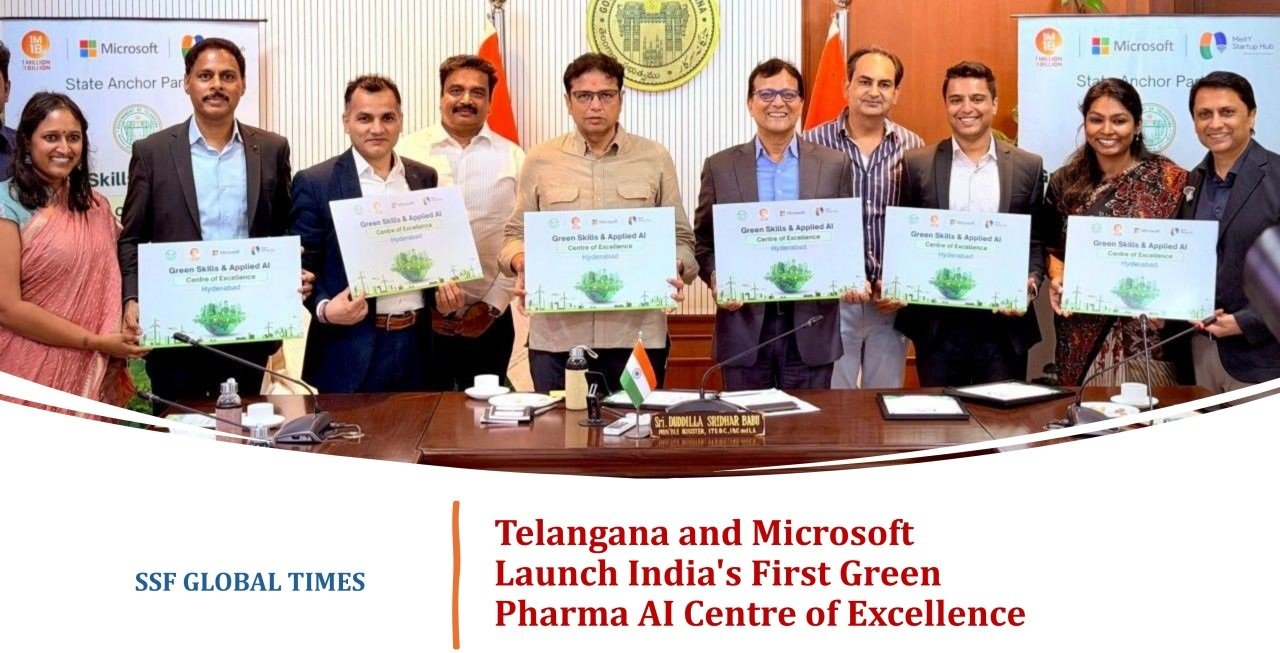
HYDERABAD | 19 July 2026: The Government of Telangana has partnered with Microsoft, the 1M1B (One Million for One Billion) Foundation and the MeitY Startup Hub to establish India’s first Green Skills & Applied AI Centre of Excellence (CoE) focused on Green Pharma in Hyderabad.
Scheduled to commence operations in August 2026, this initiative reflects Telangana’s strategy to develop advanced talent capabilities at the intersection of artificial intelligence and sustainable pharmaceutical manufacturing, reinforcing Hyderabad’s position as a global life sciences and innovation hub. Rather than supplying real estate for multinational corporations, Telangana is actively engineering the cognitive workforce required for the next industrial era. By cross-pollinating artificial intelligence frameworks with sustainable manufacturing principles, the CoE is designed to secure Hyderabad’s dominance as a global hub for eco-conscious pharmaceutical production, aligning precisely with the state’s Next-Generation Life Sciences Policy 2026–30.
KEY HIGHLIGHTS
- Public-Private Coalition: A high-level partnership integrating state infrastructure (Telangana), enterprise technology (Microsoft), impact capital (1M1B), and federal innovation frameworks (MeitY Startup Hub).
- The Green Pharma Mandate: The CoE is uniquely calibrated to merge Applied AI with sustainable pharmaceutical manufacturing, explicitly addressing the carbon-heavy legacy of global drug production.
- National Scale & Distribution: The Hyderabad facility serves as the flagship node among five Green Skills CoEs being deployed across India.
- Talent Development Goals: By 2030, the national consortium aims to skill 100,000 youth in Applied AI and green technologies, mathematically creating direct pathways to 50,000 jobs, apprenticeships, and entrepreneurial ventures.
- Applied Innovation Infrastructure: Moving beyond theoretical classrooms, the facility operates as an applied sandbox, featuring dedicated technology zones for Electric Vehicles (EV), Solar Energy, Wind Energy, and Applied AI.
Established in 1998, the Microsoft India Development Centre (MSIDC) operates as engineering and research footprints for the technology giant outside the United States. Spanning strategic hubs in Hyderabad, Bengaluru, and Noida, the entity is a core pillar of the parent corporation’s global product development matrix. MSIDC focuses heavily on architecting cloud-native solutions, advanced Artificial Intelligence platforms (Azure), enterprise security frameworks, and hardware engineering. By actively collaborating with academic institutions and regional governments, the organization drives deep-tech capability building and ecosystem modernization across the subcontinent.
Founded in 2014, the 1M1B (One Million for One Billion) Foundation is a United Nations-accredited social innovation platform and skill-development organization. The entity focuses on mobilizing youth in emerging economies by designing systemic programs centered on Applied AI, sustainable entrepreneurship, and green technologies. By establishing co-funded capability hubs in partnership with tech conglomerates and state governments, 1M1B works to democratize access to advanced technical education. The platform bridges the divide between grassroots talent pools and institutional employment, with a structured roadmap targeting massive workforce mobilization by 2030.
DECARBONIZING THE LIFE SCIENCES MATRIX
The pharmaceutical sector is historically resource-intensive, governed by complex chemical synthesis, massive water consumption, and rigid, high-waste supply chains. Optimizing these variables requires computational power that legacy systems cannot provide.
The Hyderabad CoE addresses this structural bottleneck by training a workforce to deploy Applied AI directly into manufacturing workflows. The strategic roadmap for this facility-recently presented to IT and Industries Minister Shri Sridhar Babu Duddilla at the Dr. B.R. Ambedkar Telangana State Secretariat, outlines a highly functional curriculum.
Rather than generic coding bootcamps, the center will provide:
- Industry-Led Incubation: Trainees will execute live projects designed by corporate partners, applying machine learning algorithms to reduce pharmaceutical waste and optimize energy grids.
- Cross-Disciplinary Zonal Training: Engineers will access dedicated learning environments where AI intersects with physical renewables, such as mapping predictive maintenance for wind turbines or optimizing chemical yields using solar power grids.
- Career-Readiness Pathways: The 1M1B Foundation and MeitY will facilitate direct transition pipelines, ensuring candidates receive structured mentorship and incubation support to either enter corporate capability centers or launch independent deep-tech startups.
The strategic weight of this initiative was authorized by the executive presence at the blueprint presentation, which included Rajiv Kumar (President and Managing Director, Microsoft India Development Centre), Manju D. (Senior Director, Elevate-CSR, Microsoft), Manav Subodh (Founder and CEO, 1M1B Foundation), Sai Krishna (IT Advisor), and Sarvesh Singh (CEO, Telangana Life Sciences).