




 Ask an Expert

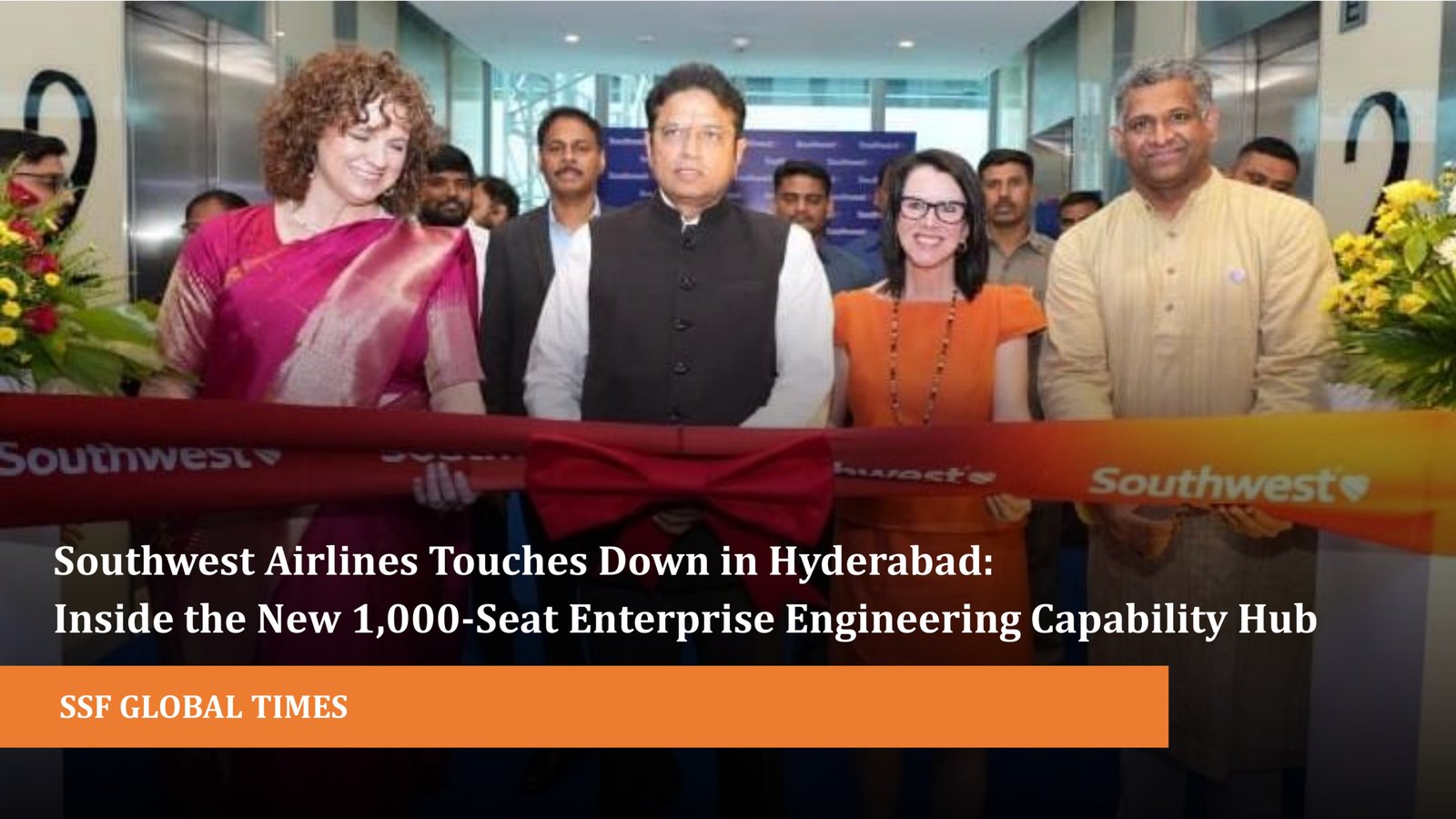
HYDERABAD | May 19, 2026: Southwest Airlines has formally operationalized its Hyderabad Global Innovation Centre, marking a significant strategic development in both the airline’s global technology roadmap and India’s evolving GCC ecosystem.
Southwest Airlines is one of the largest and most prominent commercial passenger airlines in the United States, operating a massive domestic and international flight network. Historically known for its unique point-to-point transit model, the company is now heavily accelerating its investments in digital infrastructure to modernize its global operations.
The Hyderabad Office allows Southwest Airlines to advance our vision by furthering our efforts to build critical business and technology skills. Hyderabad is one of the deepest analytics, engineering, and innovation talent pools in the world, making it an ideal location for the next phase of our journey. Opening our Hyderabad office enables us to expand our global talent network, supporting our business operations, and our long-term growth.
The Hyderabad center has been established as a strategic engineering and innovation hub designed to support enterprise technology modernization, digital capability expansion, and long-term operational transformation. That distinction is important because it reflects a broader structural shift underway across the GCC landscape. Global enterprises are increasingly using India not only for operational scalability, but for enterprise engineering capability, AI integration, platform modernization, and innovation ownership.
The airline is starting with a solid foundation but planning for rapid, aggressive growth:
- Initial Footprint: The center opens with a 20,000-square-foot physical workspace.
- Talent Scaling: Southwest leadership has confirmed plans to hire 1,000 high-skilled tech professionals in Hyderabad over the next few years to fully staff the innovation hub.
Historically, airline GCCs have largely focused on customer support, ticketing systems, infrastructure management, or shared-services operations. Southwest’s Hyderabad strategy appears materially different in both mandate and maturity orientation. The company has indicated that the center will contribute across enterprise technology domains including cloud engineering, platform modernization, cybersecurity, AI and machine learning, enterprise systems, data engineering, and digital product capability. Leadership commentary around the launch reinforced this positioning. Southwest executives emphasized that the objective was not to simply “lift and shift” work into India, but to establish a technology-infused capability center integrated into the airline’s broader innovation agenda.
Here is a breakdown of the core functions driving the new hub’s expansion
- Deep Tech and AI Integration: The engineering mandate focuses heavily on embedding advanced Artificial Intelligence (AI), Machine Learning (ML), and predictive data science directly into the airline’s operational platforms to optimize efficiency.
- Core Systems Engineering: The facility will anchor critical infrastructure development, prioritizing cloud architecture, platform engineering, and robust cybersecurity to ensure secure, future-ready aviation operations.
- Next-Generation Product Delivery: Operating as a primary innovation hub, the center will leverage digital engineering to build out enterprise platforms that directly impact both internal airline operations and the end-user customer experience.
The company is avoiding the old “lift and shift” outsourcing model. Instead, the Hyderabad team is being handed complex, frontline engineering work.
From a GCC maturity perspective, this is a critical distinction positioning the center much closer to a Value Centre evolving toward a ‘Strategic Enterprise Capability Hub’ rather than a conventional support operation.
Why Southwest Needed This Centre
The strategic rationale behind the Hyderabad center becomes clearer when viewed against the operational pressures facing the global aviation industry. Airlines today operate within highly interconnected ecosystems where competitiveness increasingly depends on technology agility, operational intelligence, cybersecurity resilience, predictive analytics, and seamless customer experience integration. Modern aviation enterprises are under constant pressure to modernize:
- operational systems,
- digital customer platforms,
- data ecosystems,
- infrastructure environments,
- and AI-enabled decision-making capabilities.
For organizations operating at a global scale, these transformations cannot be sustained through fragmented regional technology structures alone. They require centralized engineering capability and integrated digital execution models. The Hyderabad center appears intended to address precisely this requirement.
Rather than functioning as an isolated delivery unit, this center is expected to strengthen Southwest’s enterprise-wide technology capability by supporting modernization initiatives, improving digital scalability, and contributing toward next-generation operational systems. In effect, the center exists to help institutionalize technology capability within the enterprise itself.
Hyderabad’s Emergence as an Aviation-Tech GCC Ecosystem
Southwest’s entry also reinforces Hyderabad’s growing positioning as one of India’s most important aviation-tech and deep-tech GCC ecosystems. The city already hosts global enterprises across aviation, travel, aerospace, engineering, and enterprise technology domains, including American Airlines and Marriott International, alongside a broader ecosystem of aerospace and defense organizations and multiple engineering-led GCCs.
This concentration matters because aviation enterprises increasingly require specialized talent capable of operating across enterprise systems, AI-enabled operational platforms, cybersecurity environments, analytics ecosystems, and customer-facing digital technologies. Hyderabad’s maturity as a GCC destination now extends beyond cost competitiveness. The city offers engineering depth, digital capability, enterprise-tech infrastructure, and an increasingly mature ecosystem for advanced technology operations.
For Southwest, the selection of Hyderabad appears aligned with the need for access to a scalable, engineering-oriented enterprise technology environment rather than simply a large workforce base.
The Scale Ambition Reflects Long-Term Strategic Intent
Another important aspect is the scale ambition associated with the center. Southwest has indicated plans to expand the Hyderabad organization to nearly 1,000 professionals over the coming years, with hiring focused largely on advanced engineering and enterprise technology capabilities rather than traditional operational support functions.
This is strategically relevant because it reinforces another major GCC trend emerging across sectors: enterprises increasingly come to India for engineering depth, AI capability, digital modernization expertise, and enterprise platform ownership, not merely labor arbitrage. The nature of talent being built within the Hyderabad center suggests that Southwest views the hub as a long-term enterprise capability investment rather than a short-term operational expansion.
The Enterprise Capability Narrative
Southwest Airlines’ Hyderabad launch reflects a broader transformation taking place across the GCC ecosystem in 2026. Global enterprises are steadily redesigning India-based centers around enterprise technology capability, innovation ownership, AI acceleration, digital engineering, cybersecurity, and transformation management.
The significance of Southwest’s move lies not simply in establishing another GCC, but in the type of GCC being established. And that distinction is becoming increasingly important as GCCs evolve from operational extensions into strategic contributors to enterprise transformation.
The Strategic Outlook
Southwest Airlines’ Hyderabad Global Innovation Centre represents more than a geographic expansion into India. It reflects how global aviation enterprises are beginning to redesign their operating models around centralized engineering capability, enterprise technology ownership, and integrated digital transformation. For Hyderabad, the launch further strengthens the city’s emergence as a globally relevant aviation-tech and deep-tech GCC destination.
For the GCC ecosystem, the message is becoming clearer: the next generation of global capability centers will not be defined by workforce scale alone, but by their ability to influence enterprise modernization, innovation velocity, and long-term competitive advantage.