




 Ask an Expert

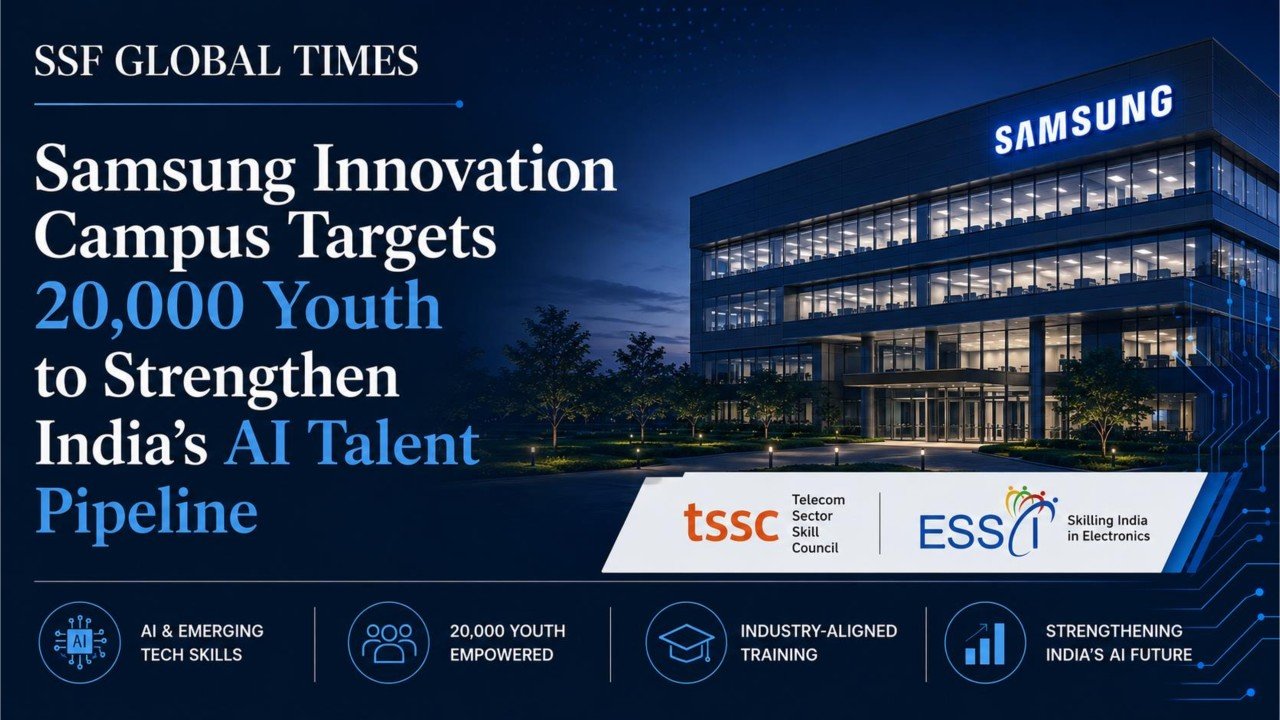
NEW DELHI | 12 August 2026: Samsung India has launched the 2026 edition of Samsung Innovation Campus (SIC), its flagship corporate citizenship programme aimed at equipping young people with industry-relevant skills in Artificial Intelligence (AI).
The 2026 programme aims to train 20,000 young people across 10 states in collaboration with the Electronics Sector Skills Council of India (ESSCI) and the Telecom Sector Skill Council (TSSC). The initiative is part of Samsung’s broader effort to strengthen India’s AI-ready workforce and expand access to emerging technology skills.
KEY HIGHLIGHTS
- 20,000 Youth to be Trained: The 2026 edition of Samsung Innovation Campus aims to train 20,000 young people in AI across 10 states.
- Industry and Skilling Partnerships: The programme will be implemented in collaboration with the Electronics Sector Skills Council of India (ESSCI) and the Telecom Sector Skill Council (TSSC).
- Focus on Practical Skills: Beyond technical learning, the programme emphasises problem-solving, critical thinking, collaboration and practical AI applications to improve career readiness.
- Building on Earlier Impact: Since its launch in India in 2022, Samsung Innovation Campus has trained more than 26,500 young people, with the 2025 programme recording 48% women participation.
Headquartered in Suwon, South Korea, Samsung Electronics Co. is multinational electronics conglomerate and a foundational pillar of the global technology sector. The corporation stands as one of the largest manufacturers of semiconductors, smartphones, and digital display technologies, commanding a global workforce spanning more than 70 countries.
Operating in the Indian market since 1995, Samsung India maintains one of the company’s most integrated regional ecosystems
The Samsung Innovation Campus (SIC) is the company’s flagship global corporate citizenship initiative, originally established in 2019 to equip young adults with core technical and workplace competencies critical to the Fourth Industrial Revolution. Operational in India since 2022, the initiative is purpose-built to address the structural gap between formal academic curricula and the practical demands of enterprise-level software deployment.
- Curriculum & Technical Specializations: The program delivers hands-on, modular training across specialized digital domains, including Artificial Intelligence (AI), the Internet of Things (IoT), Big Data, and Coding & Programming. Instruction is grounded in real-world problem statements, requiring students to build functional algorithmic models and collaborative capstone projects.
- Target Demographic & Inclusion: Tailored primarily for students and job seekers aged 18 to 25 from underserved communities, vocational colleges, and engineering institutions. The program places a deliberate focus on diversity, achieving near-parity with a 48% female participation rate in recent training cycles.
- Institutional Alignment: In India, SIC is executed in direct partnership with government-recognized bodies under the National Skill Development Corporation (NSDC) notably the Electronics Sector Skills Council of India (ESSCI) and the Telecom Sector Skill Council (TSSC). This ensures standard course frameworks, national skill certification, and direct alignment with telecom and electronics industry hiring standards.
- Integrated Cognitive Skilling: Beyond technical algorithms, the curriculum incorporates essential workplace proficiencies, covering critical thinking, quantitative analysis, teamwork, and problem-solving, ensuring graduates possess the cognitive agility necessary for immediate enterprise integration.
THE ACADEMIA-TO-ENTERPRISE PIPELINE
Samsung Innovation Campus is part of the company’s broader corporate citizenship programme focused on strengthening technology skills among young people. Launched in India in 2022, SIC has progressively expanded its reach across the country. Earlier editions covered emerging technology domains including AI, Internet of Things, Big Data and Coding & Programming, while the 2026 edition places a specific emphasis on strengthening AI capabilities.
The program combines technology education with practical learning and employability-focused skills. Samsung says the 2026 edition is designed to help participants build the knowledge and practical experience required to contribute to India’s growing AI and innovation ecosystem.
Closing the Practicality Gap
- The Core Challenge: The surging global demand for AI professionals means that understanding machine learning can no longer be restricted to textbook definitions or isolated classroom environments.
- The Interventional Impact: By utilizing government-backed institutional networks like ESSCI (Electronics Sector Skills Council of India) and TSSC (Telecom Sector Skill Council), Samsung ensures that its proprietary training modules align directly with national telecom and electronics manufacturing standards. This creates a streamlined, verified talent pipeline that global capability centers and domestic startups can instantly absorb, radically decreasing the time-to-productivity for new engineering hires.
AI represents one of the greatest opportunities of our time, and India is uniquely positioned to lead this transformation through the strength of its young talent. Realising that opportunity will require sustained investment in developing the right skills, encouraging innovation and making AI education more accessible to every aspiring learner, regardless of where they come from.
FROM TECHNOLOGY EDUCATION TO PRACTICAL APPLICATION
A distinguishing feature of programmes such as Samsung Innovation Campus is their focus on moving beyond theoretical technology education. The initiative incorporates:
- Applied Learning: Participants are encouraged to build practical technology solutions and apply their learning to real-world challenges.
- Problem-Solving and Critical Thinking: The programme extends beyond technical instruction to develop broader workplace capabilities including analytical thinking, collaboration and problem-solving.
- Career Readiness: The focus on practical experience is intended to help young learners improve their preparedness for opportunities in an increasingly technology-driven economy.
This model reflects a wider shift in India’s skilling ecosystem, where the focus is increasingly moving from technology awareness towards application-oriented and industry-relevant capability development.
THE TALENT READINESS IMPERATIVE
The announcement is relevant to the wider GCC and enterprise ecosystem because the availability of AI-ready talent is becoming an increasingly important factor in India’s next phase of capability growth. As organizations move from AI experimentation towards enterprise-scale deployment, the talent requirement is expanding beyond specialist data scientists and AI researchers. There is growing demand for professionals who can understand, apply and work alongside AI-enabled technologies across business and technology functions.
Corporate-led skilling programmes can play an important complementary role by expanding access to emerging technology education beyond traditional engineering and technology hubs.
Samsung’s 2025 programme demonstrated this geographic reach, training 20,000 participants across 10 states and extending technology education through accredited training networks.