




 Ask an Expert

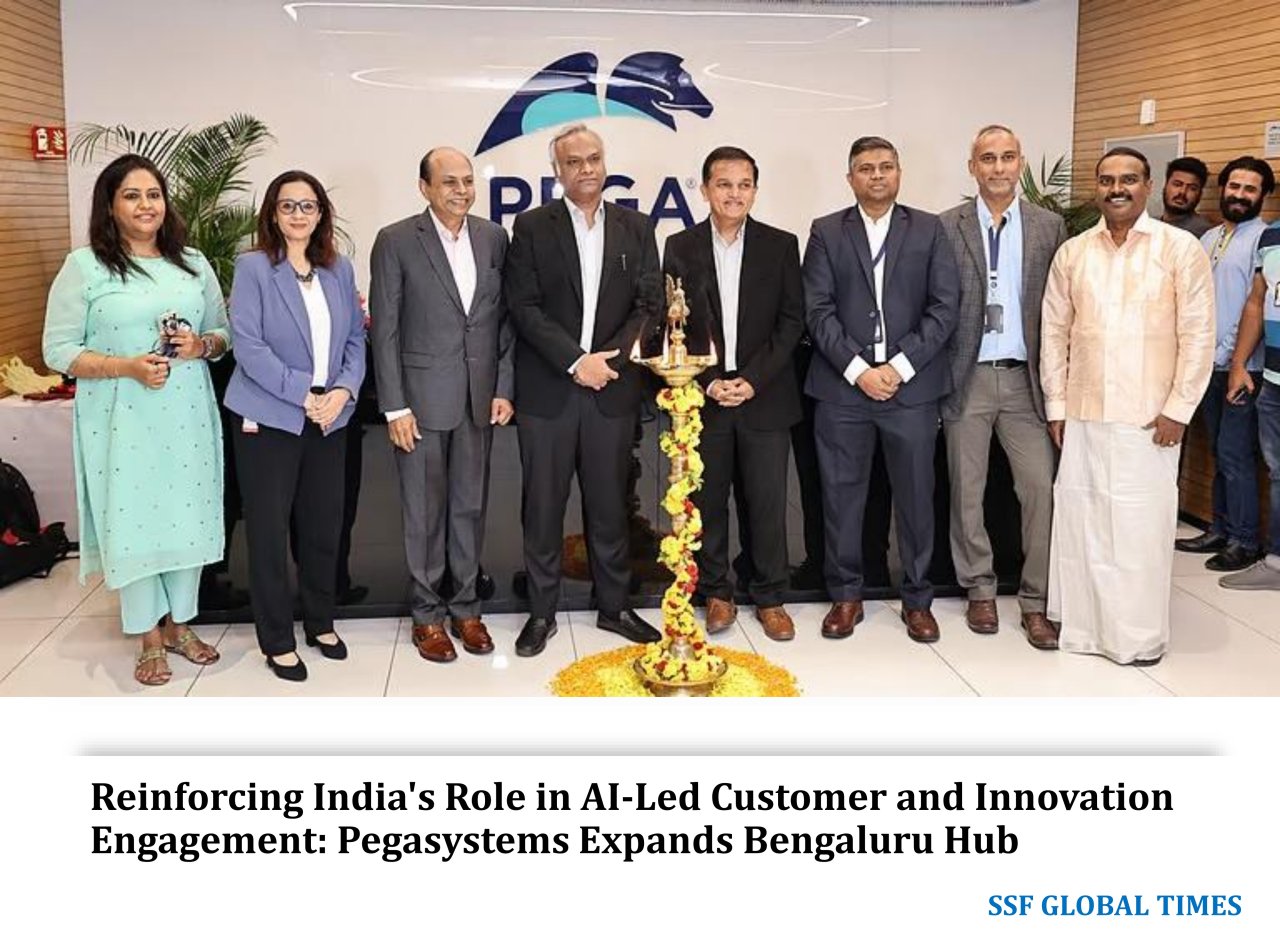
BENGALURU | 26 June 2026: Executing a definitive structural upgrade to its Indian operational footprint, US-based enterprise AI software major Pegasystems has officially inaugurated a major facility expansion at EcoWorld Tech Park in Bengaluru. Backed by a direct capital expenditure exceeding ₹60 crore, the deployment expands the company’s localized real estate footprint by 60%, establishing a highly specialized engineering and client-engagement node.
The facility was inaugurated by Priyank M Kharge, Hon’ble Minister for Home, Information Technology & Biotechnology and e-Governance, Government of Karnataka, in the presence of Karnataka Digital Economy Mission (KDEM) CEO Sanjeev Kumar Gupta and Pegasystems’ global and India leadership teams including Deepak Visweswaraiah, Senior Vice President and Managing Director.
During the launch, Minister Priyank Kharge remarked:
Pega, a global enterprise software company, established its India operations in Bengaluru in 2012 and has steadily expanded its presence, delivering AI-powered decisioning, workflow automation and customer engagement solutions to enterprises across the world. I also interacted with members of the Pega team and spoke about how enterprise technology is transforming the way industry and governments operate, automate complex processes and deliver services more efficiently. Pega’s continued investment in Bengaluru reflects the strength of our talent and innovation ecosystem. I wish the team continued success as they expand their footprint and build the next generation of enterprise technology solutions from Karnataka.
While Pegasystems has maintained an active R&D presence in Bengaluru since 2012, this latest capital allocation represents a strict departure from the legacy offshore model. Rather than simply scaling generalized software headcount, the new facility, capable of housing over 350 engineers, is explicitly engineered to function as a frontline commercial asset, anchoring the company’s enterprise workflow and AI integration strategies across the Asia-Pacific market.
Headquartered in Cambridge, Massachusetts, Pegasystems is a global enterprise software provider specializing in AI-powered workflow automation, customer engagement, and intelligent decisioning platforms. Operating as a critical infrastructure provider for Fortune 500 organizations, the firm’s proprietary low-code architecture enables multinational corporations to rapidly design, scale, and optimize complex operational workflows. Pegasystems has actively scaled its Indian operations since 2008, establishing massive capability and engineering nodes across Hyderabad and Bengaluru to support its global R&D, product engineering, and commercial strategies.
Core Differentiators of Pega’s India GCC
The core differentiators for the Pega India GCC include:
- Platform Ownership: Unlike traditional GCCs that handle backend maintenance, Pega’s India hubs (in Hyderabad and Bengaluru) own core product engineering, cloud infrastructure, and the global AI Centre of Excellence.
- Client-Facing Innovation: Facilities like the Bengaluru Executive Briefing Center (EBC) act as commercial hubs where global enterprise clients and System Integrators come to finalize massive digital transformation deals.
- Natively Built Enterprise AI: Instead of treating AI as an external add-on, Pega embeds AI natively into the platform, prioritizing governance, scalability, and predictable pricing over complex token economics.
- Partner Monetization: Pega’s India operations work directly with global IT giants based in India (such as TCS, Infosys, and Wipro) to embed Pega’s low-code/AI systems directly into multi-billion-dollar global enterprise deals.
The Executive Briefing Center: A Strategic Customer Engagement Capability
The critical differentiator of this ₹60-crore investment is the integration of a dedicated Executive Briefing Center (EBC). Historically, massive Indian engineering captives operated strictly as back-office execution engines, deliberately separated from direct client negotiations and revenue-generating activities.
The Pega EBC fundamentally reverses this structure. Built as a high-impact collaboration matrix, the center is designed to host multinational Fortune 500 decision-makers, offering immersive product demonstrations, specialized roadmap sessions, and strategic advisory engagements. This physical infrastructure allows Pegasystems to physically bridge its engineering talent pool with visiting global executives. By collapsing the geographic distance between the software architects writing the code and the corporate boards buying the platforms, Pega is enabling the real-time, high-velocity co-creation of agentic AI and automation architectures
Capitalizing on Enterprise AI Adoption
From a macroeconomic perspective, this infrastructure deployment perfectly aligns with the current bottleneck in global technology integration. As enterprises rapidly increase investments in generative AI and autonomous workflows, corporate boards are finding that off-the-shelf software purchases are insufficient; they require deeply customized, industry-specific deployments.
Addressing this exact market deficit, Alan Trefler, Founder and CEO of Pegasystems, noted that the new Bengaluru facility provides a premier destination for clients to experience the firm’s innovation firsthand. The operational logic is clear: by centralizing deep product expertise, live solution design, and executive engagement under one localized roof, Pegasystems accelerates the sales cycle and drives higher-margin, multi-year software deployments. The facility ensures that the Indian operation does not merely write the software but actively participates in closing the enterprise contract.
A critical, often overlooked dimension of this expansion is the strict physical architecture of the facility itself. The new workspace operates under a rigorous ESG (Environmental, Social, and Governance) framework, securing LEED, WELL, and IGBC Platinum certifications.
Historically, offshore captive centers prioritized maximum seating density over sustainable design. However, as the Bengaluru node transitions into a client-facing commercial hub, the real estate itself becomes a strategic closing mechanism. When hosting Fortune 500 boards and European multinationals bound by strict corporate sustainability mandates, a vendor’s physical footprint must physically reflect their global ESG commitments. By engineering a facility optimized for natural light, advanced air quality, and deep energy efficiency, Pegasystems are actively neutralizing procurement friction. The physical space serves as a tangible demonstration of corporate compliance, ensuring that visiting executives are not just impressed by the AI algorithms, but by the sustainable infrastructure housing the talent.
The Broader Shift: GCCs as Revenue Engines
The transition seen at Pegasystems reflects a wider industry movement. Increasingly GCCs are evolving from traditional offshore support hubs into strategic innovation and revenue-generation engines. Rather than just cutting costs, these “Value Orbit” hubs drive incremental revenue by spearheading AI, creating digital products, and owning global roadmaps. These centers differentiate themselves by relying on revenue, margin, and cash as their Key Performance Indicators (KPIs), rather than traditional headcount or process-SLA metrics.
Key Revenue-Generating GCCs in India mirroring this shift include:
- Google (Hyderabad, Bengaluru): Operates as a major revenue and product development hub for Google Workspace, Search engineering, and Ads, deeply integrating AI/ML to drive global sales.
- Microsoft (Hyderabad, Bengaluru): Focuses on core product engineering and cloud solutions (Azure), shipping proprietary features that drive global subscriptions.
- Mastercard (Pune, Vadodara, Bengaluru): Functions as a critical global technology and operations hub, developing global payment solutions, fraud-detection AI, and digital services that bring in direct revenue.
- Target (Bengaluru): Handles global data analytics, supply chain algorithms, and digital consumer technologies that directly power global retail profitability and customer experience.
- JPMorgan Chase (Bengaluru, Mumbai): Serves as a financial engineering and quantitative analytics hub, building algorithms and trading models that underpin their global financial markets.
- AstraZeneca (Chennai): Transitioned from a pure support arm to a global R&D and digital product hub, accelerating drug trials and digital healthcare platforms that generate commercial returns.
- Walmart (Bengaluru): Builds data science, AI, and digital twin supply-chain models that optimize inventory and e-commerce revenue worldwide.
- SAP Labs India (Bengaluru, Pune, Hyderabad): Operates as SAP’s second-largest R&D hub globally. The Indian team owns the development and deployment of SAP S/4HANA Cloud and core ERP business AI applications. Their code directly supports over 90% of SAP’s global client revenue.
- Salesforce India (Hyderabad, Bengaluru): Serves as a top global innovation center driving enterprise cloud architecture. The engineering teams here own substantial portions of the MuleSoft integrations, Tableau analytics, and Einstein AI engines, which are core revenue drivers for Salesforce’s SaaS model.
- Amazon Development Center (Bengaluru, Hyderabad, Chennai): Far beyond customer support, these centers build critical infrastructure for Amazon Web Services (AWS) and global Kindle/Alexa engineering. They write the supply chain AI and ad-tech monetization algorithms that power Amazon’s multi-billion-dollar global marketplace.
- Adobe Systems (Noida, Bengaluru): A massive hub for digital media and digital experience products. Teams in India own end-to-end product development for core platforms like Adobe Acrobat and generative AI features inside Photoshop (Firefly), translating directly into creative cloud subscription renewals.
- Oracle India (Bengaluru, Hyderabad, Noida): Focuses heavily on cloud infrastructure (OCI) and autonomous database management systems. The engineering done here creates the tech stack that enables Oracle to close high-value enterprise cloud data contracts globally.
- ServiceNow (Hyderabad, Bengaluru): Deeply integrated into the core product pipeline. The India GCC designs automated workflow solutions, creator workflows, and GenAI-powered ITSM (IT Service Management) features that drive their enterprise contract values worldwide.