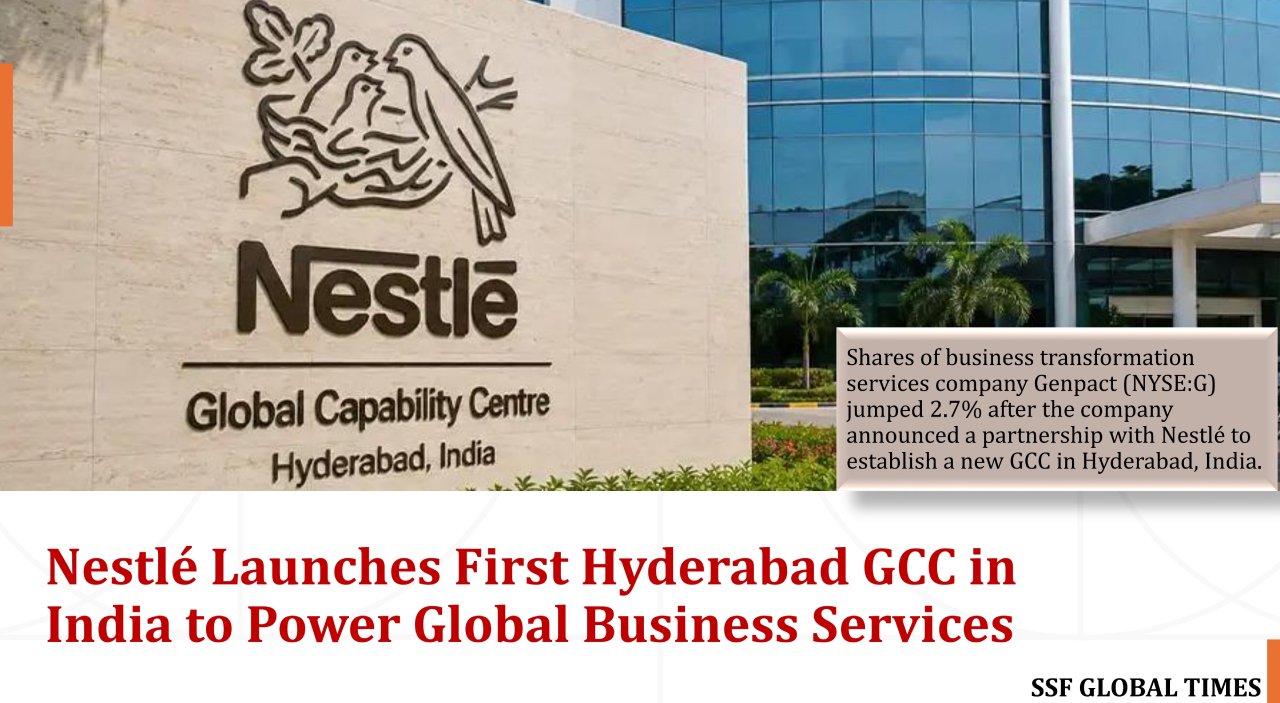




HYDERABAD | 7 July 2026: Expanding its global business services and digital capabilities, Swiss food and beverage company Nestlé S.A. has established its first Indian Global Capability Centre (GCC) in Hyderabad. Driven through its corporate shared services arm, Nestlé Business Services (NBS), the facility represents an important step towards integrating artificial intelligence, data analytics, and advanced automation into the multinational’s worldwide operations.

Rather than incubating the hub in isolation, the FMCG giant opted for a strategic alliance with professional services firm Genpact. This collaborative framework ensures the new center operating under Nestlé Business Services India (P) Limited. immediately harnesses high-level process intelligence to streamline the company’s end-to-end global business workflows.

For the macroeconomic landscape, this move confirms a broader structural trend: global retail and consumer majors are increasingly viewing India not just as a major retail market, but as a strategic hub for managing increasingly complex global operations.

KEY HIGHLIGHTS

  • Premier Indian capability node:The shared services division of the Nestlé Group has formally launched its first dedicated GCC within the Indian market.
  • Functional scope: The hub will support global finance, supply chain logistics, procurement, and broader enterprise operations.
  • Strategic geographic placement: Hyderabad continues to capture major non-IT multinational investments, solidifying its position as a preferred ecosystem for FMCG capability centers alongside brands like McDonald’s and L’Oréal.

Nestlé Business Services (NBS) Operating as the dedicated shared services network of the Swiss conglomerate Nestlé S.A., NBS provides the digital and operational backbone for the world’s largest food and beverage company. Through its global network of service centers and expert teams, the division manages end-to-end enterprise solutions, digital transformation initiatives, and process excellence protocols to ensure seamless operational execution across international markets.

The Parent Enterprise: Nestlé S.A. Headquartered in Vevey, Switzerland, Nestlé S.A. operates as one of the world’s largest food and beverage companies, managing an extensive global footprint across 185 countries. Navigating volatile global consumption patterns and an industry-wide push toward sustainability, the enterprise generated CHF 89.49 billion (approximately $100 billion USD) in total reported sales for the full year 2025. Employing over 270,000 professionals worldwide and operating more than 330 factories, the multinational relies heavily on its global brands in Coffee, Petcare, and Nutrition.

AUTOMATING THE GLOBAL FMCG MACHINE

The NBS (Nestlé Business Services) facility in Hyderabad was built to function far beyond a traditional administrative back-office; it operates as a highly advanced digital operations hub. By combining Nestlé’s operational scale with Genpact’s domain expertise, the centre focuses on converting raw enterprise data into predictive models. The operational parameters and core capabilities housed within the new hub include:

  • Global Supply Chain Analytics: Specialized data teams will monitor and optimize the end-to-end logistics network, allowing European headquarters to preempt disruptions across their worldwide manufacturing and distribution channels.
  • AI-Driven Procurement Logistics: The facility will deploy advanced automation and predictive modeling to manage global vendor networks, stabilize raw material acquisition, and improve supply chain resilience.
  • Centralized Financial Operations: The hub acts as a core financial operations center, processing global transactions, managing complex compliance protocols, and executing predictive financial modeling for international markets.
  • Enterprise Automation Scaling: Through its strategic alliance, the centre serves as a testing and deployment ground for advanced enterprise AI, integrating cognitive automation directly into Nestlé’s broader corporate workflows.

THE HYDERABAD PREMIUM: BECOMING THE FMCG TECH CAPITAL

The geographic selection signals an ongoing diversification within India’s tech landscape. While legacy IT cities have traditionally dominated the GCC narrative, Hyderabad has rapidly evolved into a highly specialized hub for global retail, consumer packaged goods (CPG), and life sciences corporations.

The city offers a unique convergence: a robust digital infrastructure, a highly skilled talent pool specialized in enterprise analytics, and a stable regulatory environment that accommodates rapid operational scaling. For an enterprise relying on continuous, round-the-clock data processing to feed its worldwide operations, ecosystem maturity is paramount. Addressing the regional strategy, Luca Fichera, Head of Nestlé Business Solutions, detailed the logic behind the location.

NBS Hyderabad represents a positive next chapter in our growth journey…. Hyderabad was selected for its strong technology ecosystem, robust infrastructure, and growing reputation as one of India’s leading global capability destinations…we have build stronger capabilities, the local workforce and partner network and will remain central to this journey.

Luca Fichera, Head of Nestlé Business Solutions

THE MACRO SHIFT IN FMCG SECTOR

Nestlé’s expansion is not an isolated event; it is part of a significant structural realignment within the Fast-Moving Consumer Goods (FMCG) and retail sectors. Historically reliant on localized distributors and traditional marketing, legacy consumer brands are transforming into high-frequency data enterprises.

According to 2026 market data, retail and FMCG capability centers in India now employ over 270,000 professionals, growing at double-digit rates. This pivot is driven by several irreversible industry pressures:

  • The Omnichannel & MarTech Imperative: Brands must now track consumer behavior across fragmented digital and physical channels. Enterprises are leveraging Indian engineering talent to build proprietary Customer Relationship Management (CRM) algorithms, dynamic pricing models, and generative AI engines that significantly accelerate marketing content creation and personalization.
  • Predictive Inventory Resilience: Post-pandemic supply chains remain highly sensitive to geopolitical and climate-driven shocks. FMCG giants are deploying large data teams to build Machine Learning Operations (MLOps) that actively predict stockouts, optimize shelf availability, and improve global supply chain visibility.
  • The Cross-Industry Validation: The competitive landscape confirms this capability rush. PepsiCo continues to expand its Hyderabad data and analytics GCC to streamline global business services, while European beverage giant Carlsberg Group recently initiated its own GCC deployment in India. These brands recognize that controlling data architecture is becoming as critical as controlling the product recipe.

Industry Insights

Analyzing the structural evolution of the capability market and the specific dynamics of the consumer sector, the Nestlé expansion yields several important insights:

  1. The GCC Revenue Surge: The offshore capability model is rapidly expanding its economic footprint. According to baseline data, the Indian ecosystem housed roughly 1,700 GCCs generating $64.6 billion in exports in FY24. Trajectory models forecast this to expand to 2,200 centers and up to $105 billion in revenue by 2030.
  2. FMCG Goes Algorithmic: Consumer packaged goods companies are fundamentally restructuring. Facing volatile global consumption and inflationary pressures, legacy brands are turning to AI-led automation to improve agility and operational efficiency. Centralizing operations in high-tech Indian hubs allows these enterprises to strengthen global support capabilities while improving backend responsiveness.
  3. The Partnered Incubation Model: Nestlé’s reliance on Genpact mirrors a growing trend where global heavyweights bypass the timeline friction of organic, ground-up incubation. By partnering directly with established technology solutions firms, corporations achieve immediate operational velocity and de-risk their complex AI integrations.

IN SUMMARY

Nestlé’s foray into the Hyderabad capability ecosystem is a strong indicator of where the global consumer goods industry is heading. By anchoring its first Indian NBS hub in a high-density tech corridor and leveraging Genpact’s automation expertise, the FMCG giant is upgrading its global business infrastructure. This transition moves far beyond basic cost arbitrage, reinforcing India’s role as a critical digital and operational hub supporting the modern multinational enterprise.

Curated by SSF Global

Tracking the shifts shaping GCCs, enterprise ecosystems, and the future of global business.

Share on      

SSF Global is a Global Community for Enterprise Function Leaders and serves as a research & advisory platform focused on Global Business Services (GBS), Global Capability Centres (GCCs), and the evolution of enterprise innovation in India and beyond. We track, publish, and partner in narratives that shape how capability centres transform into hubs of trust, intelligence, and sustainable growth. We also evaluate, assess and benchmark the GCCs for their performance, maturity and other parameters using our proprietary tools built from the knowledge gained from direct interaction with our members (GCCs & GBS).