




 Ask an Expert

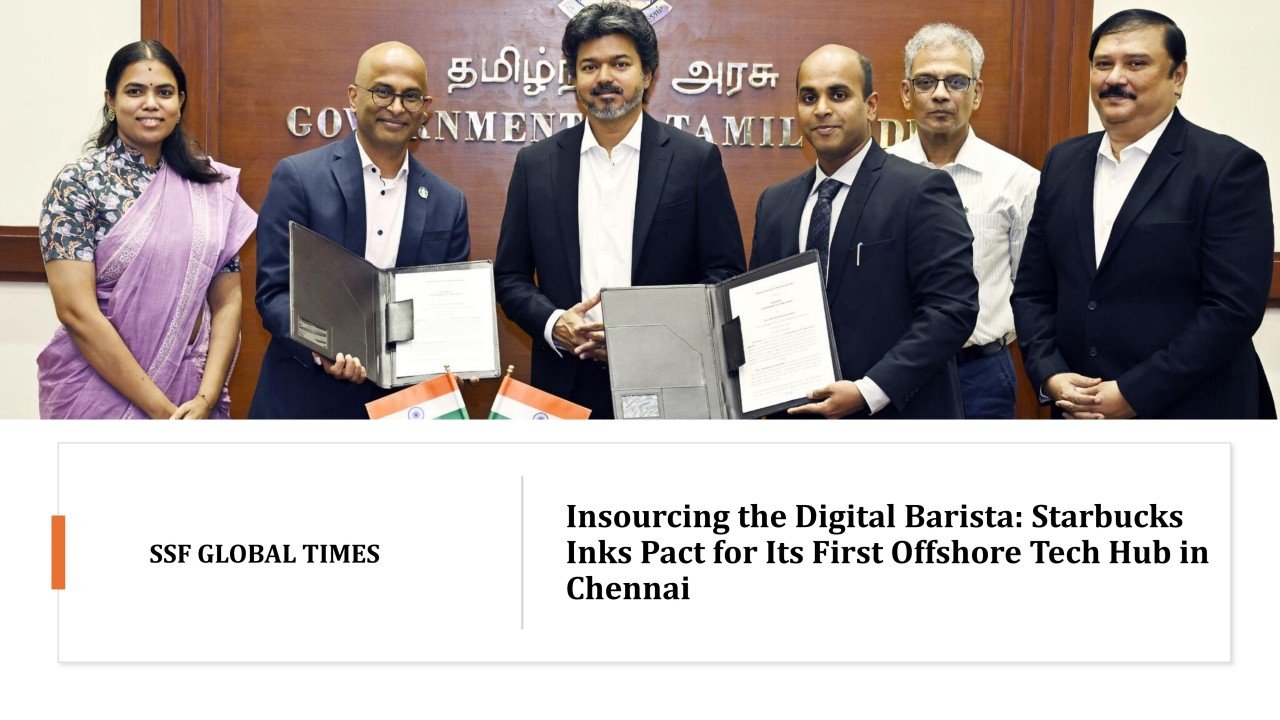
CHENNAI | 19 September 2026: Expanding beyond its traditional consumer retail footprint, global coffeehouse company Starbucks has executed a landmark agreement to establish its first-ever corporate technology hub outside the United States. Following a Memorandum of Understanding (MoU) signed with the Government of Tamil Nadu, the Seattle-headquartered enterprise is anchoring a massive new Global Capability Centre (GCC) in Chennai.
Scheduled to become fully operational by 2027, this deployment is not an expansion of its physical cafe network, but a calculated infrastructural maneuver. Driven by an aggressive corporate mandate to cut $2 billion in enterprise costs, Starbucks is utilizing the Chennai facility to radically reduce its reliance on third-party IT contractors by bringing mission-critical software engineering and digital architecture strictly in-house.
KEY HIGHLIGHTS
- High-Value Headcount: The MoU outlines the creation of approximately 800 highly specialized technology roles. Recruitment will be executed in deliberate phases aligned with the firm’s global corporate requirements.
- Premium Compensation: Bypassing entry-level IT wages, the state government confirmed the proposed roles carry a highly competitive median annual salary of ₹35 lakh, cementing the hub’s status as a top-tier engineering center.
- The Subsidy Lever: The deal was heavily incentivized by Tamil Nadu’s Special Scheme to Promote GCCs (2024–2027). This aggressive policy offers graded payroll subsidies for qualifying high-paying jobs covering 30% of eligible payroll costs in the first year, cascading to 20% and 10% in subsequent years.
Headquartered in Seattle, Washington, Starbucks is the roaster and retailer of specialty coffee, operating a staggering global network of tens of thousands of storefronts. While fundamentally a food and beverage enterprise, the modern iteration of the company operates as a high-volume fintech and digital logistics platform. Its mobile application and rewards program process billions of dollars in pre-loaded capital and digital transactions annually, requiring enterprise-grade cybersecurity, cloud infrastructure, and data science capabilities that rival traditional banking institutions.
OPERATIONAL BLUEPRINT: THE INSOURCING IMPERATIVE
Crucially, this technology hub will operate entirely independently of Tata Starbucks, the brand’s localized retail joint venture. Instead, the Chennai engineers will function as a sovereign extension of the corporate parent.
- Cross-Border Integration: The localized engineering squads will be directly tethered to Starbucks’ primary technology command centers in Seattle and Nashville.
- Eliminating Vendor Reliance: The core mandate of the Chennai hub is enterprise insourcing. By building internal algorithmic capabilities, predictive supply chain models, and secure global payment architectures in India, Starbucks aims to phase out expensive external IT consultancies a critical pillar in its broader $2 billion structural cost-reduction strategy.
- Omnichannel Architecture: As global F&B brands become increasingly reliant on mobile ordering, loyalty algorithms, and automated inventory routing, the localized tech talent will optimize the backend systems that power millions of daily consumer transactions worldwide.