




 Ask an Expert

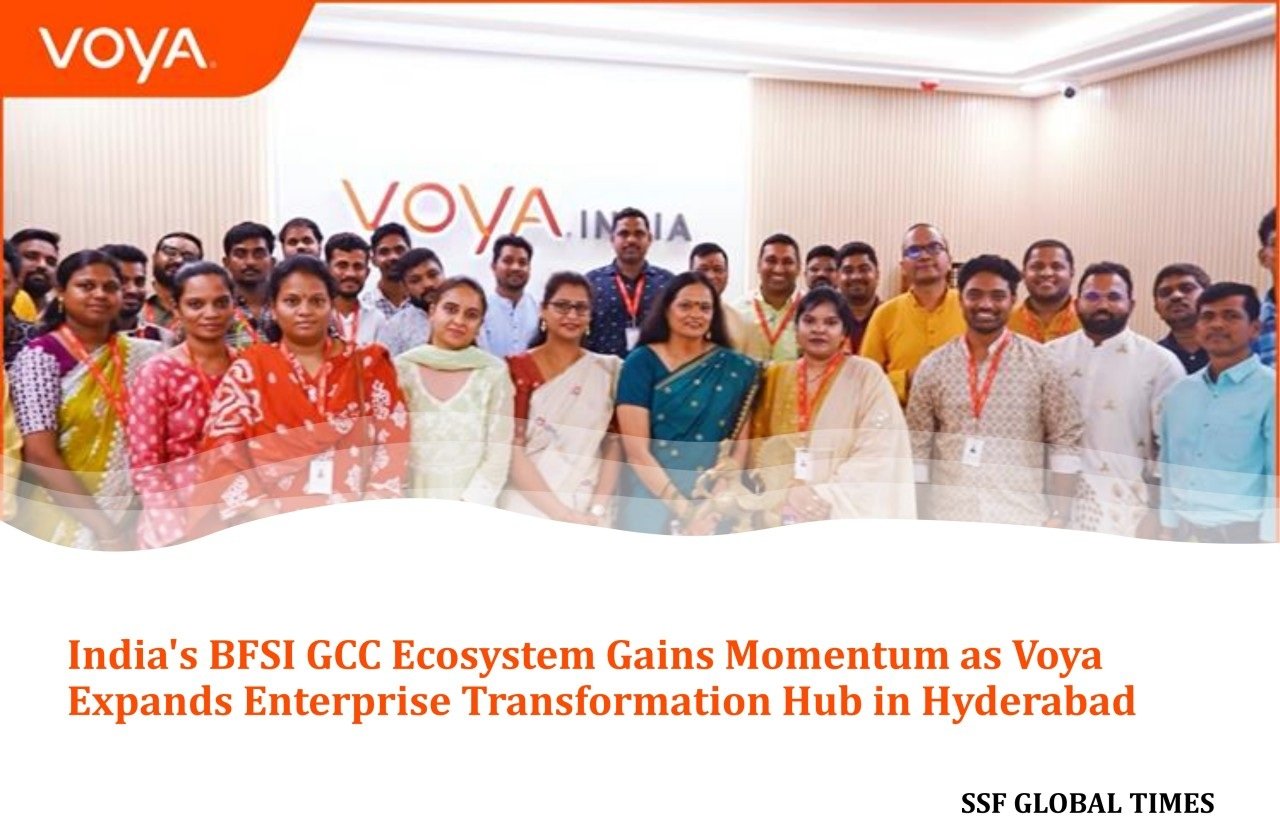
HYDERABAD | 16 June 2026: The operational blueprint for global financial institutions is moving decisively toward distributed, high-value engineering hubs. Demonstrating this structural shift, US-based retirement and investment management leader Voya Financial has formally expanded its operational footprint by launching a new Global Capability Centre (GCC) in Hyderabad.
Located at the Raheja Mindspace IT Park, this facility represents a critical node in Voya’s strategy to internalize complex workflows and drive enterprise-wide transformation. Managing a combined total of over $790 billion in assets under management and administration (AUM/AUA) and serving approximately 16 million customers globally requires an operational backbone that can scale seamlessly, a mandate that is now being heavily driven from India.
Voya Financial is a health, wealth, and investment company headquartered in the United States. The enterprise provides a comprehensive portfolio of workplace benefits, savings products, and institutional investment management services. The company manages over $790 billion in combined assets under management and administration, operating with a clear strategic mandate to deliver integrated financial solutions that promote long-term economic resilience.
Voya India is a wholly owned subsidiary of Voya Financial, serving as the enterprise’s strategic Global Capability Centre. Headquartered in Bengaluru with expanding operations in Hyderabad, the entity drives technology, innovation, and business process transformation across Voya’s core global verticals.
The Corporate Blueprint: Governing Highly Regulated Domains
The Hyderabad expansion is not an isolated IT support initiative; it is an integration of Voya’s core business architecture. The new center operates alongside the company’s existing Bengaluru hub, collectively housing a workforce of over 3,000 professionals across India.
Under the leadership of Sharada Nandakumar, President and CEO of Voya India, the functional direct of the new facility is explicitly engineered to handle three of America’s most strictly regulated and high-value financial verticals: Health, Wealth, and Investment Management. Rather than executing routine back-office maintenance, the Hyderabad node is tasked with driving:
- Investment Management Technology: Architecting the digital infrastructure that supports Voya’s massive institutional and retail investment portfolio.
- Advanced IT Delivery and Automation: Deploying engineering, analytics, and automation to streamline enterprise operations and accelerate speed-to-market.
- Business Transformation: Owning end-to-end operational workflows that directly impact the customer experience across global markets.
The Capability Evolution: From Joint Venture to Captive Engine
The establishment of the Hyderabad node highlights a critical structural evolution in how Voya manages its global capabilities. Voya India originally began as a joint venture (formerly known as VFISLK) with a software services company. However, in August 2023, Voya executed a complete buyout, transitioning the entity into a wholly owned subsidiary.
This transition was highly strategic. By moving from a partnered model to a fully captive GCC, Voya eliminated third-party operational friction and internalized its proprietary intellectual property. The opening of the Hyderabad center in 2026 serves as the aggressive scaling phase of this captive model. Managing highly sensitive health insurance and wealth management data requires absolute data governance; operating a fully owned, multi-city footprint in India allows Voya to deploy complex digital transformation securely, without the compliance risks associated with external vendors.
The Macro Shift: Why BFSI Majors are Flooding India’s Tech Corridors
The scale of Voya’s commitment is part of a much larger, structural reorganization within global finance. The Banking, Financial Services, and Insurance (BFSI) sector is currently executing a massive “flight to quality,” migrating critical workloads away from scattered third-party vendors and into fully owned, specialized capability centers in India.
Recent market data validates this sector-wide transition:
- An Outsized Talent Share: While BFSI entities account for roughly 8% of the total number of GCCs in India (approximately 170 centers), they employ an outsized 20% to 25% of the entire Indian GCC workforce, totaling over 450,000 specialized professionals.
- The Hyderabad Analytics Anchor: While Mumbai remains the traditional core for domestic finance, multinational BFSI firms are aggressively targeting southern technology corridors. Hyderabad is currently capturing over 20% of the broader GCC market, heavily anchored by BFSI firms seeking elite talent in quantitative analytics, cloud engineering, and risk modeling.
- Transitioning to Core Value: These capability centers are no longer handling simple data entry or reconciliation tasks. BFSI GCCs are now the primary engines leading the shift to cloud-native architectures, implementing large-scale AI for fraud detection, and managing complex regulatory compliance
By establishing a physical footprint in Hyderabad, Voya is tapping directly into one of the most mature, high-density BFSI engineering ecosystems in the world, securing the talent necessary to run highly regulated platforms at scale.
Why This Expansion Matters for the GCC Industry
Voya’s Hyderabad launch reflects a broader trend reshaping the global financial services industry. As institutions seek greater agility, regulatory resilience, and digital innovation, GCCs are evolving from delivery centers into strategic enterprise assets. Increasingly, these centers are being entrusted with core business functions, product development responsibilities, and transformation mandates that directly influence customer outcomes and business growth.
For India’s GCC ecosystem, this represents a continued move up the value chain, where capability centers are no longer supporting the enterprise, they are helping define its future.