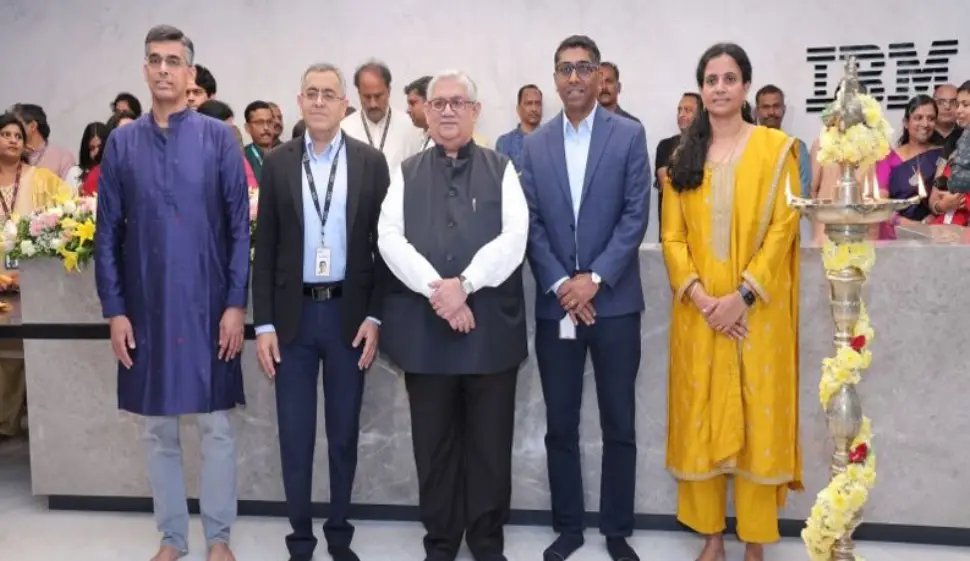




Bengaluru | 07 March 2026: IBM has inaugurated the Sangam Infrastructure Innovation Centre at its India Systems Development Lab (ISDL) campus in Bengaluru, reinforcing the company’s focus on building the infrastructure required to support large-scale enterprise AI adoption.

Founded in 1911 as the Computing-Tabulating-Recording Company and renamed IBM in 1924, the firm has remained a global technological pioneer for over a century. IBM has historically shifted its focus from revolutionizing hardware-including the 1964 System/360 mainframe and the 1981 IBM PC-to leading the current frontiers of hybrid cloud and AI solutions. Today, the company leverages its enterprise-grade watsonx platform and a network of 3,000 international scientists to push the boundaries of quantum computing and ethical AI systems across 170 countries. This strategic evolution is underpinned by a deep commitment to responsible technology and environmental sustainability.

The Innovation Centre

AI is only as powerful as the infrastructure that supports it. From hybrid cloud platforms to data architectures and automation, the backbone of AI lies in robust, secure and scalable infrastructure. This centre brings together deep systems engineering expertise and ecosystem collaboration to help clients operationalize AI at scale while ensuring performance, security, governance, and reliability across mission-critical environments.

– Subhathra Srinivasaraghavan, Vice President, IBM India Systems Development Lab

The Sangam centre has been created to address that gap by combining AI platforms, hybrid cloud architecture, and infrastructure engineering within a single development environment.

The hub will support collaboration between multiple parts of the technology ecosystem, including:

  • Global Capability Centres (GCCs)
  • Independent Software Vendors (ISVs)
  • Global System Integrators (GSIs)
  • Enterprise technology teams

By bringing these stakeholders together, the centre aims to help organizations design AI systems that are secure, scalable, and ready for operational deployment.

Rising Demand for AI Infrastructure

India is at a pivotal moment in its AI journey, and infrastructure will define the pace and scale at which organizations can innovate. Across industries, enterprises in India are modernizing mission-critical systems to become AI-ready. This centre reflects IBM’s long-term commitment to India and strengthens our ability to design, build, and scale infrastructure solutions locally, tailored to India’s unique market needs, while contributing to global innovation.

– Sandip Patel, Managing Director, IBM India & South Asia

Demand for infrastructure capable of supporting enterprise AI is rising rapidly. Industry forecasts suggest that enterprise infrastructure spending in India could grow by roughly 19% in 2025, driven by investments in data platforms, automation systems, and AI workloads.

The Sangam centre positions IBM to play a larger role in helping organizations modernize legacy systems and build AI-ready technology architectures.

Curated by SSF Global to track developments shaping the future of GCCs, enterprise ecosystems, and India’s commercial real estate landscape.

Share on   

Are you looking to set-up a GCC or expand an already existing one?

OR

Considering the launch or expansion of a Global Capability Centre?
Write to us and we will help you by providing the blueprint/ roadmap and SETUP solution – we are a one stop solution including end-to-end requirement for a GCC – Location, People, Process, Technology (AI) and Infrastructure.

About SSF Global
SSF Global is a Global Community for Enterprise Function Leaders and serves as a research & advisory platform focused on Global Business Services (GBS), Global Capability Centres (GCCs), and the evolution of enterprise innovation in India and beyond. We track, publish, and partner in narratives that shape how capability centres transform into hubs of trust, intelligence, and sustainable growth. We also evaluate, assess and benchmark the GCCs for their performance, maturity and other parameters using our proprietary tools built from the knowledge gained from direct interaction with our members (GCCs & GBS).