




 Ask an Expert

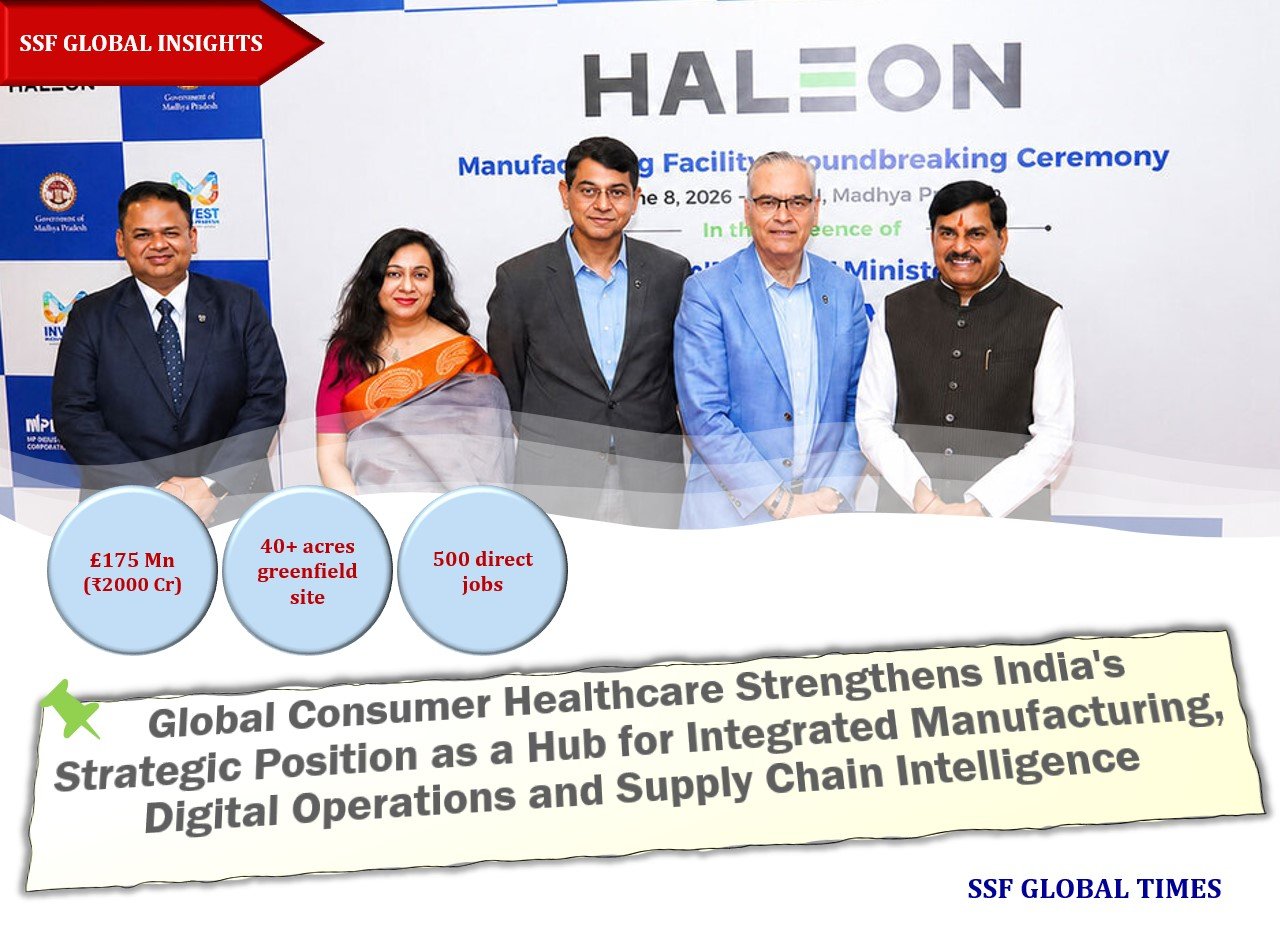
Global Consumer HealthcareStrengthens India’s Strategic Position as a Hub for Integrated Manufacturing, Digital Operations and Supply Chain Intelligence
PITHAMPUR , MADHYA PRADESH | 12 June 2026: Securing localized supply chains has transitioned from an operational luxury to an absolute necessity for global fast-moving consumer health giants. A significant shift is underway in how global enterprises view India. No longer merely a destination for talent, technology, or low-cost manufacturing, India is increasingly becoming the location where multinational corporations are building integrated operating ecosystems that combine manufacturing, digital capabilities, supply chain intelligence, and global business operations.
The latest validation of this trend comes from the British consumer healthcare. Haleon, which has committed approximately ₹2,000 crore (£175 million) to establish its first manufacturing facility in India and South Asia. The investment, announced in the presence of Madhya Pradesh Chief Minister Dr Mohan Yadav and Haleon CEO Brian McNamara, will see the company develop a state-of-the-art manufacturing campus on more than 40 acres of greenfield site within the Pithampur Smart Industrial Park. This massive capital injection signifies that multinational corporations are looking beyond traditional coastal manufacturing corridors, increasingly identifying Central India as a highly scalable hub for long-term industrial infrastructure.
While the immediate headline centers on manufacturing expansion, the broader significance of this investment extends far beyond the factory floor. For the GCC ecosystem, the announcement offers another powerful indication that the future enterprise will increasingly be built around the convergence of physical operations and digital capabilities.
The Company Behind the Investment
Headquartered in Weybridge, United Kingdom, Haleon emerged in 2022 following the demerger of GSK’s consumer healthcare business, creating one of the world’s largest pure-play consumer health companies.
Today, the company manages a portfolio of globally recognized brands spanning oral health, pain management, respiratory care, digestive health, and nutritional supplements. Its flagship brands include Sensodyne, Parodontax, Centrum, Crocin, Eno, Otrivin, and Iodex.
The company reported revenues exceeding £11 billion in 2025 and operates across more than 170 markets worldwide. Emerging markets have become an increasingly important growth engine for the organization, with India ranking among its most strategically important markets.
Beyond commercial operations, Haleon has also been steadily investing in digital transformation, advanced analytics, consumer intelligence, and technology-enabled supply chain management, capabilities that increasingly rely on its India-based talent ecosystem. The enterprise executes a highly disciplined commercial strategy, internally classified as its “Win as One” mandate, which aims to drive aggressive market penetration and expand its global footprint to reach 1 billion additional consumers by 2030.
The Operational Blueprint
Haleon’s Pithampur project is explicitly designed to be a future-ready manufacturing node, built with modern operational frameworks from inception. The facility will initially support oral healthcare manufacturing, one of Haleon’s largest global product categories, while providing a scalable platform for future expansion as market demand grows. The immediate architectural and socio-economic metrics of the site include:
- Dedicated Infrastructure: The 40-acre campus will serve as Haleon’s foundational hardware asset in the region, eliminating complete reliance on third-party contract manufacturers for its proprietary brands.
- Scale of Employment: The facility is projected to generate 500 direct jobs, while simultaneously creating a dense network of indirect employment opportunities across localized logistics and supplier ecosystems.
- Structural Diversity: Rather than treating workplace diversity as a retroactive HR initiative, the company has hardwired inclusion into the factory’s operational baseline, mandating a workforce comprising up to 30% women employees from its first day of production.
The financial commitment in Madhya Pradesh directly indicates Haleon’s aggressive international growth models. Establishing a proprietary factory allows the enterprise to control production variables, accelerate market entry for new product lines, and drive down localized unit economics.
India is a key strategic market for Haleon. By increasing access to our trusted brands and building our capabilities on the ground, we aim to expand access to better everyday health for more than 300 million additional consumers in India- key to our broader ambition to reach one billion more consumers globally by 2030
The Hidden Indicator: Predicting a GCC Mandate Expansion
The global consumer healthcare industry is undergoing a structural transformation. Rising geopolitical uncertainty, supply chain disruptions, changing consumer expectations, and growing regulatory requirements have forced multinational corporations to rethink how products are manufactured, distributed, and managed.
For companies operating at global scale, resilience has become as important as efficiency.
Against this backdrop, Haleon’s decision to localize manufacturing in one of its fastest-growing markets reflects a larger global strategy. Establishing a captive production facility allows the company to exercise greater control over quality, accelerate product launches, improve responsiveness to local demand, and reduce dependence on external manufacturing partners. The investment also aligns with Haleon’s long-term ambition of expanding access to everyday healthcare products to one billion additional consumers globally by 2030, with India expected to play a central role in that growth journey.
While the ₹2,000 crore manufacturing hardware dictates the primary headlines, there is a critical secondary narrative hidden within the company’s existing corporate structure. Haleon already operates an established GCC in India, Bengaluru which manages complex global workflows across supply chain, digital infrastructure, data analytics, and commercial functions.
In enterprise strategy, physical capital investment almost always precedes digital mandate expansion. When a corporation builds an advanced, heavily automated factory, the resulting operational complexity requires massive internal support for predictive analytics, real-time supply chain optimization, and digital engineering.
As the Pithampur site moves toward operational readiness, it will inevitably act as a catalyst for Haleon’s digital operations. Industry watchers should anticipate a significant expansion in Haleon India’s GCC hiring throughout 2027, as the enterprise integrates its new physical production lines with its existing analytical architecture.
The Strategic Gravity of Pithampur
Perhaps the most intriguing aspect of Haleon’s announcement is its choice of location. Historically, multinational manufacturers entering India gravitated toward coastal industrial corridors offering port access and export infrastructure. Haleon’s decision to establish its largest manufacturing investment in Central India reflects a changing calculus.
Located near Indore, Pithampur has evolved into one of India’s most significant industrial clusters and is often referred to as the “Detroit of India” due to its extensive manufacturing ecosystem. The region offers several strategic advantages: central geographic positioning, strong multimodal connectivity, access to skilled industrial talent, availability of large contiguous land parcels, and a mature supplier ecosystem. The area is also supported by an expanding pharmaceutical and healthcare manufacturing network that includes hundreds of pharmaceutical companies, API manufacturers, and medical device firms. And for a company seeking to serve both domestic and international markets, Pithampur offers a compelling combination of scalability, logistics efficiency, and operational resilience.
Due to its dense automotive and industrial presence, Pithampur has rapidly evolved into a premier pharmaceutical and healthcare manufacturing cluster.
- Centralized Logistics Hub: As highlighted by corporate leadership, Pithampur functions as the geographic center of India’s logistics network. It offers unparalleled connectivity to both domestic consumer markets and international export channels without the severe port congestion seen in traditional coastal states.
- An Established Ecosystem: Madhya Pradesh already houses over 300 pharmaceutical companies, 30 active pharmaceutical ingredient (API) manufacturers, and 75 medical device units. Haleon is not built in a vacuum; it is tapping into an existing, highly mature supply chain and a specialized local talent pool.
- Aggressive Policy Support: The ₹2,000 crore capital deployment follows nearly 18 months of structured engagement with the state government and the Madhya Pradesh Industrial Development Corporation (MPIDC). The state’s pro-industry policies have successfully transitioned the region from a domestic production node into a global export base, with pharmaceutical goods now contributing nearly 20% of the state’s total exports.