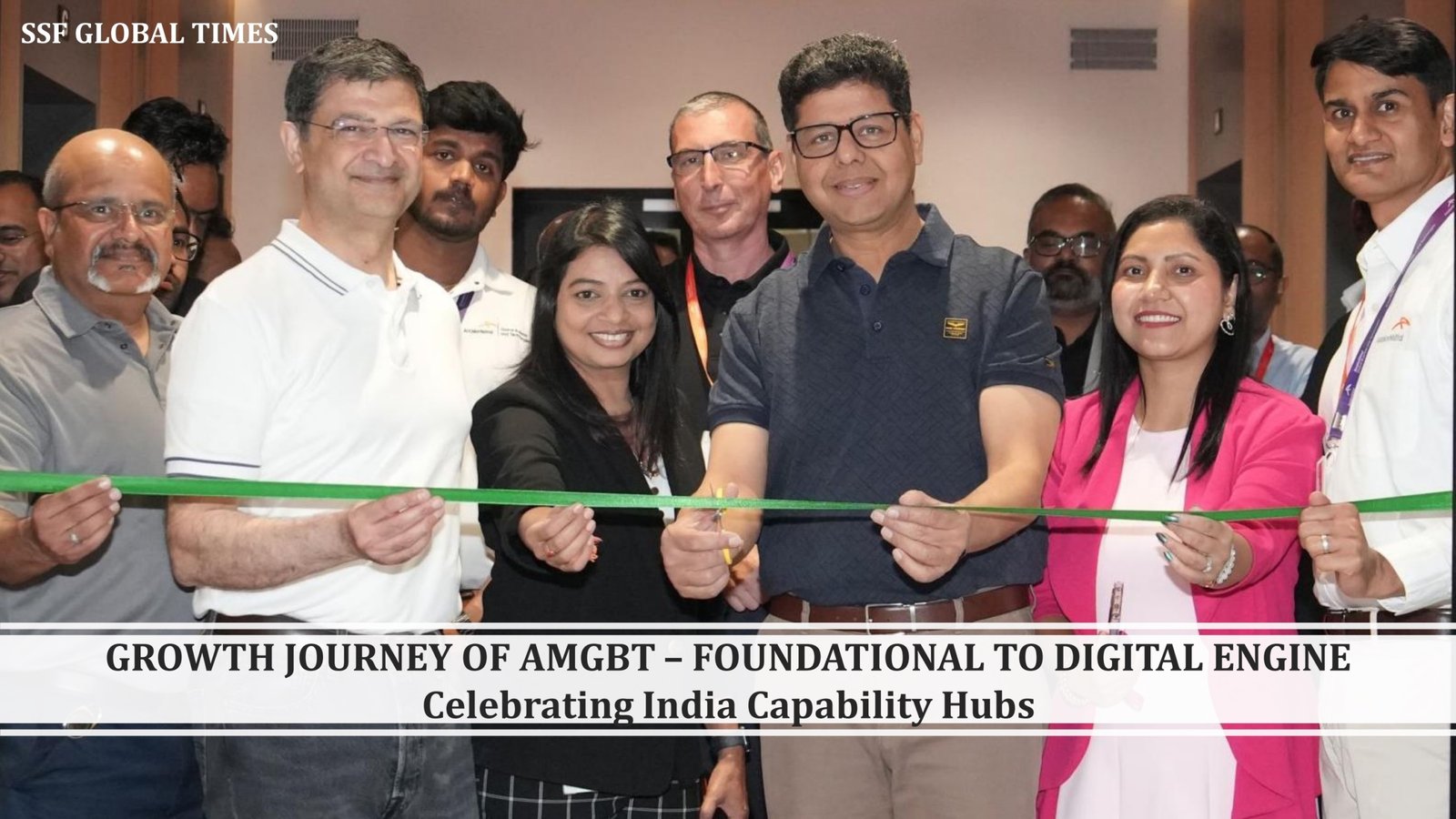




PUNE & HYDERABAD | June 1, 2026: In a clear demonstration of India’s critical role in heavy industrial transformation, ArcelorMittal Global Business & Technologies (AMGBT) has marked its one-year milestone across its Pune and Hyderabad capability hubs. Culminating in a strategic leadership townhall, the anniversary transitions the centers from their foundational phase into their permanent mandate: operating as the definitive digital engine for one of the world’s leading steel and mining conglomerates.

Operating at the apex of global heavy manufacturing, ArcelorMittal requires massive operational scale, supply chain precision, and advanced industrial technology. The capability centers in India were established to streamline and accelerate these exact functions.

Headquartered in Luxembourg, Arcelor Mittal is an integrated steel and mining company. Operating with a global workforce of approximately 125,000 to 126,000 employees, the multinational serves as the primary supplier of safe, sustainable steel across critical global sectors, including automotive, construction, household appliances, and advanced packaging. The company is entering the second year of its Indian captive operations backed by formidable global momentum. Closing the 2025 financial year with $61.35 billion in annual revenue, the enterprise demonstrated aggressive structural efficiency. Global net profit surged 135.4% year-over-year to $3.15 billion, while operating income climbed 9.6% to $3.63 billion.

This fiscal expansion was heavily accelerated by strategic development initiatives that generated an additional $0.7 billion in EBITDA. Consequently, the multinational is uniquely positioned to dominate capital-intensive macro growth sectors, including the global energy transition, defense manufacturing, enterprise data centers, and next-generation civil infrastructure.

Mirroring the parent company’s financial momentum, ArcelorMittal Global Business & Technologies (AMGBT) has aggressively bypassed its initial setup phase. Under the leadership of CEO Lalit Kumar, the dual-city capability hubs have rapidly scaled, crossing the 1,100-employee milestone in just twelve months. Anchored by the enterprise’s foundational commitment to workplace safety and a unified “ONE TEAM” culture, the GCC has successfully engineered a highly secure operational baseline. Today, AMGBT has completely transitioned from a foundational project into an active digital engine. The capability hubs are now seamlessly managing complex technological workflows and executing globally scaled enterprise projects that deliver measurable, sustained impact across ArcelorMittal’s worldwide network.

A Mandate from Global Leadership

The strategic importance of this one-year milestone was underscored by the presence of global leadership. Vijay Goyal, Executive Vice President – Regional CEO, Ukraine, Development Initiatives and EME JVs, and Nik Puri, Group CIO & CISO of ArcelorMittal, joined local leadership teams for the townhall event.

What stands out most is not only the pace of growth and consistency of service delivery, but the clarity of ambition- building a true digitally enabled engine for ArcelorMittal. This foundation, driven by strong talent, deep collaboration, and a shared commitment to safety and service excellence, positions us well for what’s ahead… Proud of what has been achieved, and even more excited about the scale of impact we can create together in the next phase.

Nik Puri, Group CIO & CISO of ArcelorMittal

Having the Group CISO and EVP engage directly with the India reinforces the reality that the engineering and business operations executed in Pune and Hyderabad are directly influencing the corporate boardroom’s long-term transformation roadmap.

Architecting the Digital Engine

The explicit ambition outlined during the anniversary proceedings reflects a profound shift in how capital-intensive industries view their captive technology centers.

AMGBT’s stated objective for its second year and beyond is to leverage technology, innovation, and deep collaboration to create enterprise value at scale. The centers are officially tasked with accelerating the parent company’s comprehensive transformation journey. This means transitioning beyond traditional IT support frameworks to architect next-generation digital manufacturing ecosystems, optimize global supply chain platforms, and enforce advanced cybersecurity protocols under the direct purview of global leadership.

Key Insights

  1. Heavy Industry Goes Digital: The transition of a traditional steel manufacturing titan toward a tech-centric operating model proves that even the most capital-heavy, legacy industrial sectors are relying on Indian engineering to drive operational modernization and algorithmic efficiency.
  2. The Dual-City Advantage: By anchoring operations in both Pune and Hyderabad, ArcelorMittal strategically taps into two highly distinct, mature talent ecosystems. This allows the enterprise to secure specialized, high-end expertise across enterprise business operations, deep tech, and cybersecurity.
  3. Accelerated Value Chain Maturity: The rapid evolution from a year-one foundational setup to the officially designated “digital engine” of the enterprise highlights how quickly modern Global Capability Centers (GCCs) acquire complex responsibilities, accelerating global business transformation at scale. view mature Indian GCCs as a guarantee of execution excellence and digital agility.

Industry Benchmarks and the Rise of the Steel GCC

  • The Evolution of the Heavy Industry GCC: The rapid scaling aligns with a broader macroeconomic shift within the Global Capability Center landscape. According to recent industry benchmarks, GCCs are decisively moving away from being mere cost-arbitrage execution centers. Instead, they are evolving into “autonomous value hubs” that take direct ownership of enterprise transformation, AI integration, and global product architectures. For a capital-intensive conglomerate like ArcelorMittal, establishing this captive “digital engine” is a mandatory defensive moat to protect supply chain resilience.
  • A Shared Strategy Among Domestic Steel Titans: AMGBT’s aggressive expansion mirrors the captive technology strategies successfully deployed by legacy Indian-headquartered steel majors. Competitors like JSW Steel and Tata Steel have long relied on their own mature, in-house capability and shared services arms to maintain operational dominance.
    • The Pivot to Hyper-Automation: Entities like JSW Global Business Solutions have actively pivoted toward hyper-automation, centralized data reconciliation, and deep cultural transformation to streamline enterprise operations across their global footprints.
    • Owning Industry 4.0: Similarly, Tata Steel heavily leverages its captive digital architecture to deploy advanced “Industry 4.0” frameworks. By building proprietary predictive algorithms, deploying automated digital twins for blast furnaces, and utilizing IoT for remote operations and drone-based inventory management, Tata Steel proves that owning internal technology capabilities directly correlates to higher production yields and reduced operational bottlenecks.

As global manufacturing enters an era defined by data-driven precision, predictive logistics, and strict sustainability mandates, a steelmaker’s competitive edge is no longer forged solely in the blast furnace. It is coded, secured, and scaled within its digital capability centers.

Curated by SSF Global

Tracking the shifts shaping GCCs, enterprise ecosystems, and the future of global business.

Share on      

SSF Global is a Global Community for Enterprise Function Leaders and serves as a research & advisory platform focused on Global Business Services (GBS), Global Capability Centres (GCCs), and the evolution of enterprise innovation in India and beyond. We track, publish, and partner in narratives that shape how capability centres transform into hubs of trust, intelligence, and sustainable growth. We also evaluate, assess and benchmark the GCCs for their performance, maturity and other parameters using our proprietary tools built from the knowledge gained from direct interaction with our members (GCCs & GBS).