




 Ask an Expert

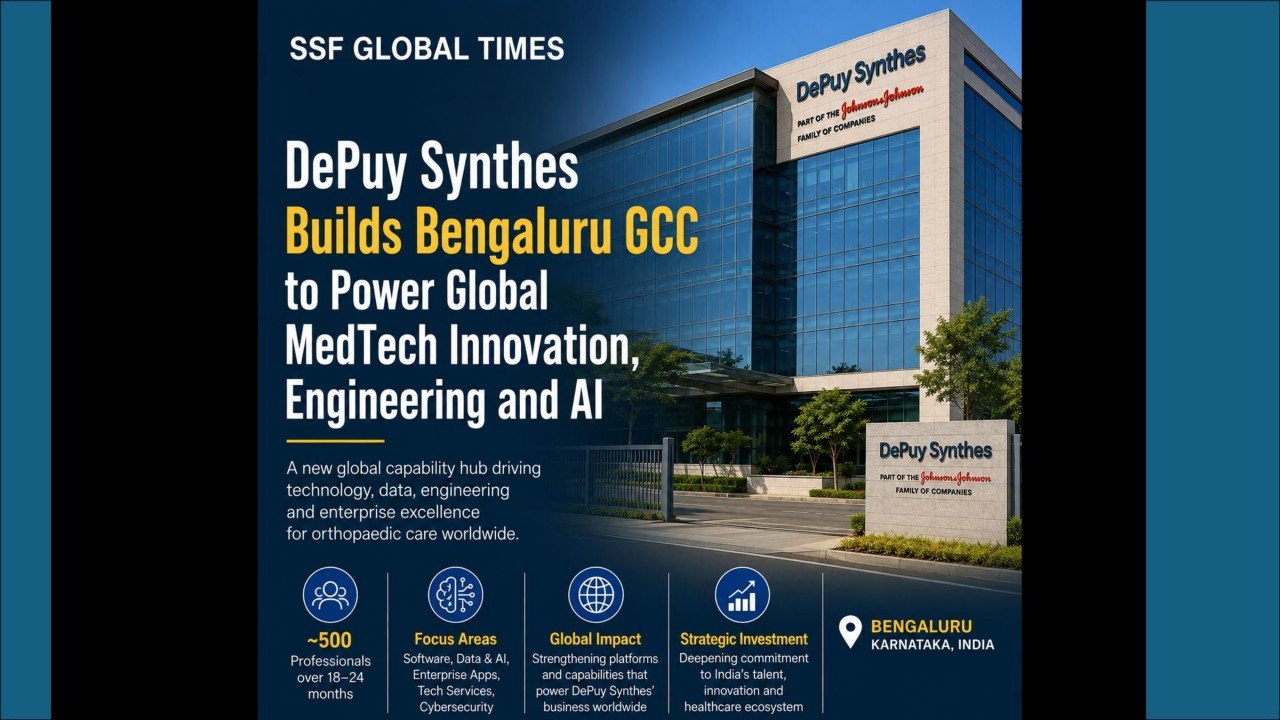
BENGALURU| 7 August 2026: DePuy Synthes, the orthopaedics business of Johnson & Johnson MedTech, has announced the establishment of a new Global Capability Centre (GCC) in Bengaluru, Karnataka, strengthening its technology, engineering and enterprise-services capabilities in India.
The new GCC is being designed as a global hub for innovation, engineering and enterprise services, bringing together technology, data and business capabilities to support clinical innovation and operational excellence. Recruitment for the centre is expected to begin in August 2026, with the facility being established in phases. Over the next 18-24 months, DePuy Synthes expects the Bengaluru centre to scale to approximately 500 employees, with the initial capability portfolio focused on software development, data and AI, enterprise applications, technology services and cybersecurity.
KEY HIGHLIGHTS
- 500-Strong Capability Ambition: DePuy Synthes expects the Bengaluru GCC to grow to approximately 500 employees over the next 18-24 months, with operations being established in phases.
- Global Innovation & Engineering Hub: The centre will serve as a global hub for innovation, engineering and enterprise services, bringing together technology, data and business capabilities.
- Deep-Tech Capability Portfolio: Initial teams will focus on software development, data and AI, enterprise applications, technology services and cybersecurity, establishing a strong technology foundation for the GCC.
- Global Leadership Structure: The GCC will be led by Nicholas Parrotta, CIO, DePuy Synthes. Dr. Jai Ganesh, CTO, will oversee technology engineering, architecture, infrastructure, cybersecurity engineering and digital platforms, while Nagaraj Bhat will lead the GCC’s local operations and leadership build-out.
- Strategic Commitment to India: Namal Nawana, Worldwide President, DePuy Synthes, highlighted India’s position as one of the world’s fastest-growing markets for orthopaedic care and the company’s long-term commitment to patients, surgeons and colleagues in the country.
Operating as a major business within Johnson & Johnson MedTech, DePuy Synthes is a global provider of orthopaedic technologies and solutions across areas including joint reconstruction, trauma, spine, craniomaxillofacial and sports medicine. As medtech increasingly converges with software, data, AI, connected technologies and digital platforms, technology capabilities are becoming integral to product development, surgical workflows, enterprise operations and customer engagement.
The Bengaluru GCC is being established with its initial mandate centred on technology engineering, data and AI, enterprise applications, cybersecurity and digital platforms.
THE INNOVATION
To support its global technology and business agenda, the new Bengaluru facility will build capabilities across specialized technology domains.
- Next-Gen Capability Clusters: The GCC will develop talent across software development, data and AI, enterprise applications and technology services, creating a technology-intensive capability base.
- Enterprise-Grade Cybersecurity: With DePuy Synthes operating across highly regulated healthcare and medtech environments, cybersecurity engineering will be an important component of the centre’s technology mandate.
- Technology & Business Synergy: By bringing together technology, data and business capabilities, the Bengaluru GCC is positioned to support global operations while enabling closer integration between technology engineering and business priorities.
Bangalore gives us access to exceptional talent and a thriving innovation ecosystem. This will be a global capability center where product owners, engineers, and data and AI leaders will carry real decision rights and build the platforms that power our business worldwide.
TECHNOLOGY CONTEXT: AI MOVES CLOSER TO THE SURGICAL WORKFLOW
The establishment of the GCC comes as DePuy Synthes continues to advance AI-enabled technologies within its product portfolio. A relevant example is VELYS™ Hip Navigation with AI Assistance, launched by DePuy Synthes in June 2026. The solution uses AI to automate image interpretation and consistently identify anatomical landmarks during total hip arthroplasty.
Johnson & Johnson reported that the AI-assisted workflow demonstrated a 57% reduction in workflow time compared with the manual workflow in the cited study. While the Bengaluru GCC has not been publicly identified as the team responsible for developing this specific technology, the example illustrates the increasingly software-, data- and AI-intensive environment in which DePuy Synthes is building its global technology capabilities.
This is significant from a GCC perspective: the technology layer supporting medtech is becoming increasingly inseparable from the product, clinical and operational value chain.