




 Ask an Expert


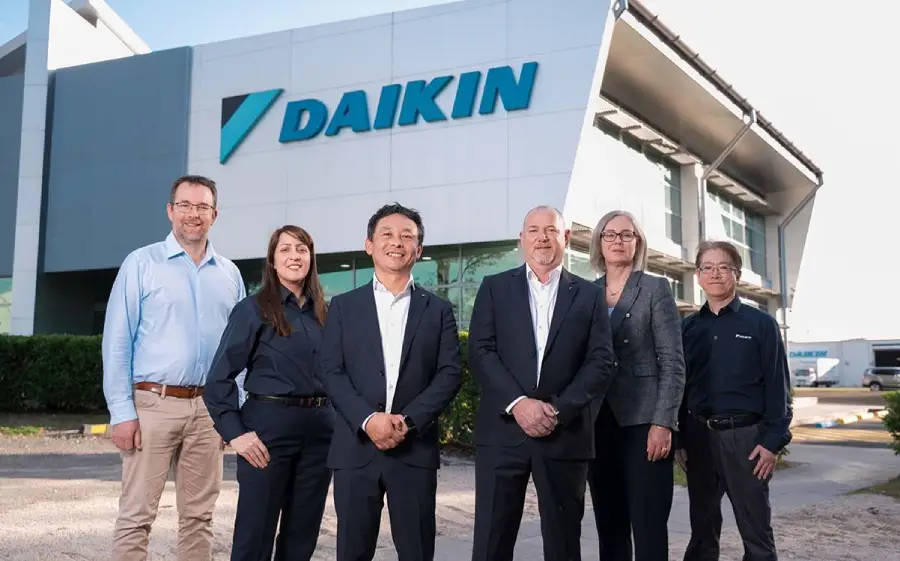
Neemrana | 12 April 2026: The inauguration of Daikin’s first global R&D center outside Japan marks a fundamental pivot in industrial logic. As the world’s largest HVAC manufacturer, Daikin is signaling the end of the “centralized innovation” model where product design was exported exclusively from Osaka in favor of a distributed, high-stakes engineering ecosystem.
As the world’s largest air-conditioning manufacturer, Daikin operates across residential, commercial, and industrial cooling systems, supported by technologies such as VRV systems, inverter-driven efficiency models, and advanced refrigeration solutions. Its portfolio extends beyond HVAC into air purification, heating systems, and fluorochemicals, reflecting a business built on both engineering depth and environmental performance.
The ₹1,000 crore investment in Neemrana, Rajasthan positions India as a location where product design, engineering decisions, and system innovation will increasingly originate.
We want to be another Maruti Suzuki in India in terms of Japanese investment. The parent is extremely bullish about India’s potential…,India is being positioned as our largest base outside Japan across manufacturing, exports, product development and component production
The Convergence Crisis: Why Cooling is a Systems Problem
Modern cooling has moved past the “white goods” category. It is now an infrastructure layer that must solve three competing pressures: extreme climate volatility, aggressive decarbonization mandates, and the surging heat loads of digital infrastructure.
The complexity shift is driven by:
- Thermal Intensity: Data centers and industrial processes now require precision cooling that basic mechanical thermostats cannot manage.
- Regulatory Friction: Global markets are bifurcating between high-efficiency standards and varying refrigerant GWP (Global Warming Potential) limits.
- Infrastructure Integration: Cooling is no longer a standalone unit; it is a node in a Smart Building Management System (BMS) that must communicate via IoT protocols.
The Structural Shift in R&D
The center is tasked with three core mandates:
- Cyber-Physical Systems: Merging proprietary inverter hardware with software to predict load requirements before they peak.
- Chiller Autonomy: A dedicated ₹200 crore localization effort for chillers moves the focus to heavy-duty, mission-critical systems used in hospitals and hyperscale data centers.
- Export Proliferation: By designing for 100 markets from a single base, Daikin is treating the Indian R&D center as a laboratory for global resilience, testing designs against the world’s most demanding electrical and environmental stressors.
The Neemrana facility is engineered to solve the “Uptime-Efficiency Paradox”:
- Liquid Cooling & Precision Air: Moving beyond traditional fans to high-density cooling solutions.
- Thermal Modeling: Using digital twins to simulate airflow patterns under maximum server load.
- Resiliency Design: Developing hardware that maintains specific humidity and temperature windows with zero tolerance for failure.
Talent as the New Industrial Currency
The recruitment of 500 specialized engineers marks a departure from traditional mechanical hiring. Daikin is targeting a cross-disciplinary workforce capable of “Full-Stack Thermal Engineering.”
- Core Competencies: Computational Fluid Dynamics (CFD), power electronics, and sustainability modeling.
- Integration Focus: Developing the firmware that allows hardware to adapt in real-time to grid fluctuations.
SSF Insight Box: The Shift from Hardware to Logic
Cooling technology is undergoing a shift where value is increasingly found in control logic rather than the compressor alone.
- Adaptive Systems: As urban heat islands intensify, static cooling systems become obsolete; systems must be responsive to real-time external data.
- Efficiency as a Constraint: Global carbon taxes mean that “inefficient performance” is now a direct financial liability.
- Software-Defined Cooling: The future of HVAC is a system that self-diagnoses and optimizes through telemetry, not just physical maintenance.
Strategic Outlook: Distributed Globalism
Daikin’s move signals a broader trend in industrial strategy: Proximity to Demand defines the Speed of Innovation. By placing its R&D at the heart of its fastest-growing market, Daikin reduces the feedback loop between environmental reality and engineering response.
Neemrana isn’t just building air conditioners; it is architecting the thermal resilience required for an increasingly hot, data-dependent, and energy-constrained world.
As industries become more dependent on localized conditions, regulatory diversity, and real-time performance requirements, R&D functions are moving toward regions that offer both technical talent and proximity to growth markets.