



 Ask an Expert


Japan is entering one of the most significant demographic transitions in modern economic history. With approximately 30% of the country’s population already above the age of 65, birth rates are well below replacement levels, and a continuously contracting workforce, what began as a domestic labor market concern, has evolved into a structural crisis. This shift directly threatens long-term innovation capacity, industrial competitiveness, and enterprise resilience.
The impact is highly acute in technology-intensive sectors. Japanese enterprises that traditionally built global leadership on manufacturing excellence and operational discipline now face an overwhelming demand for software engineering, artificial intelligence, cloud architectures, and cybersecurity. Because domestic labor markets can no longer supply these capabilities at scale, Japanese enterprises are fundamentally redesigning their global operating models.
Rather than relying primarily on third-party outsourcing, they are rapidly accelerating investments to establish wholly owned Global Capability Centers (GCCs) in India. This movement has turned Japan into the undisputed Asia-Pacific frontrunner, accounting for nearly 50% of all APAC-origin GCCs in India. By mid-2026, Japan quietly crossed the landmark milestone of 100+ established GCCs in the country, a footprint that has more than tripled from roughly 30 centers in 2020 and ~60 at the end of 2025 This structural shift is detailed in the joint research report by NRI India & SSF Global, The Next Big Focus for Japanese Companies, and various other reports which highlights how Japanese shared services are moving from regional support to global value drivers.
KEY HIGHLIGHTS
- Demographics are the ultimate GCC growth driver: Japan’s severe domestic workforce shortage frequently termed the “silver tsunami” has forced a shift from standard vendor outsourcing to strategically owned captive centers. A striking 72% of Japanese CXOs explicitly cite these domestic labor shortages as their primary driver for expanding into India.
- The vanguard of a massive corporate wave: The current 100+ GCCs represent only the initial phase of a massive structural migration, as Japan has set a formal macro target of having 5,000 Japanese companies operating in India by 2029.
- Rise of the Fourth Wave (Demographic Resilience): These investments signal a new era of GCC evolution Demographic Resilience GCCs built to ensure long-term talent sustainability, operational continuity, and engineering sovereignty.
- Co-location of R&D and GCC Hubs: A unique geographical cluster has emerged in the National Capital Region (Delhi-NCR), where major giants like Sony, Hitachi, Toshiba, and Nissan are systematically co-locating global R&D facilities alongside their GCC setups in Noida, Greater Noida, and Gurgaon.
- High concentration of ER&D functions: Reflecting Japan’s deep engineering heritage, around 48% of India’s GCCs originating from the APAC region have dedicated, functional Engineering Research & Development (ER&D)
- Modernizing the talent playbook: To thrive in India’s highly competitive tech ecosystem, Japanese firms are rapidly shedding their historical reputation for conservative compensation and high expat leadership ratios, actively competing head-to-head with aggressive US and European multinationals for mid-to-senior digital roles
THE DEMOGRAPHIC IMPERATIVE
India has emerged as the preferred destination for this strategic transition. With over 100 Japanese corporations establishing capability centers, shared services, or engineering hubs, the country has become a primary anchor for Japanese enterprise continuity. Japan has committed more than JPY 10 trillion (USD 68 billion) in cumulative public and private investments across India over the coming decade, creating a strong strategic backdrop for capability expansion. This footprint is projected to scale aggressively as demographic pressures intensify and software-led business models become central to enterprise competitiveness.
This development represents more than a new chapter in global sourcing. It signals the emergence of a new category of capability centers GCCs, established not merely for short-term efficiency, but for absolute demographic resilience. Current projections estimate that Japan’s working-age population will shrink from 72 million in 2022 down to just 60 million by 2040, a net loss of 17%.
Historically, Japanese enterprises relied on highly structured internal talent pipelines and lifetime employment models to sustain industrial competitiveness. That model is becoming mathematically impossible to maintain as experienced engineers retire and the domestic graduate pool contracts. The challenge extends beyond simple labor shortages; the global economy has shifted fundamentally from hardware-centric products toward software-defined enterprises.
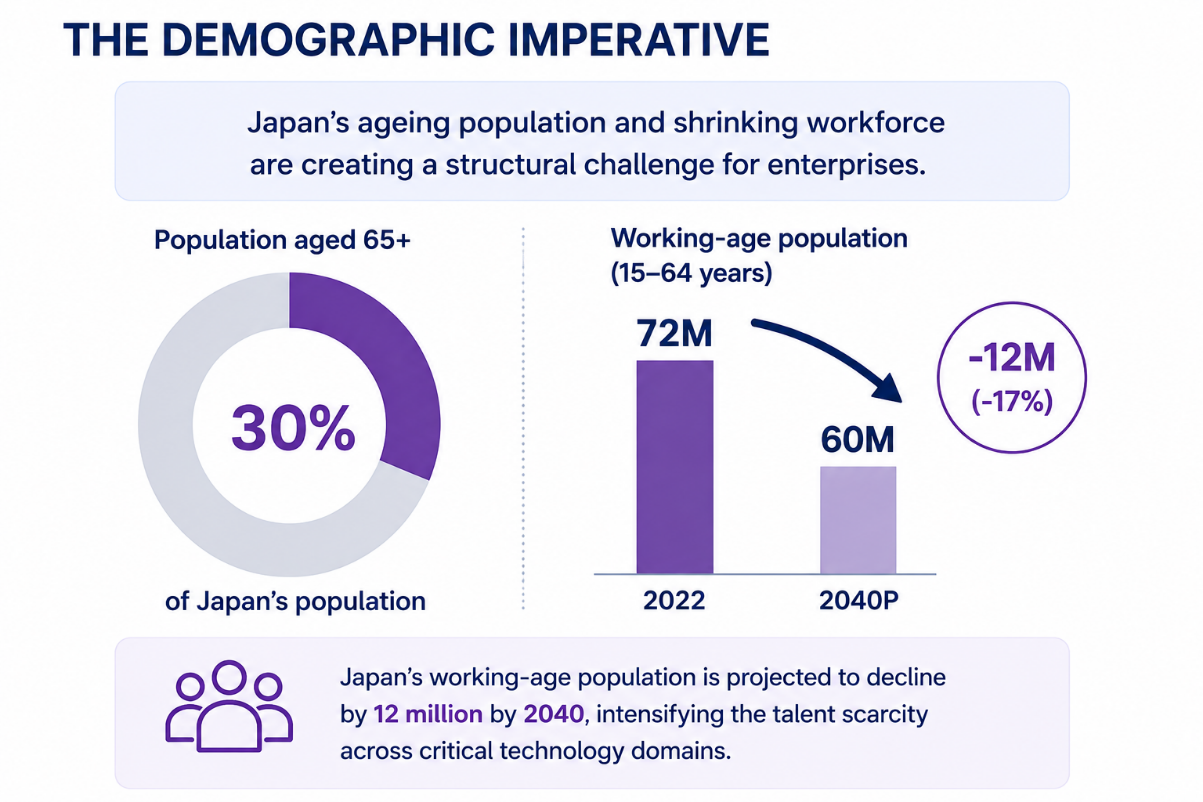
Japan’s traditional strengths in precision mechanics, mechanical engineering, and operational technology (OT) remain formidable, but maintaining leadership requires access to digital capabilities at a scale that domestic labor markets cannot provide. Industrial equipment, manufacturing plants, and automobiles now depend entirely on artificial intelligence, predictive maintenance, digital twins, and cloud connectivity. While Japan leads the world in factory robotics, physical automation cannot write advanced algorithms, optimize complex enterprise resource planning (ERP) architectures, or design next-generation semiconductor logic.
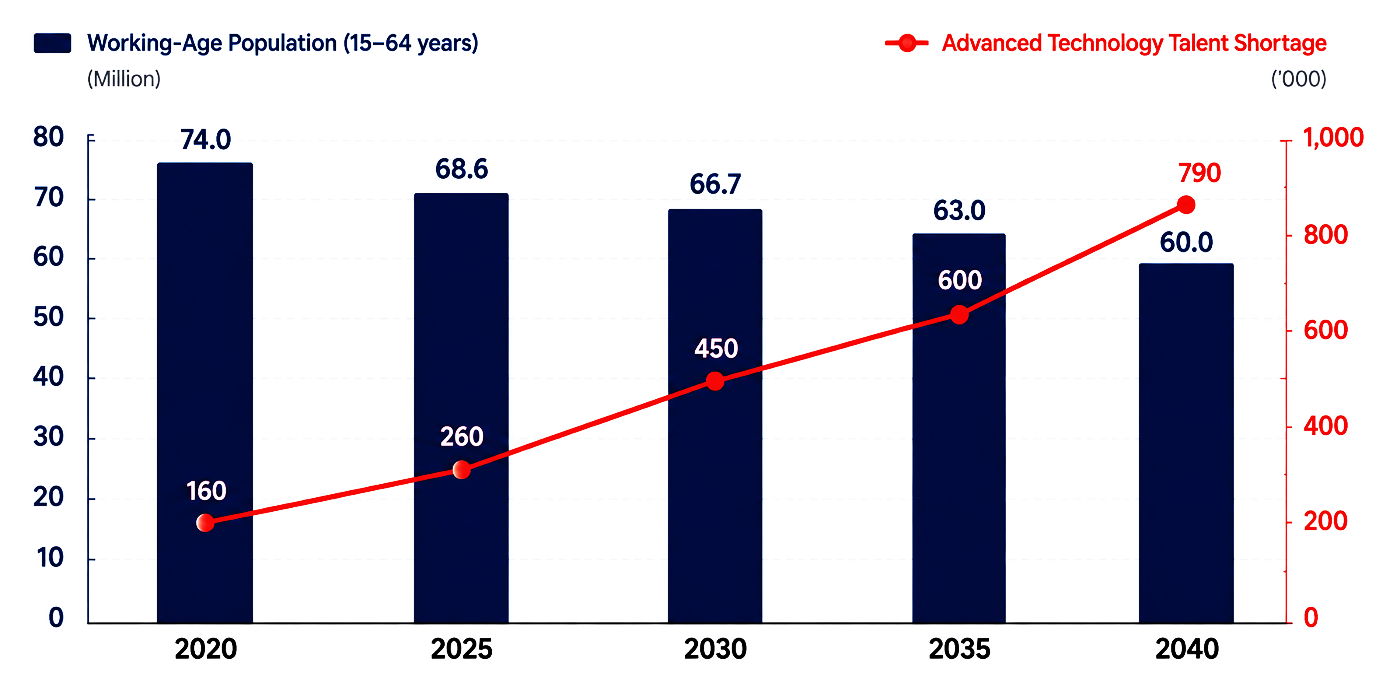
Industry projections indicate Japan will face a shortage of approximately 790,000 IT and digital professionals by 2030. Furthermore, these demographic deficits are heavily compounded by geopolitical vulnerabilities. Historically, Japan relied on near-shore Shared Service Centers (SSCs) in locations like China. However, data from major Japanese players (revenues >10B Yen) revealed that 22% plan to downsize, relocate, or withdraw business operations from China due to fears of data/IP exploitation and information security threats, forcing corporate boards to look to India for secure, far-shore capability hubs.
THE AI TALENT IMPERATIVE
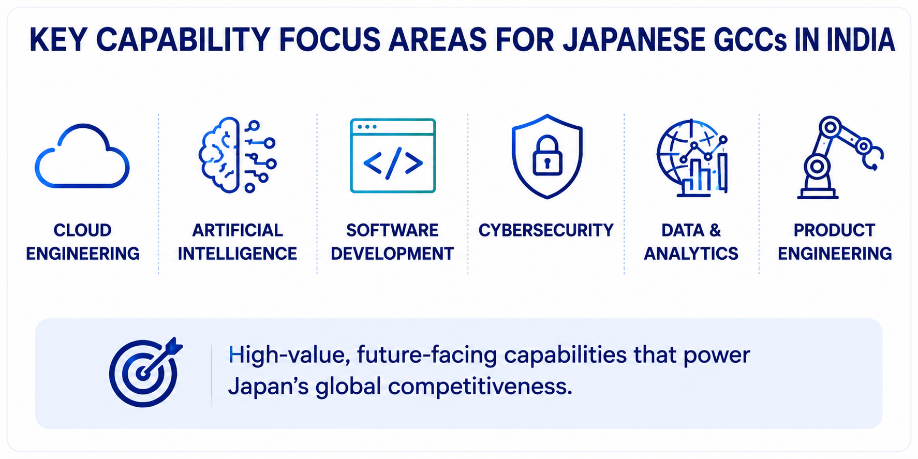
The first generation of GCC expansion was largely driven by cost efficiency and scale. The current landscape is shaped entirely by access to scarce digital talent. Artificial Intelligence is automating significant portions of repetitive and transaction-intensive work across enterprises. However, rather than reducing the overall need for headcount, the “Year of AI” is impacting over 40 million professionals in India, fundamentally enhancing digital employability and changing the specific type of talent organizations require. Demand is accelerating for AI engineers, data scientists, cloud architects, cybersecurity specialists, semiconductor design experts, and digital product managers.
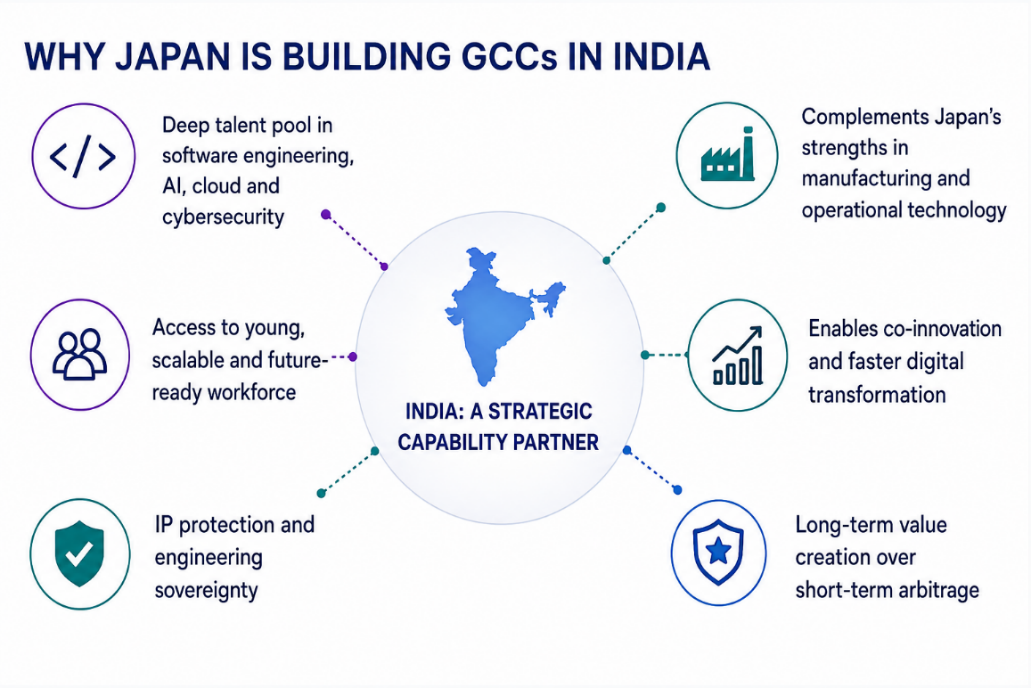
For Japan, this challenge is magnified by demographic realities. India offers far more than raw workforce scale; it provides an execution environment matured by decades of global product development. For Japanese enterprises, hubs in India are no longer about generic back-office capacity, they are strategic reservoirs of next-generation digital talent required to power intelligent manufacturing, software-defined mobility, industrial AI, and core global transformation initiatives. A key example is Takeda Pharmaceuticals, which recently launched a major greenfield site in Bengaluru focused extensively on healthcare analytics and data engineering.
FROM COST ARBITRAGE TO POPULATION ARBITRAGE
For nearly three decades, global operating models were built on cost arbitrage—relocating transactional work to regions with lower labor expenses. The current phase of globalization is shaped by a structural force: population arbitrage. Population arbitrage refers to the strategic alignment of economies facing critical demographic decline with those possessing expanding, highly skilled, and young working-age populations.
| METRIC | JAPAN’S DEMOGRAPHIC DEFICIT | INDIA’S TALENT SURPLUS |
| Median Age | 49 | 29 |
| Population > 65 | 30% | 7% |
| Workforce Trend | Declining | Growing |
| IT Talent/STEM Base | -790,000 (IT Talent Gap) | 2.5 Million/Yr (STEM Graduates) |
While Indian operations continue to provide a massive financial edge yielding 30% to 40% lower GCC operational expenses compared to keeping those capabilities within mainland Japan economics alone no longer explains the investment thesis. Indian GCCs enable Japanese enterprises to access world-class engineering talent, quicken digital adoption, and drastically cut time-to-market for innovation, all while retaining strategic control and decision-making authority.
THE FOURTH WAVE OF GCC EVOLUTION
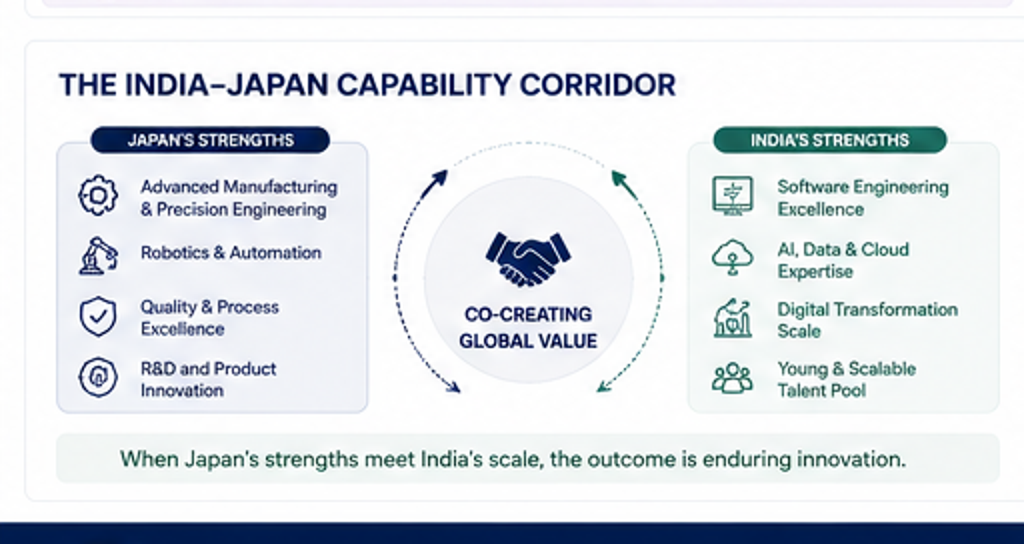
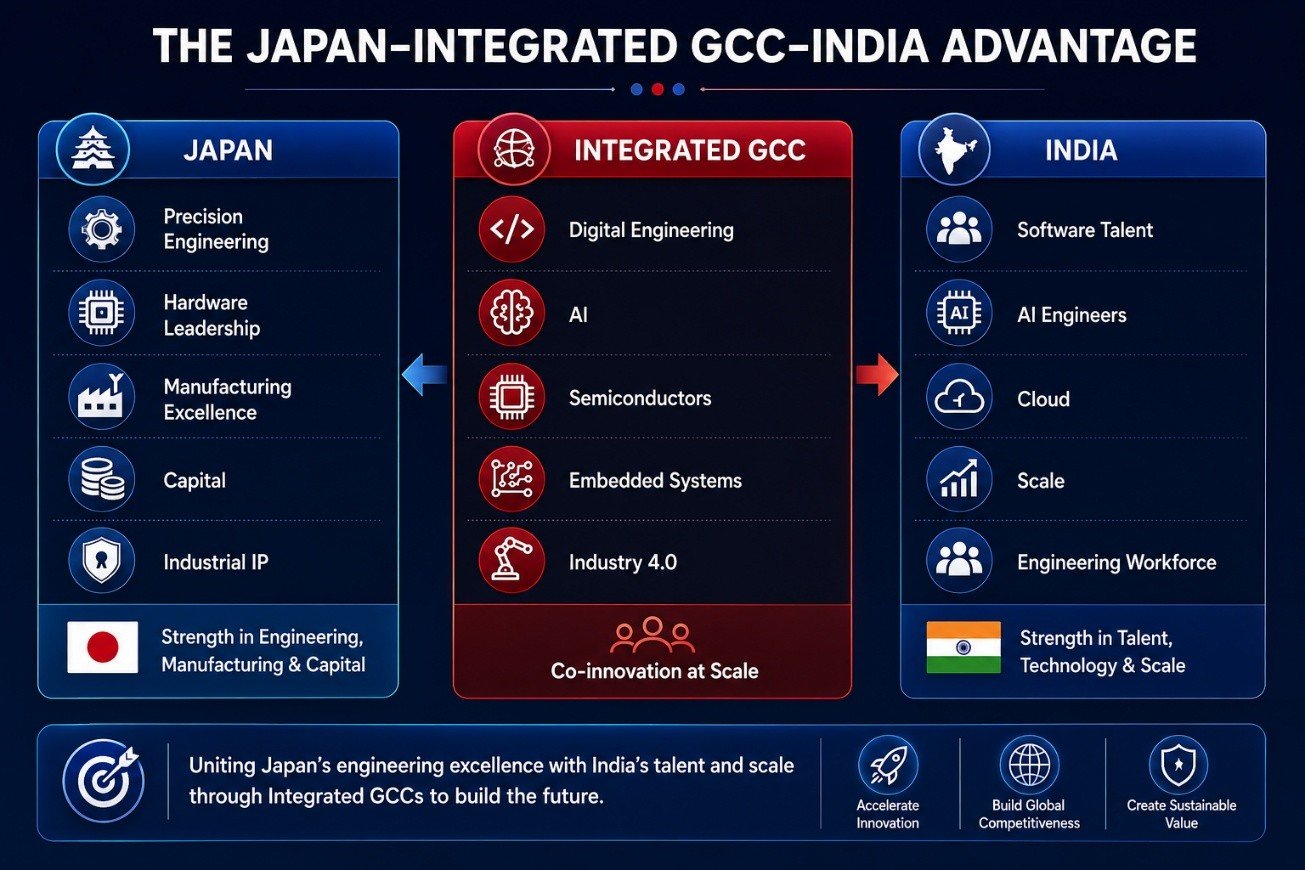
The India-Japan partnership represents demographic complementarity at a global scale. Japan contributes capital, industrial expertise, manufacturing excellence, deep R&D capabilities, and operational discipline. India contributes workforce scale, software engineering talent, digital capabilities, and demographic growth. Together, these strengths create an operating model that neither economy can achieve independently.
According to comprehensive tracking of the Indian ecosystem, the market now houses 2,100+ established GCCs. Around 50% of these hubs have direct ownership mandates and a core transformation agenda, while approximately 25% of Forbes Global 2000 maintain active GCC operations in the country. The direct Gross Value Addition (GVA) contribution from these centers operates at a 2.6x multiplier, projecting an economic footprint of $155 billion to $199 billion by FY2030.
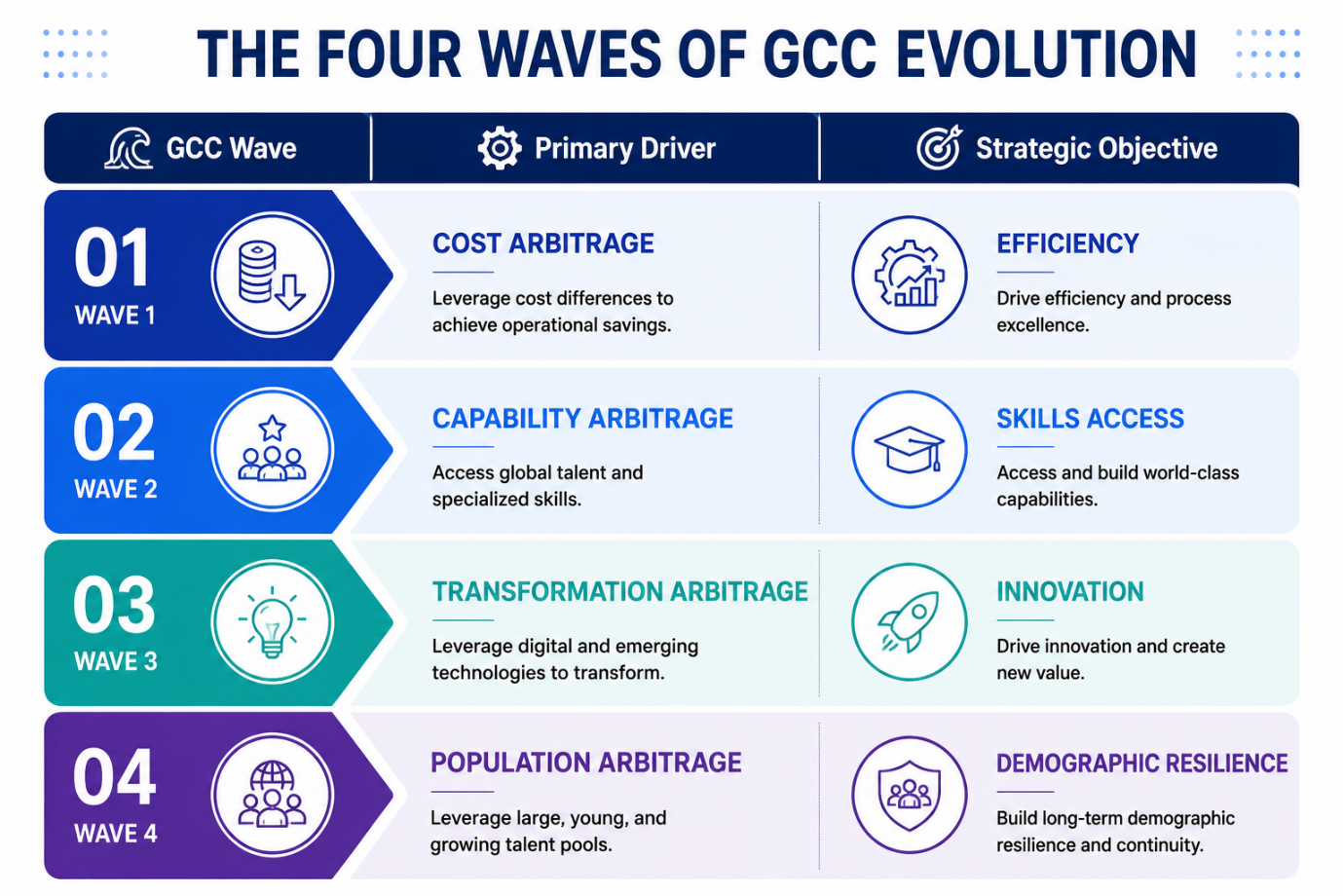
Historically, the evolution of GCCs followed three distinct phases. Japanese GCC investments represent the large-scale manifestation of a fourth wave:
The evolution of GCCs has historically followed three distinct phases.
- Wave 1 (Cost Arbitrage): Enterprises established offshore operations to reduce expenses while maintaining service continuity.
- Wave 2 (Capability Access): Emphasized access to specialized capabilities and engineering talent that domestic markets could not supply at sufficient scale.
- Wave 3 (Innovation and Transformation): Positioned GCCs as engines of innovation, digital transformation, and enterprise modernization.
SSF believes Japanese GCC investments in India represent the first large-scale manifestation of a fourth wave of GCC evolution – one driven not by cost, capability, or transformation, but by demographic resilience.
THE FOUR WAVES OF GCC EVOLUTION
| GCC Evolution Wave | Primary Driver |
|---|---|
| Wave 1 | Cost Arbitrage |
| Wave 2 | Capability Access |
| Wave 3 | Innovation and Transformation |
| Wave 4 | Demographic Resilience |
Faced with domestic constraints, Japanese enterprises are turning to India as a strategic capability partner. The sheer scale of the Indian educational ecosystem producing approximately 2.5 million STEM (Science, Technology, Engineering, and Mathematics) graduates annually offers a direct quantitative solution to Japan’s shortage. India currently houses over 2,100+ GCCs, that are generating revenues of $98-100B and employing 2.3-2.4 million specialized talent professionals.
Unlike previous generations of GCC investments, Japanese enterprises are increasingly building capability centres to preserve institutional continuity, maintain innovation velocity, and protect long-term competitiveness despite shrinking domestic labour pools. Japanese firms are actively playing catch-up in this space; according to Deloitte research on Japanese shared services adoption. as of 2019, US companies maintained a 33:1 ratio of global SSCs compared to Japanese companies (which only had 89 globally).
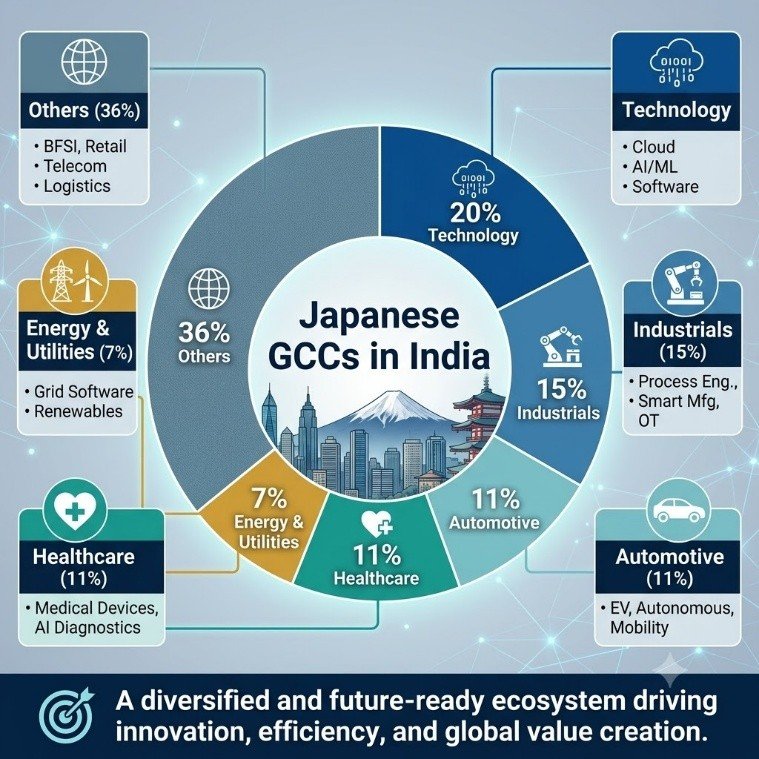
This evolution is particularly visible across industries where Japan remains globally dominant but faces increasing digital talent shortages domestically. Automotive software, industrial automation, robotics, semiconductor engineering, mobility technologies, and advanced manufacturing are increasingly dependent on software, AI, cloud computing, and data engineering capabilities.
For many Japanese enterprises, India is emerging as the preferred location to build these future-facing capabilities at scale while preserving proximity to global business priorities.
The first wave of globalization was powered by cost arbitrage. The second wave was driven by capability arbitrage. The next decade will increasingly be defined by population arbitrage – where countries with aging workforces’ partner with countries possessing deep demographic reserves and digital talent capacity.
The Japan-India corridor is emerging as one of the strongest examples of this transition.
Demographic Risk Index
| Country | Median Age | Population >65 | Workforce Trend |
| Japan | 49 | 30% | Declining |
| South Korea | 45 | 20% | Declining |
| Germany | 46 | 23% | Declining |
| Italy | 48 | 24% | Declining |
| India | 29 | 7% | Growing |
However, this shift follows a different logic than traditional business process outsourcing. While Indian operations continue to provide meaningful cost advantages relative to equivalent Japanese teams, economics alone no longer explains the investment thesis. Japanese firms are establishing GCCs to secure sovereign ownership over mission-critical research and to accelerate their speed-to-market.
Specialized Japanese GCC Blueprints in India
To execute this, Japanese firms generally follow a multi-year, step-by-step strategy: migrating simple transactional processes in Step 1 (e.g., payroll, payables), knowledge-intensive processes in Step 2 (e.g., procurement, financial reporting), and finally strategic core engineering and R&D in Step 3. This diverse corporate footprint includes:
- Industrial Engineering & Heavy Industry:
- Toyo Engineering & MODEC Joint GCC: A large-scale capability center focused on heavy industrial engineering, Front-End Engineering Design (FEED), global procurement, and advanced Floating Production Storage and Offloading (FPSO) naval project support.
- artience Group (Toyo Ink): Established its first global research facility outside Japan directly at the Indian Institute of Science (IISc) campus to pioneer molecular-level advanced sustainable materials.
- BFSI & Energy Infrastructure:
- MUFG Bank (Mitsubishi UFJ Financial Group): Operates a prominent global capability center providing core engineering, technology operations, and complex data analytics supporting global financial workflows.
- Hitachi Energy: Houses a critical global hub developing sustainable energy grid software, automation systems, and renewable engineering solutions.
- Nomura & SMBC / Mizuho: Modernizing legacy banking infrastructure, managing complex financial analytics, and strengthening global cybersecurity frameworks.
- Technology, Software & Digital Transformation:
- Rakuten India: One of the largest Japanese setups in the country, driving global e-commerce platforms, technology operations, and deep-tech AI research.
- Raksul India: A newly launched digital platform nano-GCC focusing on a highly selective, AI-integrated engineering team handling global fintech and marketplace technologies.
- Fujitsu Research: Operates a major global innovation hub completely dedicated to AI governance, high-performance computing, and quantum computing solutions.
- Sony India Software Centre / NTT Data / NEC / Ricoh / Pioneer: Engineering core software architectures, embedded systems, telecom frameworks, and digital entertainment ecosystems.
- Automotive Engineering, Mobility & Semiconductors:
- Toyota Connected India: The technology wing of Toyota, focusing on cloud-connected vehicle systems, advanced telematics, and Mobility-as-a-Service (MaaS) platforms.
- Pioneer India R&D: Pioneer’s first R&D hub outside Japan, engineering hardware and software for Advanced Driver Assistance Systems (ADAS), vision sensing, and digital smart cockpits.
- Musashi Auto / MTEC: A newly built Technology Excellence Centre (MTEC) driving next-generation energy storage systems and EV prototyping.
- Socionext & Renesas Electronics: Advanced logic design and semiconductor R&D hubs focused entirely on automotive and industrial chip design.
WHY JAPANESE GCCS ARE STRUCTURALLY DIFFERENT
Japanese enterprises approach global capability models with a distinct philosophy compared to their Western counterparts. Many American and European organizations evolved through hybrid delivery structures involving third-party vendors and fragmented outsourcing partnerships. Conversely, Japanese enterprises demonstrate significantly higher sensitivity toward intellectual property ownership, engineering confidentiality, and strict process governance. As a result, Japanese expansion is characterized by a definitive preference for wholly owned captive structures or dedicated joint ventures.
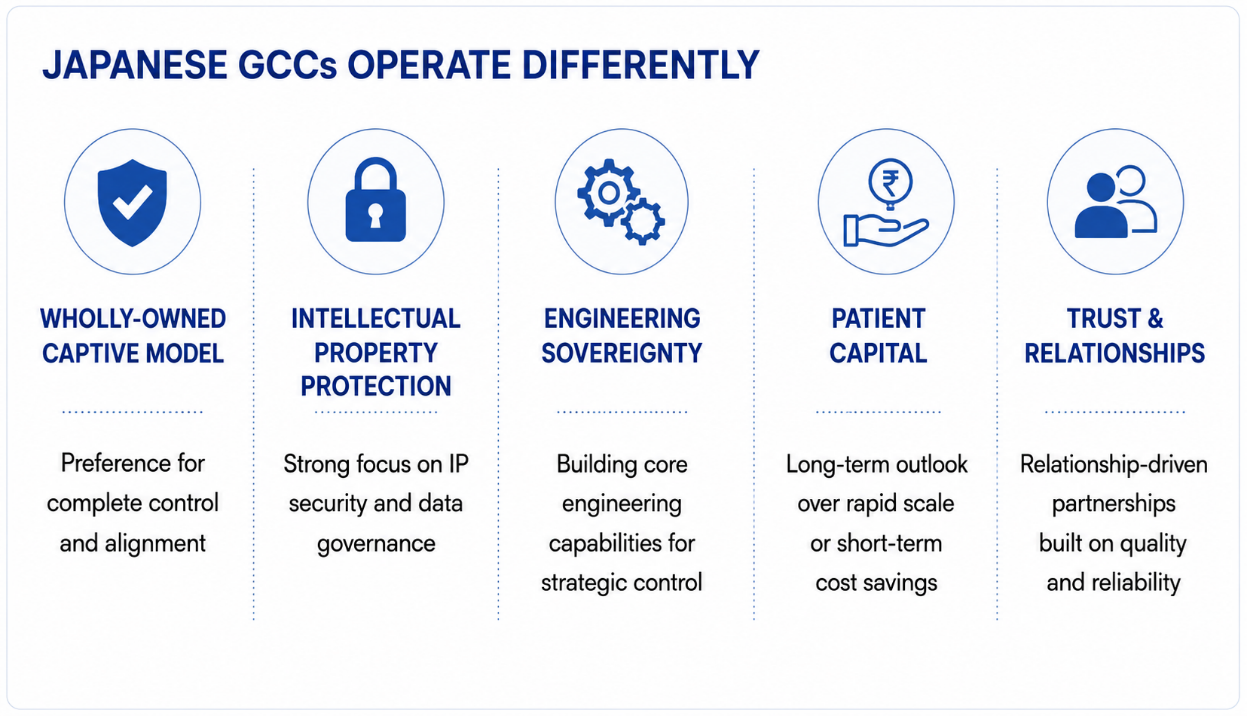
Historically, Japanese GCCs maintained a reputation for conservative compensation models and incredibly high expat-to-local leadership ratios. However, the immediate urgency of the “silver tsunami” has triggered a major paradigm shift. To secure elite digital talent, Japanese GCCs are modernizing their HR operations offering highly competitive market compensation, advanced benefits, and local leadership autonomy to compete head-to-head with top-tier US and European multinationals.
These centers are designed as long-term strategic assets rather than transactional back offices. For example, Hitachi launched a “smart transformation project” blending business process optimization with captive engineering across India, successfully saving approximately 195 billion yen in indirect corporate costs while retaining absolute control over its strategic R&D roadmap.
The distinction can be summarized as follows:
| Western GCC Model | Japanese GCC Model |
|---|---|
| Cost optimization | Capability preservation |
| Rapid scale | Deliberate scale |
| Vendor-led ecosystems | Captive-led ecosystems |
| Quarterly ROI focus | Multi-decade investment horizon |
| Software-first orientation | Hardware-software convergence |
- The objective is not merely operational efficiency.
- It is long-term enterprise survivability.