




 Ask an Expert

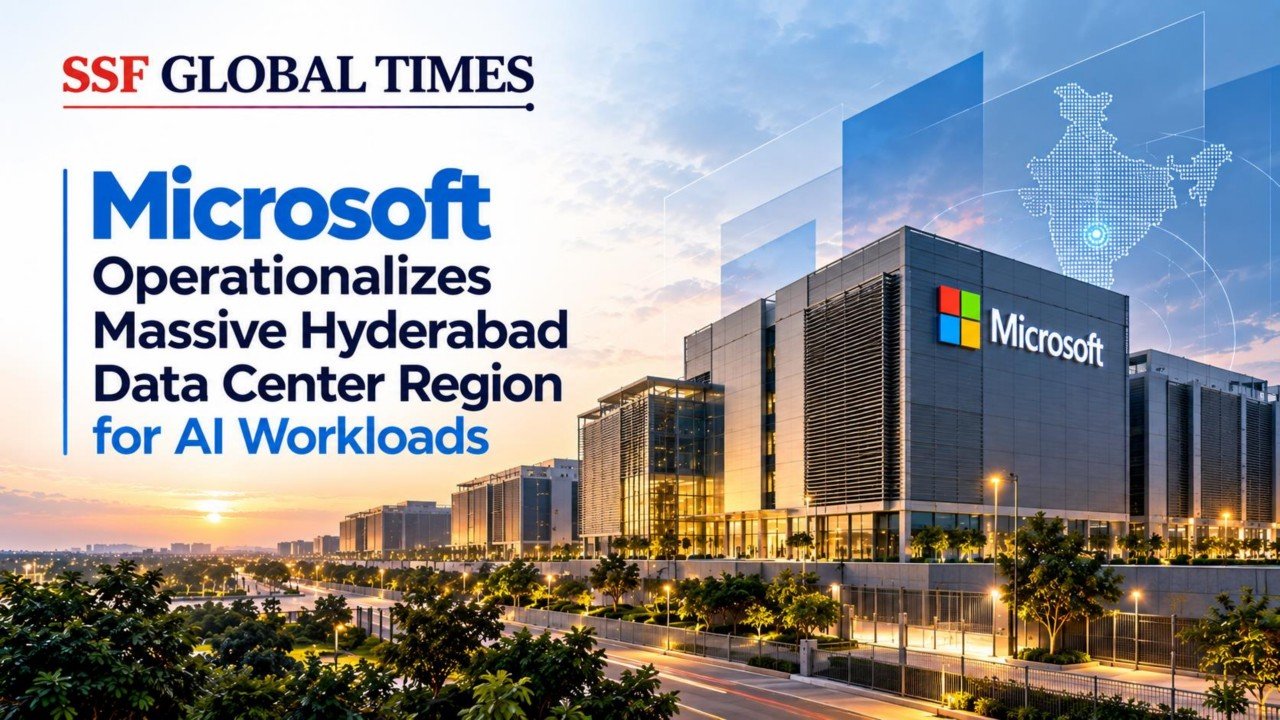
HYDERABAD | 23 September 2026: Accelerating the structural transition of India’s digital economy, hyperscale computing firm Microsoft has formally commissioned its India South Central cloud region in Hyderabad. This massive infrastructure deployment serves as the physical realization of the company’s previously announced $20.5 billion capital commitment to India’s cloud and artificial intelligence ecosystem.
Designated as a strategic capability hub not just for domestic enterprise but for the broader Asian market and the Global South, the Hyderabad facility is Microsoft’s fourth operational data center region in the country, joining existing nodes in Pune, Chennai, and Mumbai. Crucially, this expansion shifts the capability focus from general-purpose cloud storage directly toward high-density, sovereign-ready AI computation.
KEY HIGHLIGHTS
- Resilient Hyperscale Architecture: The facility operates on a three-zone architecture. These independent “Availability Zones” feature isolated power, cooling, and networking grids. Engineered for transaction-heavy financial and digital commerce platforms, the proximity between these zones guarantees a network latency of less than two milliseconds.
- Immediate Enterprise Validation: The facility has bypassed the traditional ramp-up period. Heavyweight domestic conglomerates and regulated entities—including Adani Group, HDFC Bank, Bajaj Finserv, and PB Pay have already migrated critical workloads onto the new infrastructure.
- The Subsea Cable Integration: Microsoft is linking this terrestrial data center to a broader geopolitical communications strategy. The company is a consortium partner in the upcoming 3,600-km India-Southeast Asia (I-2SEA) submarine cable system, connecting India to Malaysia and Singapore, with landings targeted for 2029.
Headquartered in Redmond, Washington, Microsoft operates one of the world’s most hyperscale cloud networks. Its enterprise cloud computing platform, Azure, commands a massive share of the global B2B digital infrastructure market. By aggressively integrating OpenAI’s foundational models across its product stack, Microsoft has positioned itself as the undisputed frontrunner in the enterprise AI arms race, requiring continuous, multi-billion-dollar injections of physical data center capacity across high-growth international corridors.
CAPABILITY BLUEPRINT: INFRASTRUCTURE FOR THE AI ERA
As global enterprises pivot from piloting artificial intelligence to deploying it at scale, they require specialized, high-capacity computing environments. The Hyderabad region is mandated to execute these exact computational loads:
- Frontier AI Capabilities: All Microsoft data center regions in India are now fully AI-enabled, but the South-Central hub is specifically engineered for advanced generative workloads. It introduces access to the Microsoft Foundry and deploys specialized AI-capable hardware designed to train and execute large language models on a scale.
- Sovereign Data Governance: For regulated sectors like banking and healthcare, data residency is non-negotiable. The new region provides Azure confidential computing and Customer Lockbox capabilities, strictly aligning with the Digital Personal Data Protection (DPDP) Act, Reserve Bank of India (RBI) mandates, and CERT-In guidelines to ensure sensitive workloads never leave Indian jurisdiction.
- Zero-Water Cooling: Acknowledging the extreme resource intensity of AI computation, Microsoft has deployed a highly sustainable cooling architecture. The facility utilizes high-efficiency air-cooled chillers, operating on effectively zero water. This is paired with 5 million liters of localized groundwater recharge capacity and a broader national commitment of 1 GW of contracted renewable energy.
Compute alone does not make a nation AI-ready; capability does—the ability to take AI from pilot to production on platforms that are sovereign-ready, secure and sustainable