




 Ask an Expert

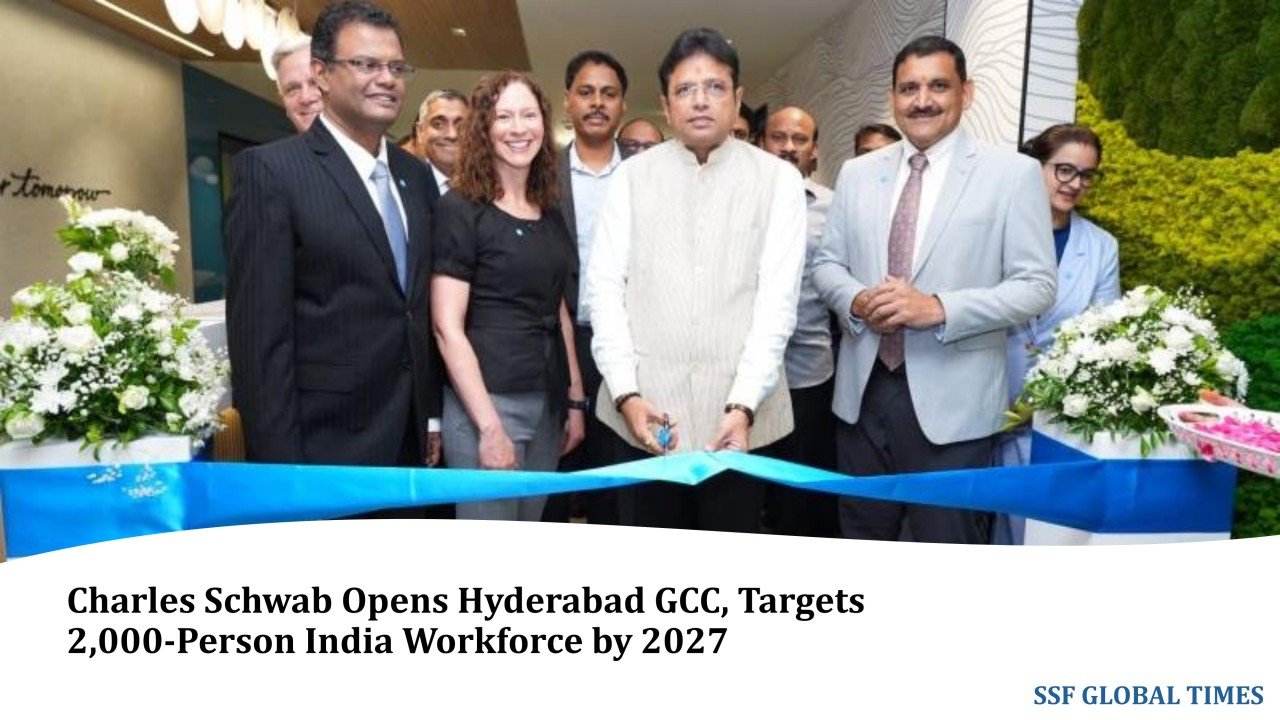
HYDERABAD | 18 August 2026: US financial services firm Charles Schwab has inaugurated its first India technology capability centre in Hyderabad, with plans to build a workforce of approximately 2,000 professionals by the end of 2027. The expansion marks a significant India entry for the brokerage and financial services major.
The Hyderabad operation will support Schwab’s global business through technology development, engineering and operational capabilities, while the company also plans to bring some technology work currently handled by third-party contractors in India into its internal organisation. Reuters reported that Schwab is targeting an initial workforce of around 500 employees within the first year, followed by a larger expansion through 2027. The company has established operations from a facility spanning approximately 345,000 sq ft, providing capacity for its planned workforce expansion.
KEY HIGHLIGHTS
- 2,000-person target: Schwab plans to scale its India workforce to around 2,000 employees by the end of 2027.
- Phased expansion: The company is targeting an initial workforce of approximately 500 employees during the first year of operations.
- Technology-led mandate: The Hyderabad centre will support technology development, engineering and operational capabilities for Schwab’s US business.
- Internalisation of capabilities: Schwab plans to bring some technology work currently handled by contractors in India into its own capability organisation.
- Large-scale infrastructure: The company has established operations from approximately 345,000 sq ft of office space in Hyderabad.
Headquartered in Westlake, Texas, Charles Schwab operates as an investment services and brokerage firm. As of its latest available Q2 2026 results, Schwab reported $13.08 trillion in client assets, 39.8 million active brokerage accounts and 48 million total client accounts globally.
As the global wealth management sector transitions from localized advisory to highly complex, borderless digital trading ecosystems, sustaining frictionless operations demands hyperscalable infrastructure. By establishing this sovereign engineering capability in Hyderabad, Charles Schwab guarantees direct control over its digital evolution, ensuring robust cybersecurity frameworks and real-time algorithmic reliability across its vast US financial networks.
A TECHNOLOGY-FIRST INDIA CAPABILITY STRATEGY
Schwab’s early hiring activity in Hyderabad indicates a broad technology and engineering talent strategy. Current roles span software engineering, data engineering, AI engineering, cybersecurity, security analytics, testing, business systems and technology operations.
The centre is therefore emerging as more than a conventional support operation. Its talent mix suggests a focus on building internal engineering and technology capabilities that can support Schwab’s broader growth, scale and efficiency objectives.
Schwab itself describes Hyderabad as central to its growth, bringing together talent and technology to drive innovation, scale and efficiency while supporting solutions used by millions of clients of its US parent organisation.
While Mumbai is India’s trading and brokerage capital, Hyderabad is increasingly building the technology that powers trading and brokerage for the world. Our ambition is to build Hyderabad as a Global Capital Markets and WealthTech Hub, where global financial institutions, technology companies, fintechs, academia and subject matter experts come together to build the next generation of global finance.
The operational mechanics of this expansion reveal a highly targeted capability acquisition strategy, centralized exclusively around advanced technology and core business outcomes:
- Cybersecurity & Risk Architecture: Safeguarding client data is paramount. The GCC is mandated to build and manage sophisticated cybersecurity operations and financial fraud monitoring systems to protect the enterprise’s massive asset base.
- Cloud & Trading Infrastructure: Localized engineering squads will maintain and modernize the cloud-native architecture that keep Schwab’s digital brokerage platforms functioning seamlessly around the clock.
- AI-Driven Efficiency: The hub will play a pivotal role in deploying artificial intelligence and machine learning to elevate engineering productivity, ultimately driving scale across the broader corporate landscape.
Over time, the centre will play an increasingly important role in advancing technology modernisation, supporting innovation and contributing to capabilities across areas such as cloud, data and AI.
STRATEGIC SIGNALS FOR THE GCC ECOSYSTEM
- Internal Capability Ownership Is Becoming More Important: One of the most significant aspects of Schwab’s India strategy is its intention to bring selected technology work currently managed through contractors into its own organisation. This reflects a broader GCC trend: enterprises are increasingly looking to build greater internal ownership of strategic technology capabilities. The objective is not simply workforce expansion. It is also about building deeper institutional capability, greater integration with enterprise technology teams and stronger control over critical digital operations.
- New GCCs Are Entering India With Technology at the Core: Schwab’s Hyderabad centre is being built around technology and engineering from the outset. This reinforces the continuing shift in the GCC model, where new centres are increasingly established to support digital platforms, software engineering, data, AI and cybersecurity, rather than following a linear progression from transactional support to higher-value work.
- Hyderabad Continues to Strengthen Its BFSI Capability Ecosystem: Schwab’s entry adds another major financial services enterprise to Hyderabad’s growing GCC landscape. Reuters reported that the city already hosts more than 475 GCCs and is targeting further expansion of its capability ecosystem. For global financial institutions, Hyderabad offers a combination of technology talent, engineering capabilities and an increasingly mature enterprise ecosystem. Schwab’s decision reinforces the city’s continuing relevance for organisations looking to establish or expand technology-intensive financial services operations.
Industry Insights
- The Unrivaled Capital Markets Anchor: Hyderabad is rapidly transcending traditional BFSI support. The city now hosts nine of the world’s top 10 brokerage and trading institutions, managing the technological infrastructure for entities representing roughly $40 trillion in assets under management.
- The GCC Ascension: Schwab’s move reflects a broader structural reality: global financial institutions are aggressively centralizing mission-critical tech in India. With over 475 GCCs already operating in Hyderabad, the city’s deep-tech gravity offers an unmatched density of talent in cloud computing, quantitative analytics, and cybersecurity.
- Decision Rights Signal GCC Maturity: By completely bypassing Level 1 support functions and prioritizing pure engineering excellence, Charles Schwab proves that modern capability centers are now strictly evaluated on disruptive IP creation and complex problem-solving.
- Domain + Tech is the Differentiator: The emerging opportunity for professional services capability centers lies exclusively at the intersection of deep domain knowledge (audit, tax, advisory) and advanced technology engineering (cloud platforms and AI-driven analytics).