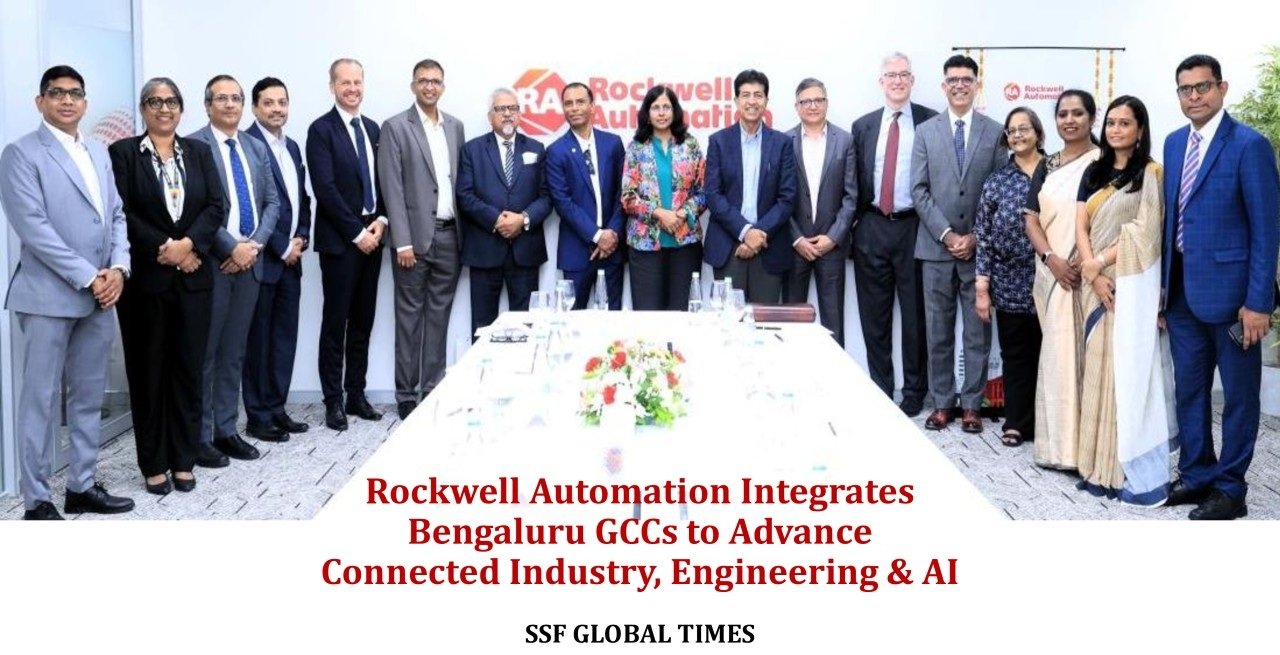




BENGALURU | 6 August 2026: US-headquartered industrial automation and digital transformation company Rockwell Automation has inaugurated a new integrated capability campus in Electronics City, Bengaluru, bringing together its Global Capability Centre (GCC) capabilities across Digital and Manufacturing Operations Management (MOM).

Moving deliberately towards greater integration of its global engineering footprint, the new campus brings together previously distinct Digital and MOM capabilities in a common environment. Inaugurated in the presence of Chairman & CEO Blake Moret, the strategic deployment underlines Rockwell Automation’s long-term commitment to leveraging India’s engineering and technology talent to foster global collaboration, product innovation and advanced industrial capabilities.

KEY HIGHLIGHTS

  • The Convergence Mandate: By bringing its Digital and MOM capabilities together under a single physical environment in Electronics City, Rockwell Automation is strengthening collaboration between software, digital engineering and manufacturing operations teams.
  • The Invest India Synergy: The inauguration was attended by Vinod Subramanian, Vice President, Invest India, highlighting the continuing institutional engagement around Rockwell Automation’s expansion in India. Invest India has also supported the company’s broader India investments.
  • The Dual-Engine Growth Model: The Bengaluru capability expansion complements Rockwell Automation’s physical manufacturing footprint in India, including its greenfield manufacturing facility in Chennai, creating a broader combination of engineering, digital and manufacturing capabilities within the country.

Rockwell Automation, headquartered in Milwaukee, Wisconsin, is a global provider of industrial automation and digital transformation technologies. The company employed approximately 26,000 people across more than 100 countries at fiscal year-end 2025. The company’s focus is on bringing the Connected Enterprise to life by connecting industrial automation, software, data and digital technologies across manufacturing environments.

India is becoming an important component of this global footprint. Rockwell Automation has been expanding both its technology capabilities and manufacturing presence in the country, including its greenfield manufacturing investment in Chennai.

THE DEEP-TECH MANDATE: OT/IT CONVERGENCE & CONNECTED INDUSTRIAL OPERATIONS

To understand the strategic significance of the Electronics City campus, it must be viewed through the convergence of Operational Technology (OT) and Information Technology (IT).

  • The Asian Centrepiece: Underscoring India’s strategic importance, Chairman and CEO Blake Moret has highlighted the country’s role across sales and marketing, product development, application engineering, manufacturing and software development, while also emphasising the opportunity to use AI to simplify how people interact with industrial technology.
  • AI-Driven Industrial Operations: Rockwell is increasingly embedding artificial intelligence and advanced analytics across industrial engineering and operations. Its portfolio includes technologies such as FactoryTalk Design Studio Copilot, FactoryTalk Analytics LogixAI, VisionAI and Plex.
  • Fueling India’s Industrial Capability: The combination of digital engineering in Bengaluru and manufacturing capability in Chennai gives Rockwell a broader India value chain spanning technology development, industrial engineering and physical production.
“

I think India is really at the centrepiece of our plans in Asia…We cover sales and marketing, product development, application engineering, manufacturing and software development, and expect that growth to continue…The goal is to leverage AI simplify the human interaction with technology, whether it is to design systems, commission them, to operate them, or to maintain them.

– Blake Moret, CEO & Chairman, RA

Industry Insights

  1. OT + IT Is Becoming a GCC Capability: Bringing Digital and MOM capabilities together reflects the growing importance of combining software, data, industrial engineering and manufacturing expertise.
  2. Industrial GCCs Are Moving Closer to the Product: The GCC proposition is shifting from enterprise technology support towards product engineering, industrial software, automation and manufacturing intelligence.
  3. AI Is Entering the Engineering Stack: Rockwell’s growing AI portfolio demonstrates that AI is moving beyond analytics into system design, plant execution, quality, maintenance and operational decision-making.
  4. Physical and Digital Capabilities Are Converging: Rockwell’s Bengaluru and Chennai investments illustrate how India can increasingly participate in both the engineering and manufacturing dimensions of the industrial value chain.

FACTORYTALK RESILIENTEDGE

Rockwell Automation’s FactoryTalk ResilientEdge, introduced in June 2026, provides a useful illustration of the technology convergence underlying the Bengaluru campus. The platform creates a unified execution architecture spanning machines, people and production systems, combining low-latency edge execution with cloud capabilities for analytics, AI training and enterprise orchestration. It is also integrated with Rockwell’s Plex Manufacturing Execution System (MES). Its significance lies in bringing traditionally separate layers of industrial technology into a more connected operating environment.

GCC implication: Industrial GCCs can create differentiated value by connecting engineering, software, AI and manufacturing operations rather than developing these capabilities in isolation.

FUTURE OUTLOOK

For years, the technology contribution of an industrial GCC could be measured largely through software development, enterprise applications and engineering support. That boundary is now becoming increasingly difficult to maintain. As factories become software-defined and AI-enabled, the people designing digital systems, the engineers understanding industrial processes and the teams managing manufacturing operations increasingly need to work within the same capability ecosystem.

This is where Rockwell Automation’s Bengaluru campus becomes strategically significant. Its importance is not simply that Rockwell has brought two GCCs under one roof. It is that the organisation is creating greater proximity between digital engineering and manufacturing intelligence, the very capabilities required to build the next generation of connected industrial systems.

For the GCC ecosystem, three implications stand out:

  • First, industrial GCCs will increasingly need hybrid talent. Software engineers will need greater understanding of industrial environments, while manufacturing and automation specialists will increasingly need fluency in data, cloud and AI.
  • Second, the highest-value GCCs will increasingly influence the industrial product itself. The opportunity is moving beyond supporting enterprise systems towards shaping automation platforms, industrial software, connected products and intelligent manufacturing solutions.
  • Third, India’s competitive advantage will increasingly depend on ecosystem depth. The combination of Bengaluru’s engineering and digital talent with India’s expanding manufacturing base creates the potential to connect product engineering, industrial technology and physical manufacturing within one national capability ecosystem.

The larger takeaway is therefore not about the size of Rockwell’s campus. It is about the changing architecture of industrial value creation. The future industrial GCC will not sit beside the factory. It will increasingly help design the intelligence that runs it.

For India, that represents a significant next step, from being a destination for engineering delivery to becoming a global development ground for connected, AI-enabled industrial systems.

Curated by SSF Global

Tracking the shifts shaping GCCs, enterprise ecosystems, and the future of global business.

Share on      

SSF Global is a Global Community for Enterprise Function Leaders and serves as a research & advisory platform focused on Global Business Services (GBS), Global Capability Centres (GCCs), and the evolution of enterprise innovation in India and beyond. We track, publish, and partner in narratives that shape how capability centres transform into hubs of trust, intelligence, and sustainable growth. We also evaluate, assess and benchmark the GCCs for their performance, maturity and other parameters using our proprietary tools built from the knowledge gained from direct interaction with our members (GCCs & GBS).