




 Ask an Expert

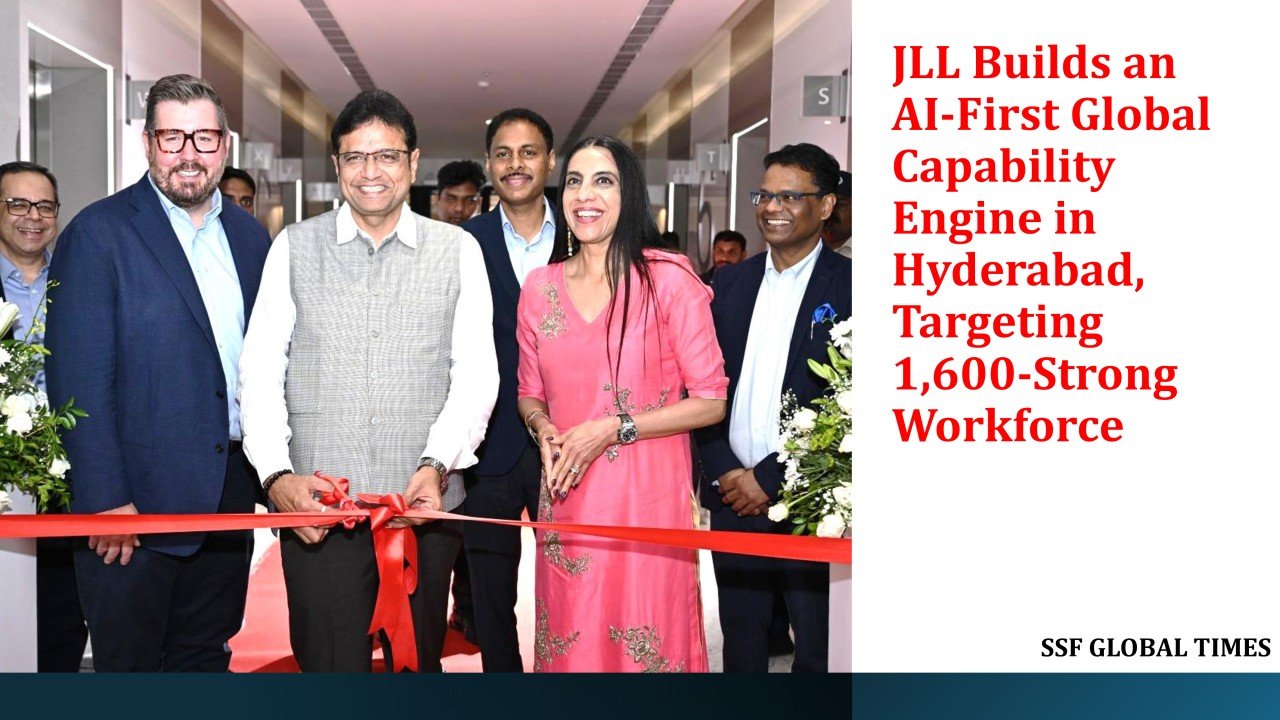
HYDERABAD | 6 August 2026: Global commercial real estate and investment management company JLL has inaugurated a 1,20,000 sq ft Global Capability Centre (GCC) in Hyderabad’s Financial District, strengthening its global business services footprint and positioning the centre as an AI-first operating hub for high-value enterprise capabilities. Operating under JLL Business Services (JBS), the new facility at Prestige Sky Tech represents a significant evolution in JLL’s global delivery model. More than 150 employees have already been onboarded, with the company planning to scale the Hyderabad operation to approximately 1,600 employees over the coming years.
The centre will bring together a broad portfolio of capabilities spanning finance, human resources, property management, global controllership, project management, architectural and design support, investment modelling, cost management, analytics and sales enablement. More significantly, JLL is designing the centre around the convergence of human expertise, standardized processes, data and AI-enabled workflows, reiterating the evolution of GCCs from traditional shared-service delivery towards enterprise-level intelligence and decision support.
KEY HIGHLIGHTS
- 1.2 Lakh Sq Ft Strategic Hub: JLL Business Services has inaugurated a 120,000 sq ft GCC in Hyderabad’s Financial District, strengthening its Indian delivery network alongside its established Gurugram centre.
- 1,600-Strong Talent Ambition: More than 150 employees have already joined the Hyderabad centre, with JLL targeting a workforce of approximately 1,600 employees over the coming years.
- Beyond Traditional Shared Services: The centre will support finance, HR, property management, global controllership, project management, architectural and design support, cost management, investment modelling, analytics and sales enablement.
- AI-First Operating Model: JLL is building the Hyderabad operation around the integration of human expertise, standardized processes and AI-enabled workflows to improve productivity and increase the value of services delivered to its global operations.
- Part of a Global Delivery Network: JBS operates six delivery centres across Dalian, Manila, Warsaw, Costa Rica, Gurugram and Hyderabad, with approximately 7,000 professionals globally. Gurugram remains JBS’s largest global capability centre.
FROM SHARED SERVICES TO GLOBAL BUSINESS OPERATIONS
Rather than concentrating primarily on transactional or standardized activities, JLL is bringing together domain expertise, analytics, technology and global process ownership within a single operating environment. The Hyderabad centre’s portfolio includes functions that directly support the economics and execution of commercial real estate, from investment modelling and cost management to property management, project management and advanced analytics.
This creates an interesting value chain:
Transaction → Process → Insight → Decision Support → Enterprise Value
The significance lies in the movement beyond scale-based delivery towards capability-based value creation. The Hyderabad centre is therefore better understood not simply as another shared-services location, but as a global business operations and intelligence platform supporting JLL’s increasingly data- and technology-enabled business model.
THE AI-FIRST OPERATING MODEL
JLL’s centre is being established at a time when artificial intelligence is moving from experimentation into the operating fabric of global enterprises. The company’s stated approach is to combine exceptional human talent, standardized processes and AI-enabled workflows. The objective is not simply to automate existing work, but to enable employees to use AI to improve productivity and support increasingly sophisticated, higher-value services.
This distinction is important.
An AI-first GCC does not necessarily mean an AI-only workforce, or simply fewer people performing the same processes faster. Instead, AI changes the composition and economics of work.
The operating model increasingly shifts towards:
- AI-assisted execution rather than purely manual processing;
- analytics and exception management rather than routine transaction handling;
- deeper domain specialization;
- technology-business integration;
- AI-enabled process ownership; and
- higher-value advisory and decision-support capabilities.
JLL’s decision to scale the Hyderabad workforce even while embedding AI into its operating model illustrates this emerging dynamic: AI adoption and GCC workforce growth can coexist when the nature and value of work are simultaneously moving upward.
JLL FALCON: THE BROADER ENTERPRISE AI CONTEXT
JLL’s GCC also comes against the backdrop of the company’s broader investment in artificial intelligence. JLL Falcon is the company’s purpose-built AI platform for commercial real estate, bringing together JLL’s proprietary data, advanced analytics, AI models and semantic processing capabilities. The platform is designed to support applications across the commercial real estate lifecycle, including portfolio optimization, space management, cost management, sustainability, compliance and market intelligence.
Falcon also provides the technology foundation for the next generation of JLL GPT, further illustrating how JLL is embedding AI into its broader enterprise and client-service ecosystem.
The Hyderabad GCC should therefore be viewed within this wider technology transformation—not as a centre that has been publicly identified as the direct execution engine for JLL Falcon, but as a strategically important AI-enabled delivery and capability hub within an enterprise increasingly built around data, technology and domain intelligence.
This distinction is important: the strategic story is the convergence of JLL’s global business-services model and its broader AI agenda, rather than a direct operational attribution between the Hyderabad centre and Falcon.
HYDERABAD’S GCC MOMENTUM
JLL’s decision to expand in Hyderabad is also closely aligned with the city’s growing position in India’s GCC ecosystem. JLL’s own India office-market data highlights the increasingly central role played by GCCs in the country’s commercial real estate market.
During Q1 2026, GCCs accounted for approximately 42.9% of Hyderabad’s gross office leasing, while Hyderabad represented around 16.8% of India’s overall gross office leasing during the quarter. At the national level, GCCs accounted for approximately 45.5% of India’s overall office leasing in Q1 2026.
The implications extend beyond office absorption. As global enterprises establish increasingly sophisticated GCCs, the relationship between GCC growth and real estate strategy is becoming increasingly circular:
Talent attracts GCCs → GCCs create demand for Grade-A real estate → ecosystem density attracts further capability investment → deeper capability ecosystems attract higher-value functions.
For JLL, this creates an interesting strategic dimension: the company is simultaneously a participant in and an observer of the real estate ecosystem that its GCC strategy is helping shape.
At the inauguration, Telangana’s IT and Industries Minister D. Sridhar Babu highlighted the state’s recent GCC expansion, stating that Telangana had attracted nearly 150 GCCs and more than 1.5 lakh high-value technology jobs over the preceding 20 months. These figures, presented by the state government, underline the increasing emphasis on high-value technology and enterprise capability creation within Telangana.
The broader trend is consistent with Hyderabad’s growing role as a location for global capability operations, particularly in technology, analytics, engineering and specialized enterprise services.
The attraction is no longer based solely on cost or workforce availability.
Increasingly, GCC location decisions are influenced by:
Talent depth + specialized skills + technology ecosystem + infrastructure + scalability + business environment + innovation potential.
INDUSTRY PERSPECTIVE: ABOUT THE NEXT GEN GCCs
- The GCC Is Becoming an Enterprise Intelligence Layer: The most important signal from JLL’s Hyderabad expansion is the breadth of capabilities being assembled under one operating model. Finance, controllership, property management, investment modelling, analytics, technology, project management and design support represent a much broader capability portfolio than a conventional shared-services centre.
The evolution can be expressed as:GCC 1.0 — Cost + Scale + Process
↓
GCC 2.0 — Expertise + Analytics + Global Delivery
↓
GCC 3.0 — AI + Proprietary Data + Domain Intelligence
↓
GCC 4.0 — Enterprise Intelligence + Business Ownership + Innovation
JLL’s Hyderabad centre demonstrates the movement from GCC 2.0 towards GCC 3.0 and, potentially, GCC 4.0. The measure of success is therefore shifting from:
“How much work can the GCC deliver?”
to:
“How much enterprise value can the GCC create and own?”
- Domain Expertise Is Becoming as Important as Technology Capability: JLL’s case demonstrates an increasingly important principle for GCC strategy:AI capability alone is not the differentiator. Domain-led AI capability is.A real estate enterprise can generate substantially greater value when its AI and analytics capabilities are combined with deep understanding of:
- property markets;
- investment modelling;
- asset and portfolio management;
- cost structures;
- leasing;
- sustainability;
- project management; and
- client requirements.
The competitive advantage therefore emerges at the intersection of:
Domain Expertise × Data × AI × Process Ownership × Decision Intelligence
This is likely to become one of the defining characteristics of the next generation of GCCs.
- AI Is Changing the GCC Talent Equation, Not Simply Reducing Headcount: JLL’s planned expansion to approximately 1,600 employees while simultaneously positioning the Hyderabad centre as an AI-first operation offers an important counterpoint to the simplistic narrative that AI adoption automatically means workforce reduction.
The calibre of talent needed to deliver the sophisticated analytics and strategic advisory services that power our competitive advantage globally.
The more relevant question for GCC leaders is: What happens to the composition of work when AI becomes embedded into the operating model?
The likely trajectory is towards:
- fewer purely transactional roles;
- greater automation of repetitive activities;
- more analytics and exception management;
- increased demand for domain specialists;
- AI-enabled process and product ownership;
- greater technology-business integration; and
- stronger advisory and decision-support capabilities.
The GCC workforce of the future will therefore need to be AI-enabled, domain-deep and increasingly capable of working across business and technology boundaries.
- GCCs and Real Estate Are Becoming Strategically Interdependent: JLL’s own expansion provides a compelling illustration of a wider market dynamic.GCCs are no longer simply occupiers of office space. They are increasingly becoming drivers of Grade-A office demand, ecosystem formation and urban economic development. As GCCs move towards larger, specialized and innovation-oriented operations, their location decisions increasingly influence:
- office-market absorption;
- talent corridors;
- infrastructure investment;
- residential development;
- technology ecosystems; and
- the emergence of specialized business districts.
For real estate companies such as JLL, the GCC phenomenon is therefore both a business opportunity and a strategic operating-model consideration.
CASE EXAMPLE: JLL’S DOMAIN-LED GCC MODEL
JLL Hyderabad GCC
- Operating model: Domain-led Global Capability Centre
- Scale: 1,20,000 sq ft; 150+ employees already onboarded; approximately 1,600 workforce ambition
- Capability portfolio: Finance, HR, controllership, property management, project management, architectural and design support, investment modelling, cost management, analytics and sales enablement
- Technology layer: AI-enabled workflows, analytics and technology integration
- Strategic proposition: Combine global process ownership, domain expertise and technology to deliver higher-value capabilities to JLL’s worldwide operations.
The case demonstrates that the next stage of GCC evolution is not about moving individual processes to India. It is about building integrated capability platforms that can influence global business outcomes.
THE NEW GCC VALUE EQUATION
the global GCC ecosystem.
The first generation of global capability centres was primarily built around cost arbitrage and scale. The second generation expanded into process excellence, analytics and global service delivery.
The emerging generation is being built around AI, proprietary data, domain expertise and enterprise decision support. The strategic opportunity now is to move one step further, from delivering services to owning outcomes. This requires GCC leaders to rethink five dimensions of the operating model:
- Talent: Build AI-fluent talent with deep business and domain expertise.
- Technology: Embed AI into processes rather than treating it as a standalone innovation programme.
- Data: Create trusted, accessible and reusable enterprise data assets.
- Ownership: Move GCCs closer to global process, product and business ownership.
- Value Measurement: Measure impact through productivity, revenue enablement, risk reduction, innovation and business outcomes—not simply FTEs and cost savings.