




 Ask an Expert

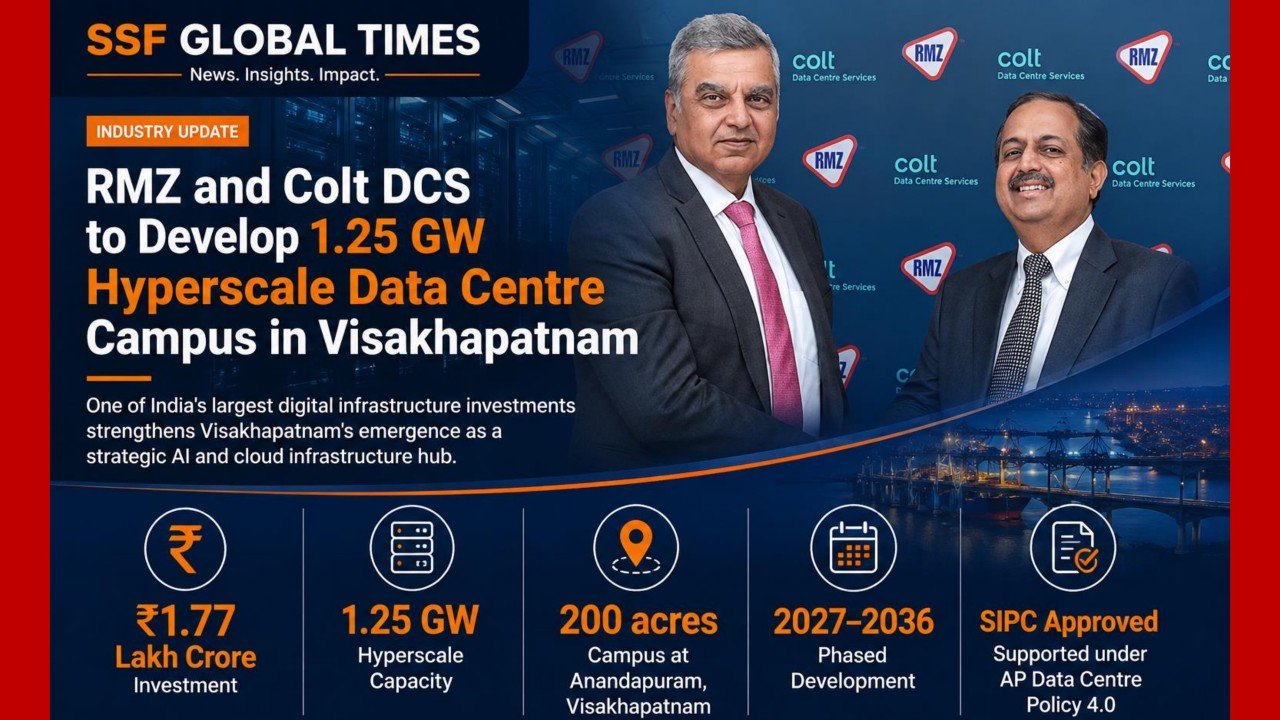
VISAKHAPATNAM | 1 August 2026: RMZ Group and Colt Data Centre Services (Colt DCS) have secured approval from Andhra Pradesh’s State Investment Promotion Committee (SIPC) to develop a 1.25 GW hyperscale data centre campus in Visakhapatnam. With a proposed investment of approximately ₹1.77 lakh crore, the project ranks among India’s largest digital infrastructure investments and further strengthens Andhra Pradesh’s ambition to emerge as a leading AI and cloud infrastructure destination.
By aggressively capitalizing a 1.25 GW hyperscale facility outside of the saturated Bengaluru and Hyderabad corridors, the RMZ-Colt alliance is telegraphing a fundamental macroeconomic reality: the sheer scale of modern artificial intelligence (AI) and enterprise cloud computing requires coastal geographies, massive land parcels, and robust power grids that legacy IT hubs struggle to accommodate.
KEY HIGHLIGHTS
- 200-Acre Campus | 1.25 GW Capacity: The proposed hyperscale campus will be anchored across 200 acres of strategically identified land at Jagnadhapuram village in the Anandapuram mandal of Visakhapatnam district. Once fully operational, the site will deliver a staggering 25 Gigawatts (GW) of IT power capacity.
- Phased Execution: The mega-campus is designed to be developed across five distinct phases between 2027 and 2036. Initial ground-breaking for Phase 1 is officially slated to begin within the next 37 months.
- Policy Support & Incentives: The development stems directly from a Memorandum of Understanding (MoU) signed at the World Economic Forum in Davos. Recognizing the project’s gravity, the Andhra Pradesh government is heavily backing the venture through aggressive incentives codified under the newly formulated AP Data Centre Policy 4.0, propelling the state closer to its ambitious 6 GW total capacity target.
- Job Creation Multiplier: Beyond the immediate tech footprint, the sheer scale of civil, electrical, and cooling infrastructure required to run a 1.25 GW hub will generate massive localized employment, creating thousands of high-value roles across network engineering, facility management, and renewable energy integrations.
RMZ Group Historically recognized as the privately-owned commercial real estate developer, RMZ is aggressively pivoting its capital allocation toward alternative asset classes. Through its dedicated digital infrastructure arm, RMZ Digital Infrastructure Partners (RDIP), the enterprise has committed to deploying over $30 billion across the Indian digital landscape over the next decade.
The Global Operator: Colt Data Centre Services Headquartered in London, Colt DCS operates as a designer, builder, and operator of hyperscale data centres across Europe and the Asia-Pacific (APAC). Renowned for its sustainable infrastructure and deep integration with global cloud service providers, Colt brings the stringent operational architecture and cooling technology required to manage the massive thermal output of modern AI workloads. This Vizag mega-project builds aggressively upon RMZ and Colt’s existing 50:50 joint venture, which initially targeted strategic sites in Navi Mumbai and Chennai (Ambattur).
INDIA’S NEXT WAVE OF HYPERSCALE INVESTMENTS
RMZ and Colt’s ₹1.77 lakh crore deployment does not exist in a vacuum; it is the latest maneuver in a staggering $50 billion AI infrastructure boom currently sweeping across India. Recognizing the subcontinent’s unmatched scale and rapid digitalization, global technology titans are actively locking down sovereign compute capacity across the nation:
- Google’s Vizag Beachhead: Google’s 1 GW AI data centre project, backed by an estimated US$15 billion investment, has significantly accelerated Visakhapatnam’s emergence as a strategic AI infrastructure hub. Partnering with entities like AdaniConneX, Google’s project starts at a 1 GW capacity, definitively proving Vizag’s status as a premier node in the global AI supply chain.
- The Big Tech Triad (Microsoft & AWS): Microsoft has announced a historic $17.5 billion commitment, its largest ever in Asia-to launch a new hyperscale cloud region in Hyderabad by mid-2026 and rapidly expand its footprint across Chennai, Mumbai, and Pune. Amazon Web Services (AWS) matched this, committing $12.7 billion by 2030 across Maharashtra and Telangana. Meanwhile, domestic titans like Reliance Industries are targeting colossal deployments, including a planned 3 GW facility in Jamnagar.
- The Power & Automation Backbone (ABB): This influx of server farms requires industrial-grade electrical engineering. Consequently, global infrastructure giants are scaling parallel to the cloud providers. Swiss technology major ABB recently announced a $75 million investment in India for 2026 to drastically expand its manufacturing and R&D capabilities. This capital specifically targets the production of advanced electrical protection, Uninterruptible Power Supply (UPS) systems, and power grid modernization required to keep these gigawatt-scale hyperscale facilities operational.