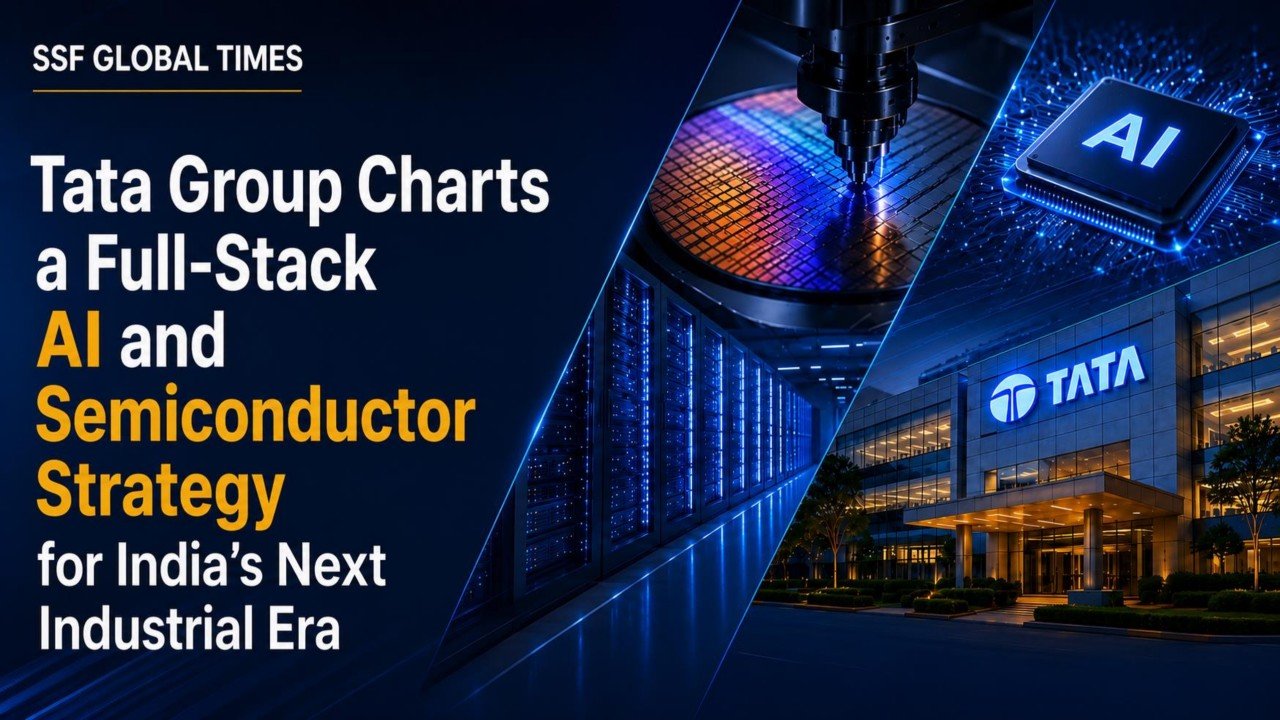




MUMBAI | 28 July 2026: Tata Group has identified artificial intelligence (AI) and semiconductor manufacturing as two of its most significant long-term strategic priorities, according to the conglomerate’s FY2025–26 Annual Report. The strategy reflects the Group’s growing focus on building capabilities across semiconductor manufacturing, AI infrastructure, enterprise software and digital platforms to support the next phase of industrial and technological growth. The holding company is aggressively deploying capital to architect an integrated AI and semiconductor ecosystem, ranging from physical silicon fabrication to scalable data center infrastructure.

By strategically securing control over both the hardware and software layers of the AI value chain, Tata Group underscores a critical macroeconomic reality: the future of industrial resilience increasingly depends upon controlling the intelligence and the microchips that power global supply chains.

KEY HIGHLIGHTS

  • Sovereign Silicon Scaling: Validating its rapid operational expansion, Tata Electronics has become the group’s fourth-largest entity by revenue, generating ₹1.31 lakh crore in FY26 while achieving operating profit breakeven. The subsidiary is currently constructing India’s first high-volume semiconductor fabrication plant in Dholera, Gujarat.
  • Enterprise AI Monetization: On the software and integration front, Tata Consultancy Services (TCS) reported an annualized AI revenue run rate of $2.6 billion in the first quarter of FY27, heavily supported by the rollout of its 1 GW HyperVault AI data center platform.
  • Conglomerate Financial Health: The broader Tata Group delivered robust financial performance to fund this deep-tech pivot. Group PAT increased 9% to ₹1.70 lakh crore while revenues rose to ₹16.24 lakh crore.

Headquartered in Mumbai, Tata Sons operates as the principal investment holding company and promoter for the Tata Group. Managing a vast, multi-sector portfolio that spans automotive (Tata Motors, Jaguar Land Rover), aviation (Air India), consumer goods, and heavy industry, the legacy conglomerate is aggressively rebalancing its asset mix toward future-ready verticals. Under the leadership of Chairman N. Chandrasekaran, the group is heavily prioritizing advanced manufacturing, clean energy (Agratas), telecommunications, and high-performance computing to maintain global industrial leadership.

To secure its competitive moat in an AI-driven economy, Tata’s operational blueprint intentionally avoids fragmented digital investments. Instead, the focus is on a vertically integrated technology stack.

Addressing shareholders in the FY25-26 Annual Report, Chairman N. Chandrasekaran defined the company’s structural approach to enterprise intelligence:

The opportunities offered by AI cannot be captured by simply giving organizations access to AI technology. Enterprises need to organize their data and integrate it into IT systems that have evolved over decades…. Across the Tata Group, we are working towards enabling the full stack that does this: the silicon that computes it, the data centres which host it, the enterprise systems which apply it and the physical platforms, in energy, mobility as well as defence, where it meets the real world.

N. Chandrasekaran, Chairman, Tata Group

Industry Insights

  1. The Hardware-Software Convergence: The global artificial intelligence boom has cemented the reality that advanced software cannot be scaled without specialized hardware. By concurrently scaling TCS’s enterprise software frameworks and Tata Electronics’ chip manufacturing and advanced packaging capabilities, the conglomerate effectively positions the Group across multiple layers of the AI value chain – from compute infrastructure to enterprise applications.
  2. AI Infrastructure Will Drive the Next Wave of Capability Centers: As enterprises invest in AI platforms, semiconductor ecosystems and high-performance computing, GCCs are expected to assume larger roles in AI engineering, chip design, enterprise platforms, data operations and digital infrastructure management. This evolution further strengthens India’s position as a strategic hub for technology-led global operations.
  3. Securing Technological Self-Reliance: Amid escalating geopolitical friction and cybersecurity threats, multinational enterprises now view domestic chip manufacturing as a strategic priority. Tata’s heavy investments in the Gujarat fabrication plant actively reduce dependence on global supply chains, and it’s massive automotive and aerospace divisions from future semiconductor shortages.
  4. Capital Allocation Is Shifting Toward Deep Technology: Large diversified conglomerates are increasingly directing long-term investments toward semiconductors, AI infrastructure and digital engineering alongside traditional manufacturing businesses, signalling a broader rebalancing of industrial portfolios.
  5. India’s Emerging Full-Stack Technology Ecosystem: India’s technology ecosystem is gradually expanding beyond software services into semiconductor manufacturing, AI infrastructure, electronics and enterprise platforms. Investments by diversified industrial groups indicate that future competitiveness will increasingly depend on integrating manufacturing capabilities with digital technologies.

THE “NEW STEEL” PARADIGM: REDEFINING FOUNDATIONAL INFRASTRUCTURE

Mr Chandrasekaran has explicitly equated the manufacturing of semiconductors to the production of foundational industrial materials, famously declaring that “chips are the new steel.”

This classification carries profound historical and economic weight for the conglomerate and provides vital insight into its capital deployment strategy:

  • Paralleling Historical Infrastructure: Just as Tata Steel provided the physical architecture for India’s 20th-century industrialization, Tata Electronics is purposefully positioned to supply the core digital architecture for the nation’s 21st-century economy.
  • Infrastructure-Scale Investment Approach: By treating microprocessors and AI data centers as essential sovereign infrastructure rather than mere technological commodities, the conglomerate is committing to a utility-scale mindset. The goal is to build an underlying grid of intelligence that powers everything from consumer devices to national defense platforms.
  • De-Risking the National Supply Chain: This approach has the potential to strengthen the broader Indian corporate ecosystem spanning automotive manufacturers, telecom providers, and financial institutions to eventually operate on a secure, localized silicon foundation, drastically reducing the nation’s historical vulnerability to volatile global supply chain disruptions.

THE STRATEGIC OUTLOOK

Tata Group’s decision to place artificial intelligence and semiconductor manufacturing at the center of its long-term strategy signals a broader shift in how diversified enterprises are preparing for the next era of industrial competitiveness. By investing across the technology stack – from semiconductor fabrication and AI infrastructure to enterprise platforms and digital applications – the Group is building capabilities that extend beyond individual businesses into a scalable innovation ecosystem.

For India, this strategic direction reinforces the country’s growing ambition to become a global hub for advanced manufacturing, AI infrastructure and deep-tech innovation. Equally significant is the opportunity it creates for the Global Capability Center (GCC) ecosystem. As enterprises increasingly invest in AI engineering, semiconductor design, high-performance computing and intelligent digital platforms, GCCs are expected to play an expanded role in product engineering, AI model development, chip design support, enterprise platform modernization and technology operations. This evolution further strengthens India’s position not only as a global delivery destination, but as a strategic innovation and engineering powerhouse at the heart of next-generation enterprise transformation.

Curated by SSF Global

Tracking the shifts shaping GCCs, enterprise ecosystems, and the future of global business.

Share on      

SSF Global is a Global Community for Enterprise Function Leaders and serves as a research & advisory platform focused on Global Business Services (GBS), Global Capability Centres (GCCs), and the evolution of enterprise innovation in India and beyond. We track, publish, and partner in narratives that shape how capability centres transform into hubs of trust, intelligence, and sustainable growth. We also evaluate, assess and benchmark the GCCs for their performance, maturity and other parameters using our proprietary tools built from the knowledge gained from direct interaction with our members (GCCs & GBS).