




 Ask an Expert

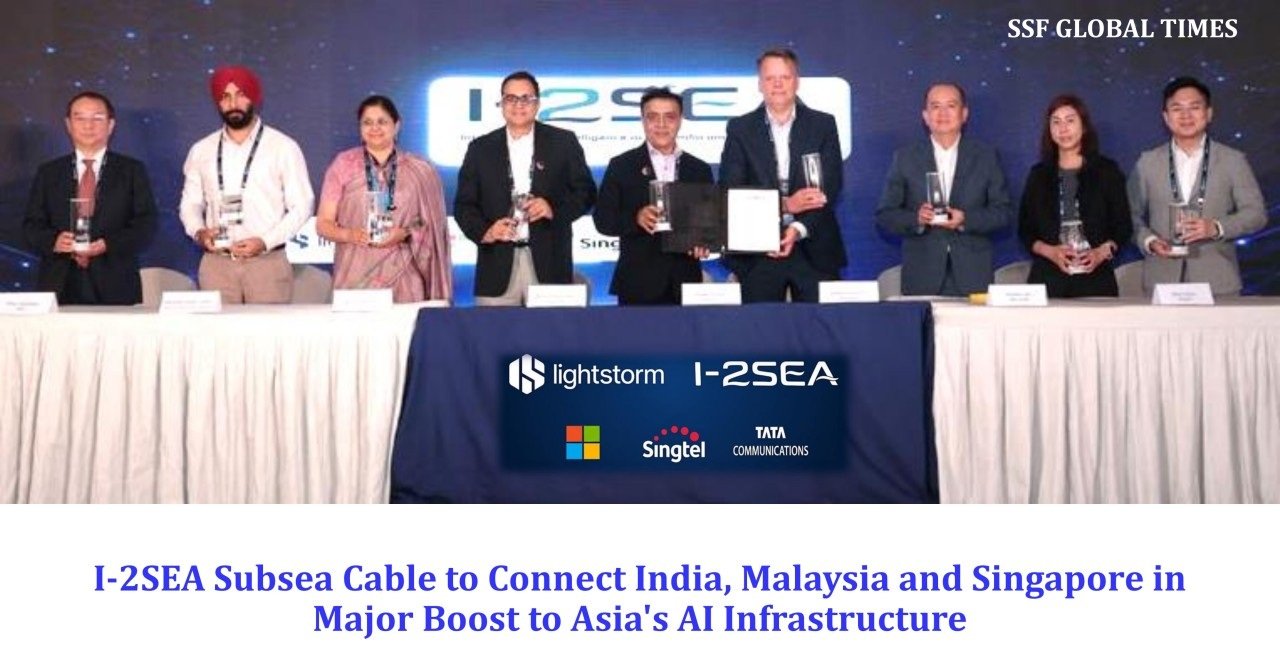
HYDERABAD & SINGAPORE | 13 July 2026: Lightstorm, Microsoft, Singtel and Tata Communications have officially launched the build of the I-2SEA (India–Southeast Asia) submarine cable system, marking one of the region’s most significant digital infrastructure investments aimed at supporting the next generation of AI and cloud computing workloads.
Targeted to be Ready-for-Service (RFS) by the fourth quarter of 2029, the 3,600-kilometer subsea network has been designed to support hyperscalers, GPU infrastructure providers and enterprises operating AI training, inference and cloud environments across the India-Southeast Asia corridor.
By creating a direct, low-latency connection between India’s emerging AI and hyperscale clusters and Southeast Asia’s established cloud hubs, the consortium is laying the foundational digital infrastructure required to support Asia’s next phase of artificial intelligence growth.
KEY HIGHLIGHTS
- Strategic Consortium Build: The project is being developed under a Joint Build Agreement involving Lightstorm as majority owner alongside Microsoft, Singtel and Tata Communications.
- Operational Timeline: The consortium expects the system to become Ready-for-Service in Q4 2029.
- Regional AI Corridor: The 3,600-kilometer cable will directly connect India with Malaysia and Singapore, linking some of Asia’s fastest-growing AI and hyperscale infrastructure markets.
- Dual Indian Landings: The system will make landfall at South Chennai and Machilipatnam, Andhra Pradesh, creating a diversified east coast connectivity corridor into India.
- Global Supply Chain Execution: NEC Corporation will serve as the principal system supplier while ASEAN Cableship Pte Ltd (ACPL) will manage marine installation activities.
THE CONSORTIUM BEHIND THE BUILD
The I-2SEA consortium operates under a Joint Build Agreement among Lightstorm (majority owner), Microsoft, Singtel, and Tata Communications. NEC Corporation has been appointed as system supplier and ASEAN Cableship Pte Ltd (ACPL) as marine installation partner.
- Lightstorm, which positions itself as an AI connectivity platform across Asia-Pacific, brings an extensive terrestrial network spanning more than 30,000 kilometers across India. The I-2SEA system extends this footprint into the subsea domain, enabling end-to-end connectivity between AI clusters, data centres and cloud regions.
- Microsoft’s participation reflects a broader trend among hyperscalers increasingly investing directly in strategic digital infrastructure to support cloud and AI growth. As AI workloads become more distributed and compute intensive, connectivity is emerging as a critical component of the AI supply chain.
- Singtel and Tata Communications contribute decades of expertise in international connectivity, subsea operations and regional telecom infrastructure, strengthening the project’s execution capabilities and regional integration.
Targeted to be fully Ready-for-Service (RFS) in the fourth quarter of 2029, the I-2SEA project intentionally targets the most critical economic and compute hubs between India and the ASEAN bloc, utilizing a geography-defying architecture to maximize transcontinental data transit speeds.
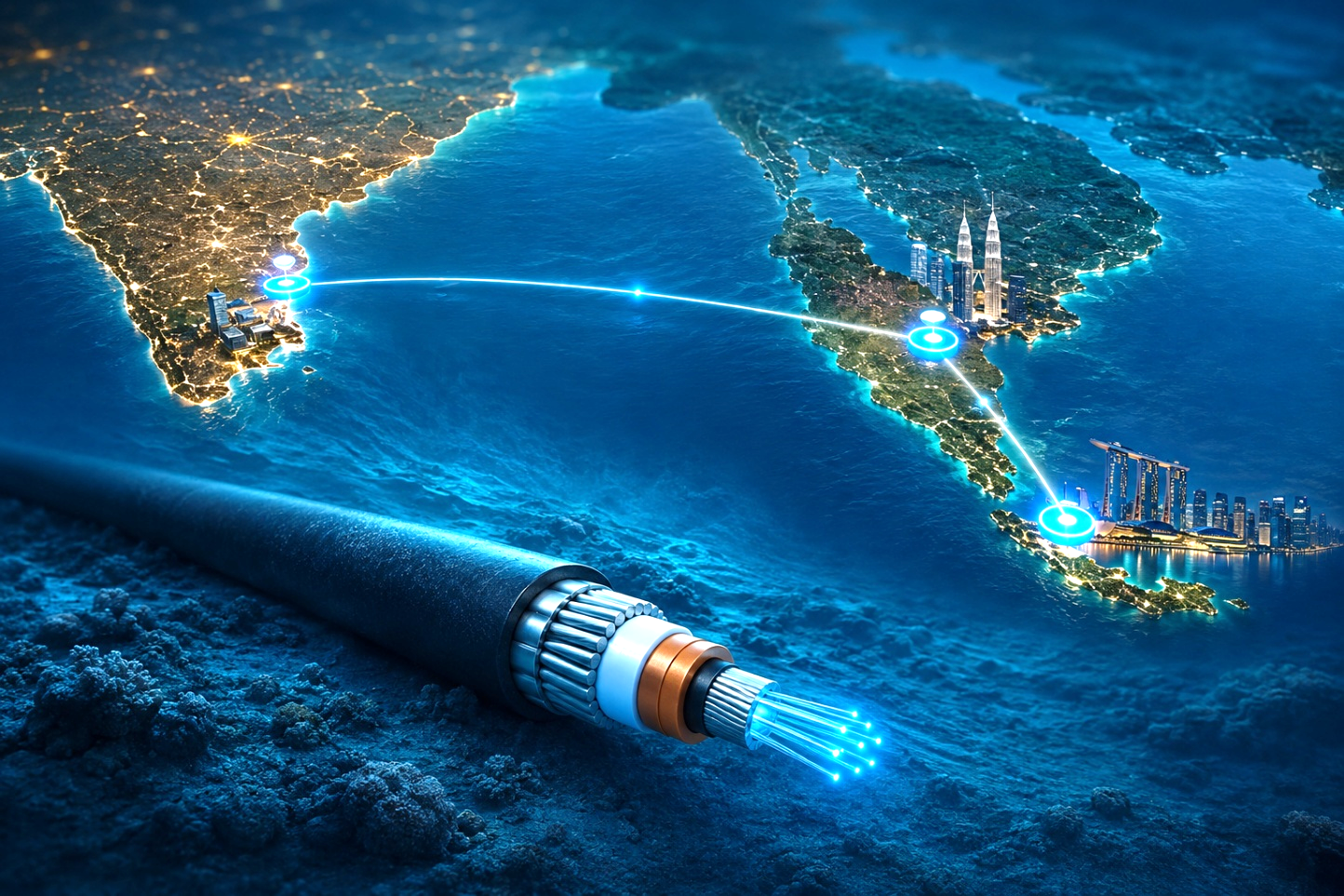
- The Southeast Asian Anchors: The cable connects directly to Singapore, the region’s dominant cloud interconnect and AI hub, alongside Kuala Lumpur, the heart of Malaysia’s rapidly expanding hyperscale data centre corridor.
- Dual Indian Landings: To protect against unexpected downtime and isolate routing paths, the cable will feature two distinct landing stations on India’s east coast:
- Machilipatnam: Strategically selected to offer the absolute shortest subsea path and fastest transmission from Singapore/Malaysia directly to the massive hyperscale and AI data centre clusters in Hyderabad.
- South Chennai: A brand-new, geographically diverse landing site designed to bypass existing, heavily congested maritime zones.
- Terrestrial Backhaul Loop: Once onshore, the subsea system will plug seamlessly into Lightstorm’s 30,000-kilometer Indian terrestrial fiber network. This allows zero-throttling onward reach to Hyderabad, Mumbai, and more than 80 major data centres across mainland India.
- Protective Burial Depth: Extraordinarily deep burial of 3 meters across all buried sections through the Bengal Sea and the Malacca Strait, instead of traditional 1 meter burial. It improves reliability while driving up the Capex.
THE ANATOMY OF AN AI-NATIVE SUBMARINE CABLE
Unlike traditional international connectivity projects designed primarily for internet traffic growth, I-2SEA has been architected specifically for AI, cloud and hyperscale workloads that require high-capacity and low-latency connectivity between geographically distributed compute environments. Several design choices underscore this objective:
- The East Coast Advantage: The selection of Machilipatnam provides the shortest subsea path into Hyderabad, one of India’s fastest-growing AI and hyperscale data centre clusters. The route also strengthens the emergence of an east coast digital corridor linking Hyderabad and Chennai with Southeast Asia’s cloud ecosystem.
- Terrestrial Integration: The value of a submarine cable does not stop at the shoreline. Once the cable lands in India, enterprises will have access to Lightstorm’s terrestrial network spanning over 30,000 kilometers and reaching more than 80 data centres nationwide, enabling seamless onward connectivity to major cloud and AI regions.
- AI-Optimized Connectivity: The infrastructure has been designed to support distributed AI training and inference environments where latency, resilience and bandwidth increasingly determine application performance and operating economics.
THE INDIA-ASEAN AI CORRIDOR: SOLVING THE AI INFRASTRUCTURE TRILEMMA
Beyond connectivity, the strategic significance of I-2SEA lies in the complementary strengths of the three markets it connects. Singapore remains Southeast Asia’s primary financial and cloud interconnection hub but continues to face land and power constraints that limit large-scale data centre expansion. Malaysia, particularly the Johor and Kuala Lumpur corridors, has emerged as a preferred destination for power-intensive AI training infrastructure because of greater land availability and competitive energy economics.
India completes this equation by bringing scale in engineering talent, rapidly expanding data centre capacity and one of the world’s fastest-growing digital economies. According to industry estimates, India’s operational data centre capacity currently stands at approximately 1.4 GW, with forecasts suggesting that this could double by 2027 and potentially increase five-fold by 2030 as hyperscale investments accelerate. By physically connecting these complementary ecosystems, I-2SEA creates a regional AI architecture where workloads can increasingly move between locations based on latency requirements, power availability and compute economics.
The result is the emergence of a distributed AI region rather than isolated national infrastructure clusters, one where Singapore serves as an interconnection and inference hub, Malaysia provides power-intensive training capacity, and India contributes both engineering scale and hyperscale infrastructure.
WHY SUBSEA CABLES MATTER MORE IN THE AI ERA
Despite the rise of satellites and wireless technologies, submarine cables continue to carry approximately 95% of international internet traffic, making them among the most critical pieces of digital infrastructure in the global economy. India currently has 17 active international submarine cable systems, with several additional systems under planning or deployment as the country strengthens its position as a major cloud, AI and data centre market.
The rapid growth of AI workloads is now reshaping investment decisions in this sector. Low latency, resilience, route diversity and direct access to data centre clusters are becoming just as important as raw bandwidth capacity. This shift explains why hyperscalers and cloud providers are increasingly participating directly in subsea infrastructure investments rather than relying exclusively on traditional telecom operators.