




 Ask an Expert

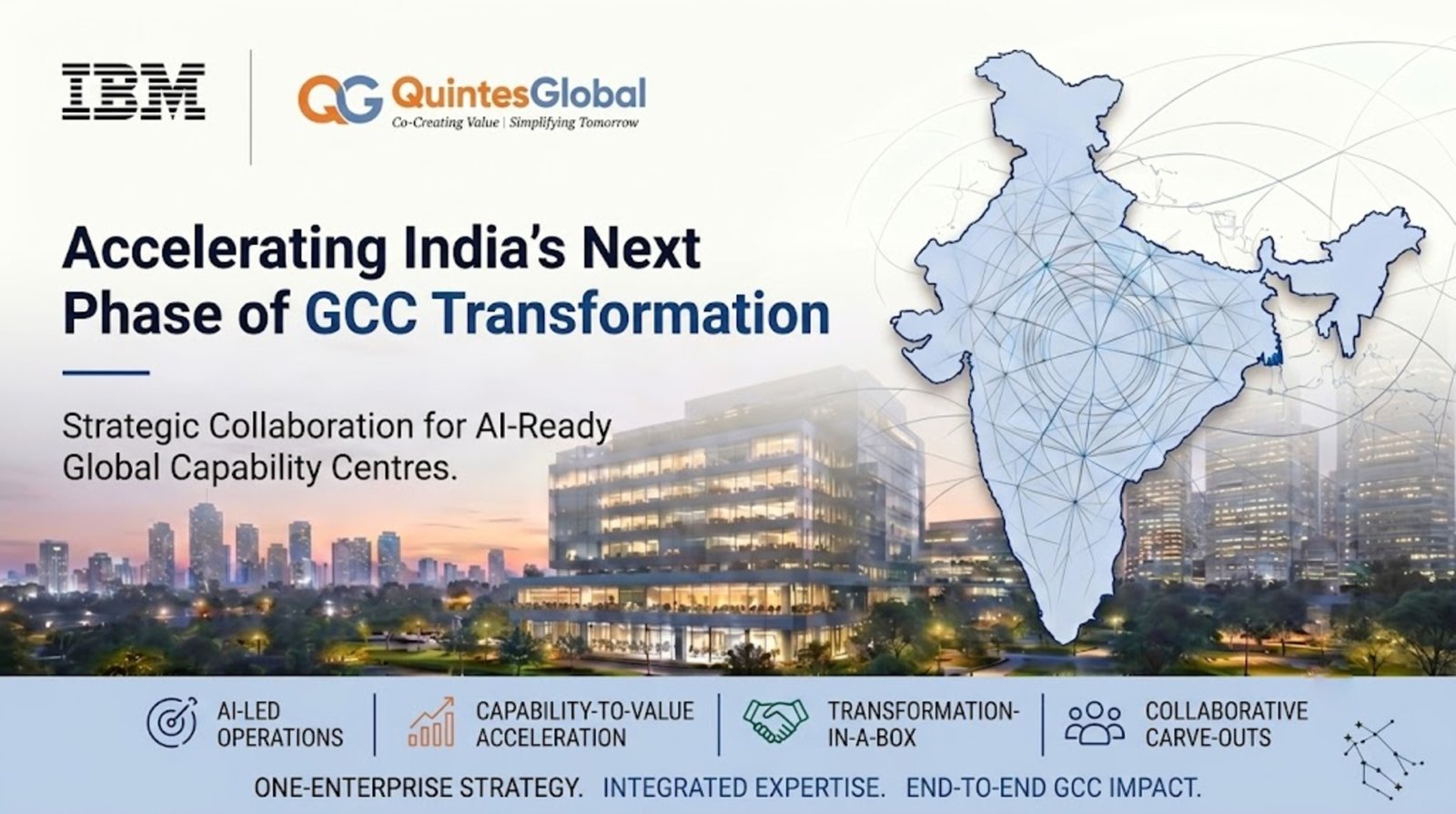
NEW DELHI | 24 June 2026: India’s Global Capability Centre story is entering a new chapter. For over two decades, enterprises built Global Capability Centres (GCCs) in India to drive efficiency, scale operations, and optimize costs. Today, that mandate has fundamentally changed. Modern GCCs are expected to own products, lead innovation, shape customer outcomes, and increasingly operate as AI-powered enterprise nerve centres.
Recognizing this shift, IBM and Quintes Global have announced a strategic collaboration aimed at accelerating the next generation of GCC transformation in India. At the heart of the partnership is the IBM-Quintes Accelerator – an AI-integrated framework designed to help global organizations establish, scale, transform, and future-proof their capability centres with enterprise-grade AI readiness and operational ownership embedded into their foundations.
India’s GCC ecosystem today contributes approximately $98.4 billion in annual revenue, operates through 2,117 centres across 3,728 units, and employs nearly 2.36 million professionals. More importantly, the ecosystem is undergoing a strategic evolution from transactional execution hubs to globally integrated capability engines responsible for products, platforms, analytics, customer experience, and business outcomes.
More than 1,200 GCCs already operate embedded AI and machine learning capabilities, supported by over 250 AI Centres of Excellence and an AI talent pool exceeding 250,000 professionals. Nearly half of all GCCs established in recent years have been designed with AI as a foundational operating principle rather than an enabling technology layer.
The implications for enterprise leaders are immense.
The critical question facing boards and global operating committees is no longer whether India is the right destination for capability investments. The real question is whether the GCC being established today is structurally designed to support the enterprise it will be expected to become tomorrow. This is the challenge the IBM-Quintes collaboration seeks to address.
IBM brings global enterprise transformation capability, AI deployment infrastructure, cloud modernization expertise, and the institutional scale of approximately 160,000 consultants operating worldwide.
Quintes Global contributes practitioner-led expertise across the complete GCC lifecycle – from setup and scale-up to transformation and value acceleration – backed by more than 500 major technology and transformation engagements and proprietary frameworks developed specifically for the GCC ecosystem.
The resulting Accelerator combines these complementary strengths to help enterprises move beyond incremental improvements and architect truly AI-native operating models. The framework focuses on three strategic dimensions:
- Enterprise AI Integration: Embedding AI-native operating models, intelligent workflows, and agentic decision architectures directly into the design of capability centres rather than retrofitting them after scale has been achieved.
- Structured GCC Operating Models: Leveraging Quintes Global’s proprietary D-Cap™ model and flexible operating structures such as Build-Operate-Transfer (BOT) and Build-Operate-Transform-Transfer (BOTT), etc. to reduce execution risk during
- Talent Architecture and Leadership Readiness: Deploying TalentXcale™ to build leadership pipelines and specialist talent ecosystems capable of supporting enterprise-wide mandates and scaled human-machine collaboration.
Together, these capabilities create a structured pathway for organizations seeking to establish new centres, transform existing captives, execute carve-outs, or accelerate AI-led modernization programs.
Commenting on the collaboration, Rishi Aurora, Managing Partner, IBM Consulting India and South Asia, said:
India’s GCC ecosystem is entering a defining phase, where the opportunity is no longer just to scale, but to reshape these centres as next-generation capability hubs delivering enterprise value and innovation. Through our collaboration with Quintes Global, we are bringing together the transformation depth and ecosystem capabilities required to execute this shift, helping enterprises move from intent to impact with greater certainty.
The collaboration arrives at a time when GCC growth is increasingly being driven by private equity-backed enterprises and mid-market organizations looking to establish strategic capability centres without inheriting the risks traditionally associated with greenfield builds.
India today hosts more than 500 private equity-backed GCCs and nearly 600 mid-market capability centres, creating demand for operating models that deliver both speed and governance while preserving strategic flexibility. For these organizations, the challenge is not simply standing up a centre quickly. It is ensuring that decisions made during the first twelve months do not become structural constraints five years later.
As AI systems evolve from content generation tools to reasoning engines capable of autonomous decision support and self-correction, the cost of delayed transformation continues to rise. Organisations that postpone redesigning operating models risk accumulating structural debt that becomes progressively more difficult to unwind.
Speaking on the announcement, Rakesh Sinha, Founder and CEO of Quintes Global, said:
Quintes empowers enterprises and GCCs across domains and verticals to re-imagine their value maturity journey through differentiated frameworks, proprietary tools, and an aggregated solutions approach. The Quintes-IBM Accelerator enables us to deliver transformation-in-a-box capabilities more comprehensively and help GCCs fast-track their journey towards value creation and innovation. Together, we are enabling enterprises to execute with greater speed, clarity, and confidence.
The broader significance of the collaboration extends beyond technology deployment or operating model redesign. It reflects a structural shift in how global enterprises view India itself.
The country is no longer simply a destination for capability creation.
It is becoming the location where enterprises design products, deploy AI, manage global platforms, orchestrate business outcomes, and increasingly determine competitive advantage. The winners in this next phase of the GCC story will not necessarily be those with the largest centres or the lowest operating costs.
They will be the organizations that build AI-ready, ownership-driven, innovation-led capability ecosystems from day one.
The IBM-Quintes Accelerator has been designed precisely for that future.