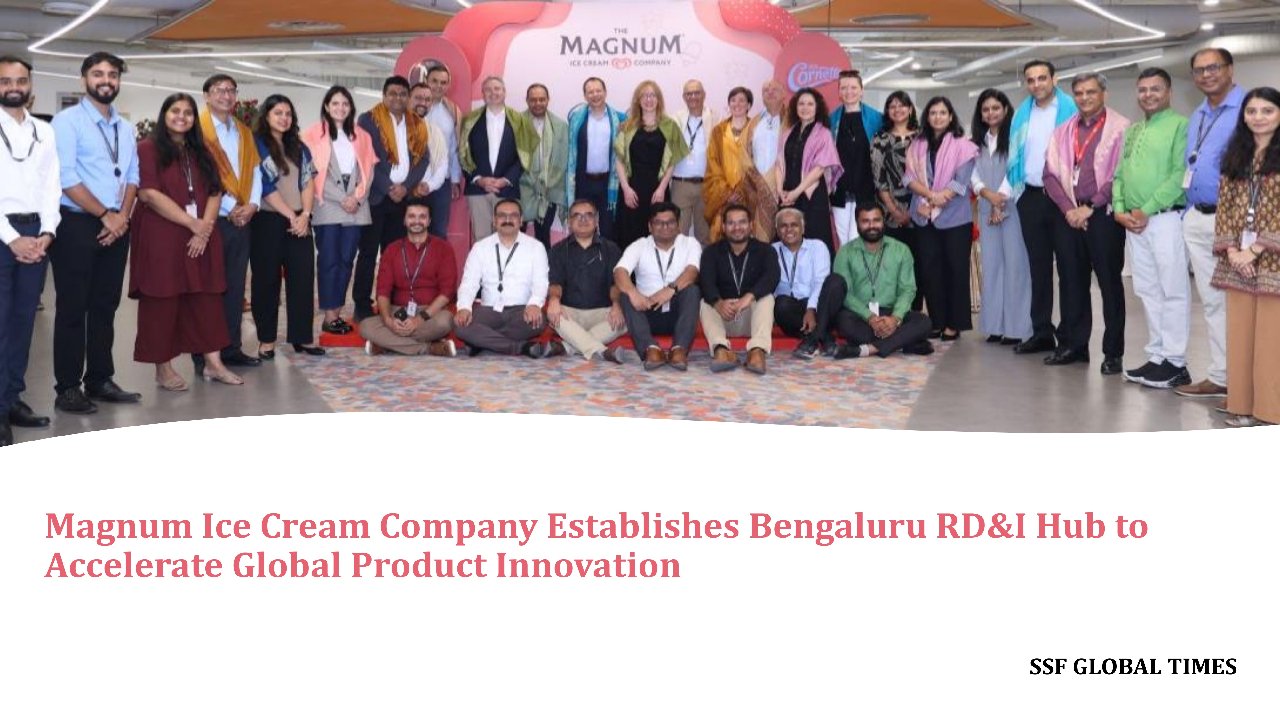




BENGALURU | 7 July 2026: Expanding its global product innovation capabilities, The Magnum Ice Cream Company (TMICC) has officially launched a 13,000 sq. ft. Research, Design & Innovation (RD&I) Centre in Whitefield, Bengaluru. The new facility consolidates the enterprise’s culinary, packaging, and food science capabilities into a single operational hub, designed to accelerate the development of the company’s core dairy portfolios, including Kwality Wall’s, Cornetto, Magnum, Carte D’Or, Feast, and Twister.

This infrastructure investment signifies a shift in how multinational fast-moving consumer goods (FMCG) corporations utilize the Indian market. Rather than relying solely on Western laboratories, TMICC is leveraging the Bengaluru facility as an important research node, operating in direct structural alignment with its Global Design Centre in Colworth, UK, and its Regional Innovation Hub in Istanbul, Turkey. The core objective is to translate regional consumer data into market-ready, structurally optimized products capable of withstanding the complex realities of the Indian supply chain.

KEY HIGHLIGHTS

  • 13,000 sq. ft. campus: The Magnum Ice Cream Company has opened a dedicated RD&I hub in Whitefield, Bengaluru.
  • Cross-border collaboration: The facility will operate in tandem with the enterprise’s innovation centers in Colworth, UK, and Istanbul, Turkey.
  • Strategic business functions: The centre integrates ice cream science, culinary craft, and consumer technical insights under one roof.
  • Advanced infrastructure: The site features a digitally enabled pilot plant focused on 3D packaging prototyping and cold-chain validation.
  • Brand acceleration: The laboratory will drive structural innovations across the Kwality Wall’s, Cornetto, Magnum, and Twister portfolios.
  • Broader ecosystem expansion: The launch complements the company’s broader capability investments in India, including its business operations footprint in Pune supporting global functions.

TMICC operates as a newly independent entity following its demerger from Unilever. The standalone company manages a portfolio that includes major global ice cream brands such as Magnum, Kwality Wall’s, Ben & Jerry’s, Cornetto, and Breyers.

Operating as the pure-play ice cream business, The Magnum Ice Cream Company (TMICC) is headquartered in Amsterdam, The Netherlands. The enterprise commands an extensive global footprint, maintaining a workforce of approximately 18,000 employees across a network of 34 factories and 13 dedicated R&D centers worldwide.

The company began standalone operations in July 2025. In tandem with building its global digital infrastructure, TMICC is consolidating its Indian market assets. In March 2026, the company completed the acquisition of a 61.9% stake in Kwality Wall’s (India) Limited and launched a mandatory open offer to acquire an additional 26% from public shareholders.

Valued at an estimated €9 billion (approximately $10.59 billion), the standalone entity manages a sprawling portfolio of market-leading brands and operates a vast physical logistics network comprising over three million freezer cabinets globally.

WHAT’S INSIDE THE NEW HUB: CAPABILITIES & INFRASTRUCTURE

The Bengaluru centre is engineered to bridge the gap between computational food science and culinary craftsmanship. Moving beyond standard test kitchens, the facility integrates advanced simulation and manufacturing technology. The core capabilities housed within the hub include:

  • Digitally Enabled Pilot Plant: A highly automated manufacturing simulation floor that allows engineers to execute rapid experimentation across multiple product formats, including cups, sticks, cones, kulfi, and premium ice cream cakes.
  • 3D Packaging Prototyping: Advanced fabrication tools that allow packaging engineers to design and test custom wrappers and containers concurrently as food scientists adjust the product formulation.
  • Cold-Chain and Climate Testing: Dedicated simulation chambers designed to replicate the fluctuating temperatures of the Indian distribution network, ensuring structural integrity from the factory to the consumer.
  • Transport Simulation: Specialized testing environments that mimic the physical stress, transit logistics, and vibrations of real-world emerging market supply chains.
  • Sensory Evaluation Laboratories: Controlled environments where technical teams analyze flavor profiles, textures, and melting points utilizing both consumer panels and digital analytics tools.

Kwality Wall’s has been part of the Indian ice cream scene for more than seven decades, consistently delighting consumers with new flavours and familiar icons. As part of The Magnum Ice Cream Company, we now have access to world-class R&D capabilities, deeper product expertise and a sharper innovation ecosystem. The new Bengaluru ice cream centre will help us respond faster to evolving consumer preferences, create products that are relevant to Indian tastes and occasions, and continue building a future-ready ice cream business in India.

Chitrank Goel, Deputy Managing Director, Kwality Wall’s (India)

ARCHITECTING LOCAL INNOVATION FOR A GLOBAL SUPPLY CHAIN

The operational mandate of the Whitefield facility is to eliminate the technical silos that traditionally delay product launches in the FMCG sector. Developing a structurally sound frozen dessert requires simultaneous cross-disciplinary engineering; an adjustment to an ice cream’s melting point necessitates an immediate recalibration of its protective packaging. By centralizing these functions, the enterprise significantly compresses its product development lifecycle.

This localized approach is critical for navigating the structural complexities of the region. Products conceptualized in temperature-controlled European labs often fail in tropical climates if not properly stress-tested against local realities. Highlighting this strategic requirement, Zbigniew Lewicki, Chief Research, Development & Innovation Officer at TMICC, detailed the operational convergence occurring at the new facility.

India is one of the world’s most exciting ice cream markets, with fast-evolving tastes, occasions and expectations. The new Bengaluru RD&I Centre brings together our global science, technology and culinary expertise with deep local consumer insight, helping us to move faster from idea to market-ready innovation.

Zbigniew Lewicki, Chief Research, Development & Innovation Officer at TMICC

Industry Insights

  1. The Localization of Intellectual Property: Multinational consumer goods firms are increasingly transitioning core product engineering from Western headquarters to emerging markets, ensuring formulations are natively designed for local supply-chain realities.
  2. The Digitization of Food Science: FMCG capability nodes are moving beyond basic culinary testing, heavily absorbing deep-tech functions like 3D packaging prototyping and digital sensory evaluation to accelerate the innovation lifecycle.
  3. Integrated Hubs Replace Fragmented Labs: Enterprises are replacing isolated regional testing facilities with integrated RD&I campuses to encourage cross-functional collaboration between packaging engineers, food scientists, and consumer data analysts.
  4. The Maturation of FMCG GCCs: Global Capability Centers in the consumer sector are expanding their mandates far beyond back-office finance and IT, taking direct accountability for core product and process development and global business strategy.

THE BENGALURU ADVANTAGE

The selection of Whitefield, Bengaluru, emphasizes a specific structural requirement for modern food and beverage capability nodes: the convergence of biotechnology, consumer data, and software engineering. While traditional test kitchens can operate anywhere, a facility focused on product and process development requires a deep labor pool of food technologists and data scientists.

Bengaluru provides this highly specific demographic. The city sustains an extensive network of specialized food science research institutions and biotechnology startups, offering enterprise firms immediate access to raw material innovations and highly specialized talent. Additionally, the region’s IT services ecosystem provides the engineering support necessary to operate complex simulation software and digitize the pilot manufacturing process.

For multinational FMCG corporations, integrated campuses are replacing isolated regional laboratories. A consolidated hub allows the enterprise to centralize expensive capital equipment—such as climate testing chambers and 3D printers, while fostering a collaborative corporate culture that retains technical talent in a highly competitive labor market.

The inauguration of the Bengaluru lab builds directly upon the firm’s broader capitalization in the region. Earlier in 2025, the company established its overarching Global Capability Centre (GCC) in Pune, reinforcing the country as a primary engine for both global business operations and core intellectual property generation. For the domestic market, the research investment ensures that products are designed natively for Indian consumption rather than imported as afterthoughts.

THE WAY FORWARD

The establishment of the 13,000 sq. ft. RD&I Centre by The Magnum Ice Cream Company confirms a structural maturation in how global consumer brands operate in India. By committing significant infrastructure to local product development, the enterprise ensures that its future innovations are engineered to withstand complex supply chains and meet highly specific regional demands. Moving forward, the Bengaluru node will serve as a critical anchor in the company’s pipeline, translating raw data and regional insights into scalable, market-ready dairy platforms.

Curated by SSF Global

Tracking the shifts shaping GCCs, enterprise ecosystems, and the future of global business.

Share on      

SSF Global is a Global Community for Enterprise Function Leaders and serves as a research & advisory platform focused on Global Business Services (GBS), Global Capability Centres (GCCs), and the evolution of enterprise innovation in India and beyond. We track, publish, and partner in narratives that shape how capability centres transform into hubs of trust, intelligence, and sustainable growth. We also evaluate, assess and benchmark the GCCs for their performance, maturity and other parameters using our proprietary tools built from the knowledge gained from direct interaction with our members (GCCs & GBS).