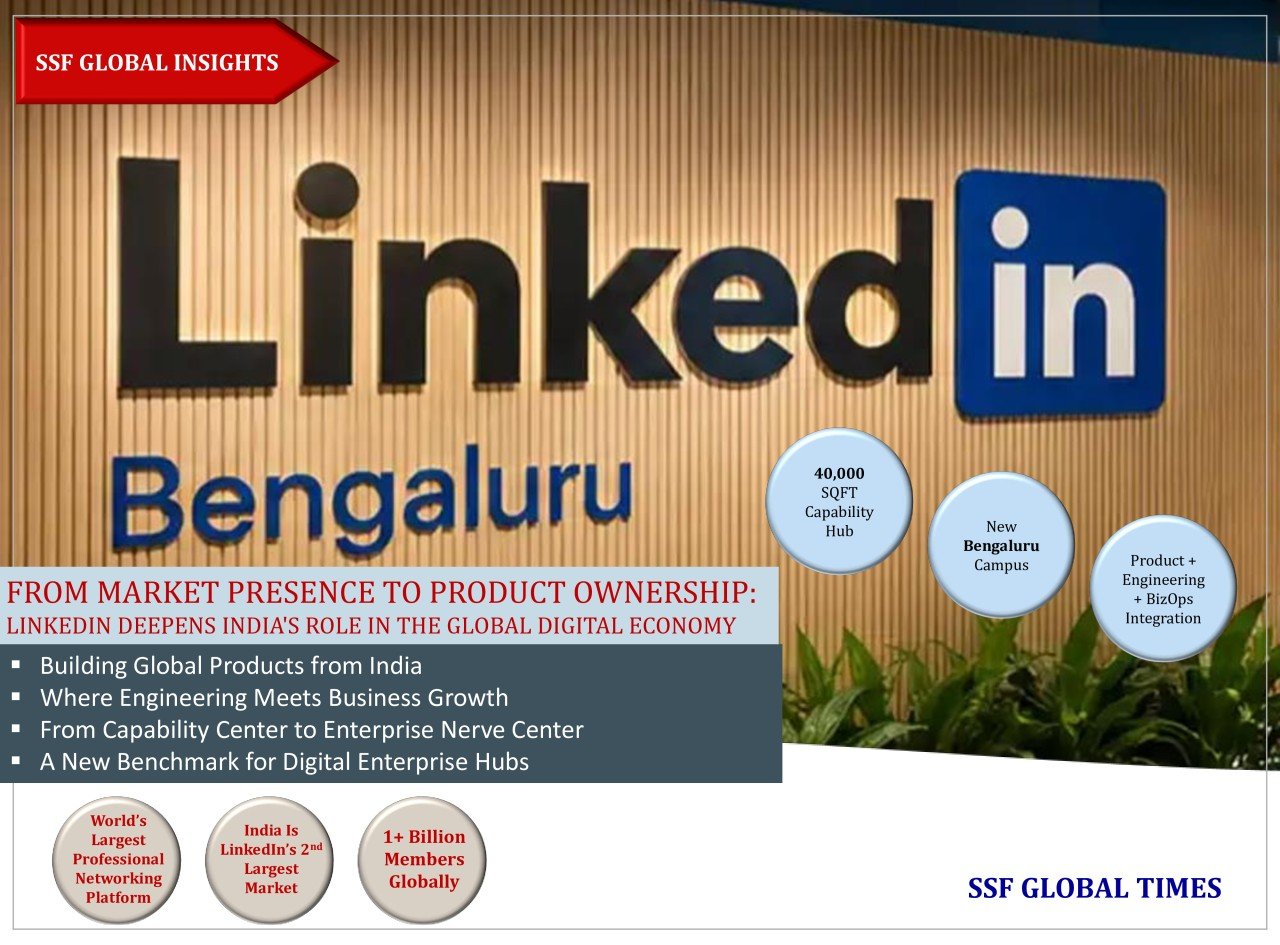




BENGALURU | 20 June 2026: LinkedIn has officially operationalized the first phase of its new enterprise campus in Bengaluru, marking one of the company’s largest real estate investments in the Asia-Pacific region. Spanning nearly 400,000 square feet, the facility reflects the continued evolution of India’s role within global digital enterprises, from a market of users and talent to a location where core products, platforms, and business capabilities are being built and managed at scale.

Headquartered in Sunnyvale, California, and operating as a wholly owned subsidiary of Microsoft Corporation, LinkedIn is the world’s largest professional networking platform, serving more than one billion members globally. The company generates revenue across Talent Solutions, Marketing Solutions, and Premium Subscriptions. India remains LinkedIn’s second-largest market globally by member base and increasingly serves as a strategic capability hub supporting the platform’s worldwide growth agenda.

The Bengaluru campus has been designed to house cross-functional teams spanning engineering, product development, business operations, enterprise sales, trust and safety, and platform support functions. The expansion signals LinkedIn’s long-term commitment to India as a critical node within its global operating model.

Converging Product, Platform and Business Operations

Unlike traditional offshore structures that separate technology development from commercial functions, LinkedIn’s new Bengaluru campus has been designed around integrated capability ownership.

The facility will support several critical global functions:

  • Core Engineering and Platform Architecture: Developing algorithms, machine learning capabilities, data infrastructure, and product innovations that power LinkedIn’s global platform, recruitment solutions, and enterprise offerings.
  • Global Business Operations: Supporting enterprise customers, scaling commercial operations, and enabling revenue growth across multiple geographies.
  • Trust, Safety and Compliance: Designing systems and governance frameworks that strengthen platform integrity, user trust, cybersecurity, and regulatory compliance.

Laila Khalil, APAC Regional Director of Global Workplace Services at LinkedIn, described the launch as “just the beginning” of the company’s next phase of growth in India, while acknowledging the contributions of workplace, architecture, and leadership teams involved in the development of the campus.

The Evolution of the Workplace in the AI Era

The scale of LinkedIn’s investment is notable at a time when hybrid and distributed work models continue to reshape corporate real estate strategies.

Rather than treating office space as a purely operational requirement, many leading technology companies are increasingly viewing physical workplaces as collaboration infrastructure. Complex product development, AI model building, platform innovation, and cross-functional decision-making often benefit from concentrated teams operating in highly interactive environments. The Bengaluru campus reflects this philosophy through collaborative workspaces, innovation zones, technology-enabled environments, and employee wellness infrastructure designed to support creativity, learning, and team-based problem solving.

In this context, workplace strategy is becoming closely linked to talent strategy, particularly in highly competitive markets where attracting and retaining specialized engineering and product talent remains a key business priority.

Key Insights

  1. The Rise of India as a Product and Platform Hub: Global technology companies are increasingly moving beyond locating support functions in India. Engineering teams in India today contribute directly to product architecture, AI innovation, platform development, and customer-facing solutions that serve global markets. LinkedIn’s expansion reflects this broader shift toward capability ownership.
  2. Product, Commercial, and Operational Integration: The convergence of engineering, business operations, and enterprise sales within a single location reflects a growing enterprise trend. Organizations are seeking to reduce the distance between product development and market execution, accelerating innovation cycles and improving responsiveness to customer needs.
  3. Bengaluru’s Continuing Strategic Relevance: While enterprises continue to explore distributed operating models across India, Bengaluru remains the preferred destination for global product organizations requiring access to mature technology ecosystems, experienced engineering talent, startup networks, research institutions, and leadership capabilities. Large-scale investments by global digital enterprises continue to reinforce the city’s position as India’s premier product and innovation hub.

Industry Perspective

LinkedIn’s expansion highlights a broader structural evolution underway across the GCC and digital enterprise ecosystem. The next generation of capability centers is no longer defined by scale alone; it is defined by ownership of products, platforms, intellectual property, customer outcomes, and business growth. What is particularly significant is the convergence of engineering, commercial operations, trust and safety, and platform governance within a single integrated capability model. This reflects how leading global enterprises are increasingly designing India-based centers as strategic enterprise nodes rather than function-specific delivery locations.

As artificial intelligence, digital platforms, and knowledge-intensive business models continue to reshape industries, enterprises will increasingly require locations capable of combining deep technical expertise with product thinking, customer understanding, and business leadership. LinkedIn’s Bengaluru campus represents this transition in action.

Concluding Remarks

LinkedIn’s latest expansion is not simply a real estate milestone; it is a reflection of how global digital enterprises are redefining the role of India within their value creation architecture.

The significance lies not in the size of the campus, but in the nature of the work being concentrated within it. As global organizations increasingly integrate product development, AI innovation, platform governance, and commercial operations, India is emerging as a location where enterprise strategy is executed, not merely supported.

For the GCC industry, the message is clear: the future belongs to centers that move beyond service delivery and participate directly in shaping products, platforms, customer experiences, and competitive advantage. LinkedIn’s Bengaluru investment is another indicator that India’s role in the global digital economy is steadily expanding from capability provider to capability owner.

Curated by SSF Global

Tracking the shifts shaping GCCs, enterprise ecosystems, and the future of global business.

Share on      

SSF Global is a Global Community for Enterprise Function Leaders and serves as a research & advisory platform focused on Global Business Services (GBS), Global Capability Centres (GCCs), and the evolution of enterprise innovation in India and beyond. We track, publish, and partner in narratives that shape how capability centres transform into hubs of trust, intelligence, and sustainable growth. We also evaluate, assess and benchmark the GCCs for their performance, maturity and other parameters using our proprietary tools built from the knowledge gained from direct interaction with our members (GCCs & GBS).