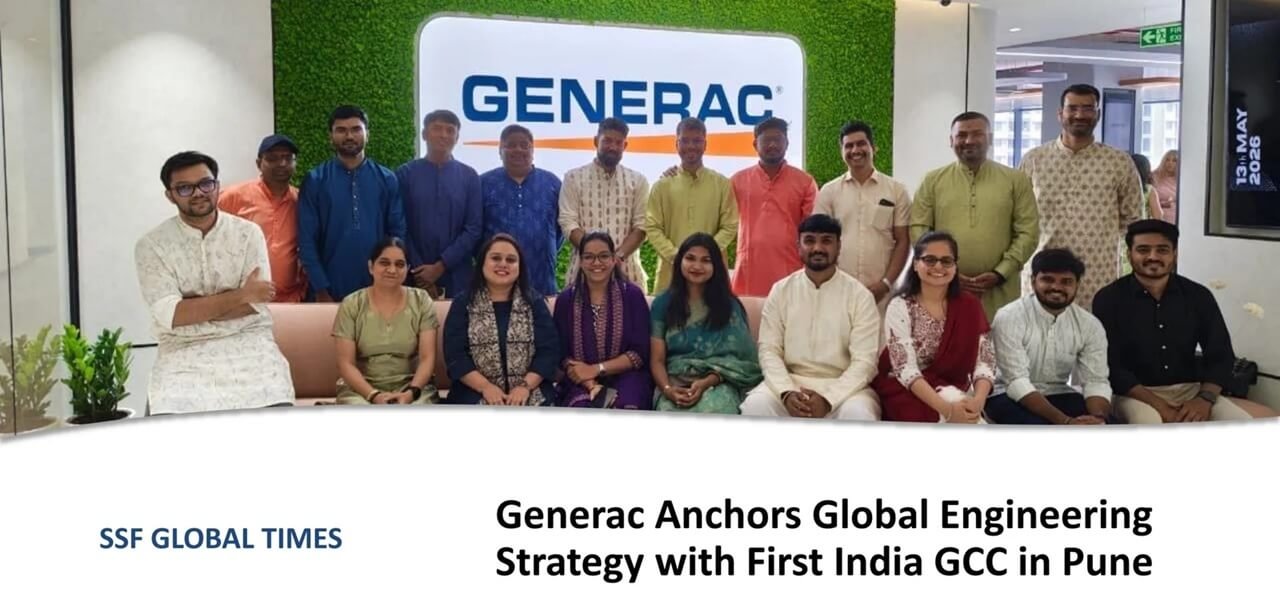




PUNE | 11 June 2026: Marking a definitive expansion of its global engineering footprint, Generac Holdings Inc. has formally inaugurated its first Indian capability node. The Generac Business & Technology Centre (GBTC) in Pune represents a calculated structural response to the accelerating demands of the global energy transition.

Occupying a 21,494-square-foot purpose-built facility, the center is designed to house more than 150 specialized professionals. Most critically, Generac is bypassing the traditional offshore lifecycle, the Pune hub is not functioning as a transactional support outpost. From its inception, GBTC carries an explicit mandate to operate as a Centre of Excellence (CoE), feeding specialized engineering expertise directly into Generac’s international product innovation pipeline.

Founded in 1959 in Waukesha, Wisconsin, Generac introduced the first affordable backup generator and, in doing so, created an entirely new product category. Over six decades, it has grown into one of the world’s energy technology enterprises, a company whose products today span residential standby generators, industrial power systems, energy storage solutions, energy management devices, and advanced grid-edge technology. Its commercial and industrial segment now serves data centres, telecommunications infrastructure, and critical industrial facilities globally.

Generac closed FY2025 with $4.2 billion in net sales, with its revenue spread across residential (54%), commercial & industrial (35%), and other segments (11%). The company employs approximately 9,400 people worldwide, including roughly 1,200 engineers, a figure that underscores how deeply engineering capability is embedded in its competitive identity. With hyperscale partnerships deepening and domestic manufacturing capacity for large megawatt generators expected to surpass $1 billion by Q4 2026, Generac is at a decisive inflection point in its evolution from a standby power company to a full-spectrum energy solutions enterprise. The India GCC is one of the most consequential investments supporting that transition.

The timing is equally deliberate. As Generac accelerates its “Power a Smarter World” enterprise strategy focused on energy resilience, efficiency optimisation, and infrastructure protection it needs engineering and technology depth that scales with global demand, not behind it. Building a GCC now, rather than in five years, gives GBTC the time to develop institutional knowledge and domain maturity at the pace the business requires.

The Facility: Built for Depth, Not Just Headcount

The physical design of GBTC reflects a considered philosophy about how high-performance technical work happens. Designed by TOA, a design-first, technology-enabled architecture firm, the facility moves deliberately beyond the standard open-plan office template.

The workspace integrates:

  • Collaborative zones for cross-functional and cross-geography problem-solving
  • Quiet work areas for focused engineering and technical development
  • Flexible meeting infrastructure for seamless global team connectivity
  • Technology-enabled environments purpose-built for productivity at scale

The infrastructure deliberately separates collaborative cross-functional zones from quiet engineering environments, functioning on the premise that the built environment directly dictates the quality of technical output.

The India GCC will play a vital role in enhancing Generac’s technology, engineering and business capabilities. Beyond supporting global operations, the centre will help develop future leaders and build specialised expertise that contributes to the company’s long-term innovation agenda.

 Shyam Sunder, Vice President – Global Business and Technology Centre, Generac India

Key Insights

  1. Pune Consolidates Its Industrial Capability Identity: While cities like Bengaluru lean heavily toward software and consumer tech, Pune has successfully captured the industrial and advanced manufacturing ecosystem. Hosting over 500 GCCs, Pune provides Generac immediate access to specialized talent pools in power generation engineering and energy management systems.
  2. The Energy Sector’s GCC Moment: Generac’s entry highlights a broader sectoral shift. As demand for distributed power and grid-edge solutions intensifies, energy technology enterprises require continuous, large-scale product innovation. Leveraging India’s deep engineering base is no longer optional for legacy energy firms; it is a mandatory competitive lever to maintain global market speed.
  3. The Institutional CoE Design: Launching directly with a Centre of Excellence mandate fundamentally alters the operational stakes. It dictates a higher standard for talent acquisition and performance evaluation. If executed correctly, GBTC will operate as a proprietary competitive asset, fundamentally distancing itself from the traditional cost-center model.

Demand Inflection

The world is experiencing a power demand inflection that few industries were positioned for. Data centres alone are projected to account for a growing share of global electricity consumption through the end of this decade, driven by the computational demands of cloud infrastructure, machine learning workloads, and always-on digital services. Hyperscalers – the Amazons, Microsofts, and Googles of the world are engaged in an unprecedented buildout of physical infrastructure, and every facility in that buildout requires reliable, resilient, high-capacity power backup. Generac is already a named partner in that ecosystem, and its commercial and industrial order book reflects it.

Simultaneously, the residential energy picture is shifting. Climate-driven power outage frequency has risen significantly across North America. Energy storage adoption is accelerating, with consumers increasingly investing in whole-home backup and solar-plus-storage systems. Generac’s ecobee acquisition and its energy management platform investments are direct responses to a market where the relationship between a home and the grid is being fundamentally renegotiated.

What both trends have in common is engineering complexity. The products required to serve a data centre with 100MW+ of backup power, or to manage a home energy ecosystem that balances solar generation, battery storage, and grid interaction in real time, are substantially more sophisticated than the standby generators that built Generac’s original reputation. They require deeper software integration, advanced controls engineering, rigorous testing across diverse operating environments, and continuous product iteration at a pace that legacy R&D structures were not designed to sustain.

This is precisely the gap GBTC is built to help close. Pune’s engineering talent pool steeped in embedded systems, power electronics, controls engineering, and industrial software, maps directly onto the capability requirements that Generac’s next product generation demands. The India GCC is not a cost play. It is a capacity and velocity play, giving Generac the engineering depth to develop, iterate, and deploy products at the speed the market is now demanding.

Way Forward

From an industry perspective, this development is far bigger than the launch of another GCC. It reflects a broader shift in how industrial and energy enterprises are redesigning their global innovation architecture. Generac’s decision to establish a Centre of Excellence in Pune from day one signals that India’s role in global business has evolved from execution to engineering leadership. As energy resilience, grid modernization, and intelligent power systems become defining priorities worldwide, companies that can scale specialized engineering capability fastest will shape the next era of industrial innovation. For India, and increasingly for cities like Pune, this is another validation that the future of global R&D, product engineering, and enterprise transformation will be built through deeply integrated capability centers, not peripheral support functions. Generac’s GCC is therefore not just an investment in talent; it is an investment in innovation velocity, reinforcing India’s position as a strategic engine powering the world’s next generation of energy technology.

Curated by SSF Global

Tracking the shifts shaping GCCs, enterprise ecosystems, and the future of global business.

Share on      

SSF Global is a Global Community for Enterprise Function Leaders and serves as a research & advisory platform focused on Global Business Services (GBS), Global Capability Centres (GCCs), and the evolution of enterprise innovation in India and beyond. We track, publish, and partner in narratives that shape how capability centres transform into hubs of trust, intelligence, and sustainable growth. We also evaluate, assess and benchmark the GCCs for their performance, maturity and other parameters using our proprietary tools built from the knowledge gained from direct interaction with our members (GCCs & GBS).