




 Ask an Expert

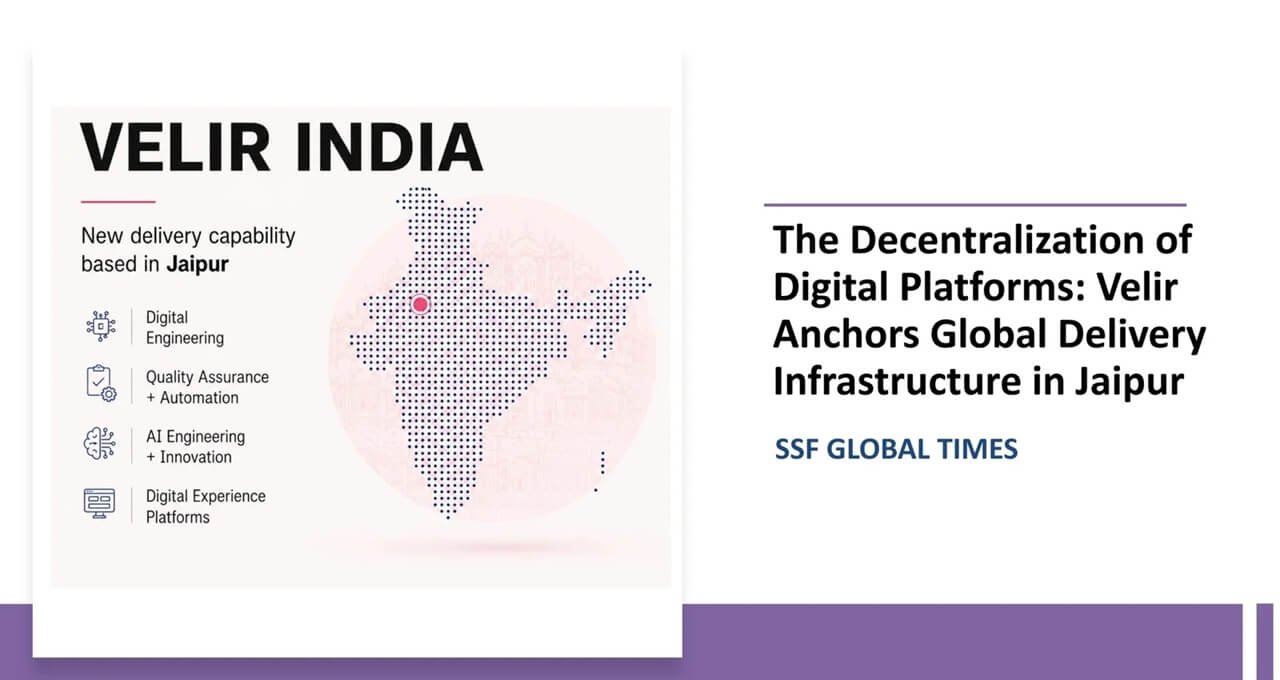
JAIPUR | June 7, 2026: Velir a digital experience agency serving enterprise clients, has formally established its India capability center, Velir India, in Jaipur, Rajasthan. In a deliberate geographical pivot, the enterprise bypassed traditional, high-density technology corridors such as Bengaluru, Hyderabad, and Pune to anchor its operations in the Pink City. To facilitate this market entry and support long-term capability development, Velir partnered with Origin, an execution firm that managed the establishment and scaling of the Jaipur facility
Headquartered in Boston, Massachusetts, and founded in 2000, Velir operates as a specialized digital experience and technology agency serving large-scale enterprise clients. The organization integrates data strategy, platform engineering, and digital design to build and maintain complex digital ecosystems. Rather than functioning purely as a creative marketing firm, Velir focuses heavily on the technical architecture that drives enterprise delivery, specializing in the implementation of major digital platforms such as Sitecore, Acquia, and Optimizely.
The new Jaipur hub does not function as an isolated offshore unit. Instead, it operates within a single, integrated global delivery model that connects Velir’s teams across the United States, Latin America, and India. This unified structure utilizes shared governance standards and tools to maintain consistent service delivery for complex digital programs across multiple time zones.
Expanding Engineering Depth
Architected to deliver core technical functions, Velir India operates as an integrated extension of the firm’s global network. The facility focuses on several primary capability pillars:
- Digital Engineering & QA: Architecting scalable digital frameworks and executing comprehensive quality assurance protocols for complex client deployments.
- AI Engineering: Developing and integrating artificial intelligence solutions to optimize digital delivery and internal capabilities.
- Platform Automation: Building autonomous delivery pipelines to increase operational efficiency across global projects.
- Enterprise Digital Experience Platforms (DXP): Providing end-to-end management, engineering, and architectural support for high-stakes enterprise systems.
Velir CEO Wendy Karlyn noted that the launch marks a critical milestone, enabling stronger AI capabilities and the flexibility to support a global delivery network. Furthermore, CTO, Corey Caplette confirmed that the facility provides the agency with direct access to highly specialized talent capable of managing dense digital experience and AI frameworks.
The Alternative Talent Thesis: Why Jaipur?
The decision to bypass established technology corridors like Bengaluru, Hyderabad, and Pune highlights a growing push toward geographic de-risking among mid-market technology firms. While Tier-1 markets offer massive scale, they present severe operational headwinds for specialized, agile agencies. The selection of Jaipur is driven by three distinct structural factors:
- Insulation from Tier-1 Attrition and Churn: In legacy tech hubs, the hyper-concentration of global capability centers has created an ecosystem of rapid talent rotation, where software engineers frequently move between enterprises for incremental compensation gains. This structural churn disrupts multi-year project continuity and drives up recruitment costs. Jaipur, by contrast, provides a high-retention environment. Tech firms operating in Tier-2 ecosystems experience significantly higher workforce stickiness, allowing for long-term project stability and predictable delivery timelines.
- Unsaturated Academic Pipeline: Rajasthan houses a dense network of technical institutions and universities, producing a consistent annual pool of engineering, data science, and mathematics graduates. In Tier-1 hubs, this fresh talent is immediately absorbed or fragmented across thousands of competing firms. In an emerging node like Jaipur, a global enterprise can directly capture premium engineering graduates, securing a first-mover advantage in talent acquisition without competing against the hiring volume of Fortune 500 captives.
- Infrastructural Efficiency and Livability Metrics: Beyond talent economics, the operational costs of establishing a physical footprint in Jaipur are substantially lower than in legacy commercial zones. Lower Grade-A office rents and reduced secondary operational expenses optimize corporate capital allocation. For professionals, the city offers reduced urban congestion, shorter commute times, and a lower cost of living compared to saturated metropolitan areas. This balance helps mitigate the urban infrastructural fatigue common in Tier-1 cities, acting as a secondary mechanism for long-term employee retention.
The Macro Landscape: India’s Great GCC Rebalancing
Velir’s entry into Jaipur aligns with a broader structural shift detailed in a Research paper by SSF Global, titled The Great GCC Rebalancing. The analysis indicates that India’s capability center footprint is transitioning into a distinct phase of geographic diversification. While the first wave of corporate expansion focused on cost arbitrage and the second on localized digital innovation, the emerging third wave is defined by distributed capability networks moving into Tier-2 regional ecosystems.
This macroeconomic shift is driven by specific data points and structural transformations across the market:
- Concentration Pressures in Legacy Hubs: Six mature metropolitan clusters—Bengaluru, Hyderabad, Delhi-NCR, Pune, Chennai, and Mumbai—currently command 94% of India’s total GCC footprint. Bengaluru alone hosts approximately 450 to 500 centers, creating intense talent competition, rising operational costs, and localized infrastructure strain.
- Strategic Corporate Drivers: Enterprise choices to look beyond traditional hubs are increasingly driven by long-term operational resilience rather than simple real estate savings. An industry survey reveals that only 12% of corporate leaders view real estate arbitrage as the primary driver for Tier-2 expansion. Instead, risk diversification and business continuity (48%) combined with mitigating wage inflation in Tier-1 markets (31%) serve as the primary catalysts.
- The Northern Talent Supply Gap: States across northern India produce an abundant annual talent pipeline, including roughly 1 million STEM graduates and 200,000 MBAs. Despite this volume, corporate presence outside of Delhi-NCR has remained fragmented, leaving a large pool of technical professionals available to early-moving global enterprises.
- Targeted Policy Frameworks: Regional governments are introducing specific frameworks to attract captive investments. Under the Rajasthan GCC Policy 2025, the state has established an operational target to host 200 GCCs by 2030 and create 150,000 high-skill jobs, using capital subsidies, payroll support, and rental reimbursements to attract global firms.
- The “5P” Benchmarking Framework: Modern enterprise site selection has evolved past basic labor-cost calculations. Corporations are evaluating emerging markets through a standardized 5P Framework that measures Pollution (environmental quality and urban livability), Policy (incentives and governance stability), Performance (infrastructure reliability), Positioning (global brand perception), and Partner Ecosystem (local consulting and startup networks).