



 Ask an Expert


GCCs do not become Capability Centres by being named so – surely, not right away as they are set up or merely by efflux of time or scale! They need to consciously become one! Most GCCs are still struggling with this simple truth!
1. Living in the False World – Assumption vs Reality
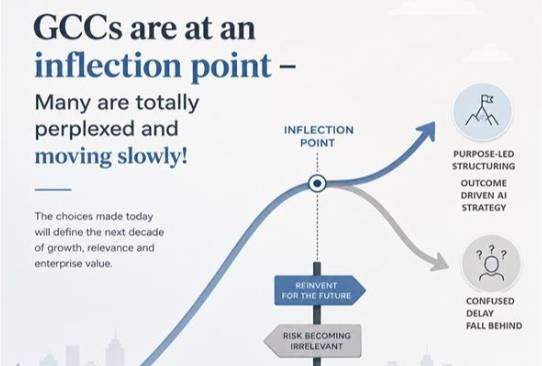
Based on my recent candid one-on-one conversations with 30+ senior GCC leaders across different maturity curves – 250 to 15,000 FTEs — spanning business operations, product engineering, and innovation hubs — one pattern is impossible to ignore. Every GCC forum. Every offsite. Every leadership deck. The same three words: “drive enterprise value.” But here’s what nobody wants to say out loud — most GCCs are still measuring the incorrect things, operating in the incorrect way, and quietly falling behind!
- More FTEs ≠ Higher maturity
- More bots ≠ Digital transformation
- Green SLAs ≠ Business value
- Sporadic AI deployment ≠ AI First GCC etc etc…
The challenge is not intent. Most GCCs genuinely aspire to become enterprise value creators. The challenge is that they overestimate their progress & maturity because they’re measuring outputs, instead of business outcomes and enterprise impact.
Then how does one measure the enterprise value that the GCC creating? This is precisely the thinking behind RISE, Quintes Global’s GCC Capability Maturity Framework. RISE is a strategic lens that challenges GCCs to leverage ‘collaboration’ for ‘capability’ and progress towards “Commitment to enterprise outcomes”, and the “Competitive Edge”.
At its core, RISE helps organizations to answer one critical question: “Where are we today (Level 1) , and what will it take to become an Enterprise Centre (Level 5)?”. The framework approaches maturity not as a linear scale exercise, but as a progression of enterprise capability: Process Centre → Service Centre → Value Centre → Strategic Centre → Enterprise Centre
More importantly, the framework examines maturity through dimensions that are often under-assessed in traditional GCC evaluations: enterprise alignment, collaboration depth, decision ownership, innovation contribution, digital capability, AI readiness, operating-model maturity, and business outcome orientation. This becomes particularly relevant now because AI is rapidly exposing the maturity divide between GCCs.
2. Artificial Intelligence is not a side experiment – Widening of the Gap
Enterprises globally are racing to embed AI into their Operations and Business, and GCCs are now supposed to or expected to lead that charge…..to make the Enterprise accelerate that AI journey! Yet many remain stuck due to lack of clarity, slow decision-making, unclear prioritization, IP concerns, and use-case selection that is technology-led rather than business-led and hence leaving transformative value on the table. Everyone is talking about it, however only few of them are thinking holistically. As a result, three distinct categories of GCCs are beginning to emerge.
(a) Sitting Ducks — Talking AI. Waiting for clarity. Losing ground daily.
(b) Window Dressers — Piloting. Presenting. Delivering theatre, not transformation.
(c) Marching Ahead — Executing a real AI roadmap. Building moats. Widening the gap.
The uncomfortable truth? The majority are in bucket (a) and (b). The gap between these groups is widening quickly. Industry observations increasingly reinforce this direction. A relatively small segment of GCCs currently operate at advanced strategic maturity levels, and they are expected to function as enterprise innovation orchestrators and AI transformation hubs rather than traditional support organizations.
What many organizations lack today is not AI awareness, but structured AI acceleration.
Our proprietary tool TIES, enables GCCs to just not assess their current digital maturity but provides a playbook for accelerating on the right areas to ‘up the digital & AI maturity’ focused on delivering results (read here value impact for enterprise).
This thinking also shaped the launch of AIXeleron — Quintes’ AI acceleration and scale hub for GCCs. The premise behind AIXeleron is practical rather than conceptual: most GCCs are no longer struggling with awareness of AI opportunities. They are struggling with scaling AI systematically across enterprise functions while balancing governance, speed, risk, capability readiness, and business alignment. AIXeleron – helps GCCs to accelerate this journey from AI ‘experimentation’ to scale fast for enterprise value realization
3. Hybrid Model is Gaining the Ground – The Real Accelerator
It is interesting the way the world of GCC is evolving and finding its own direction – what we, at Quintes, call as the ‘Age of Collaboration’ or the ‘Age of Collaborative Value’! When a pure-play captive model (Company Owned & Company Operated) can’t move or does not know how to move fast enough, and traditional outsourcing means losing control (to the Service Provider) — there’s a third, and more value generating path – The HYBRID: Company Owned, Partner Operated (COPO).
- Partner-led execution — specialist horsepower without ceding control
- You (Enterprise) own the IP — models, data, talent strategy, branding inside your boundary
- 30–50% faster AI deployment cycles — leap-frog without the build-from-scratch tax
Several factors are driving this shift:
- Unbiased Orchestrators to make the ‘COPO’ happen
- Velocity to Transform and Adoption of AI
- Investment Avoidance to scale AI in GCCs
- Guaranteed Saves & Benefits
- Channelize Focus on Core Business
- Scale Constraints and Fat belly Optimization (Rhombus to Pyramid)
The increasing interest in hybrid operating structures is also being reflected in broader industry discourse and several global advisory firms, particularly as GCCs move toward becoming enterprise transformation hubs rather than standalone operational entities. Interestingly, COPO is not simply outsourcing under a different label.
We strongly believe that over the next 12-18 months, we will be witnessing many of the pure play captives shifting to this partner-led GCC models. We are actively engaged on a few of similar initiatives of GCC Spin-offs/ strategic carve outs; not as the traditional spin-offs to outsourcing but ensuring accelerated #AI-fication and unlocking the enterprise value. We are working closely with a few SIs (System Integrators) to shape the partnership construct their GCC offerings, stack up bespoke solution approach and co-create the value through these spin-offs.
“The GCCs that lead the next decade won’t be those who waited for a miracle — they’ll be the ones who co-created the engine with the right partners and delivered the magic.”
4. For IT Services firms — the Playbook has changed
The “either/or” era is over. Happy to see that IT Services majors have moved to accept the reality of the “and” paradigm to co-exist. The GCC world doesn’t want you as a vendor. It wants you as a co-creator. The firms gaining relevance are already making that shift:
- From FTE/margin thinking → enterprise value thinking
- From traditional outsourcing → capability acceleration
- From headcount delivery → outcome ownership
If you’re still pitching seat-based models to GCC leaders in 2025, you’re not late — you’re irrelevant.
At Quintes, we are working with many ITS/ ITeS Majors to stack up their GCC growth strategy, relevant market positioning, develop their IPs/ capability readiness / offerings and propel the go-to-market! The Choice is yours – whether to become ‘irrelevant’ or make the change today!
5. ‘Call to Action’ – for GCC Leaders to Prioritize
So, is your GCC indispensable tomorrow, or just relevant today or has already been losing its relevance, yesterday? GCC leaders now need to make deliberate choices around capability maturity, AI operationalization, operating-model evolution, and ecosystem collaboration, and below are the recommended areas of action:
- Baseline the Maturity (Leverage the RISETM framework)
- Evolve holistic AI strategy (Deploy TIESTM framework and leverage AIXeleronTM platform)
- IT/ITeS firms to uplift market positioning (Redefine and roadmap for enhancing capability)
- Adopt bespoke Hybrid structuring (Shape your strategy to speed up & amplify unlocking the value)
The future GCC will not be differentiated by scale alone. It will be differentiated by how deeply it shapes enterprise decisions, transformation velocity, innovation capability, and competitive advantage. For leaders, the uncomfortable but necessary question is this: is your GCC still being valued for scale, or is it being trusted for transformation? The answer will define its relevance in the years ahead.
Happy to hear your views/ schedule a honest & candid chat to exchange our thoughts. Please feel free to reach out to me to share your thoughts, experiences, or if you are keen to learn more about some of the frameworks and its relevance for your organization.
ABOUT THE AUTHOR

Rakesh Sinha is Co-Founder, SSF Global; Founder & CEO, Quintes Global; ED & COO – RvaluE Group
Rakesh is a seasoned professional with an entrepreneurial experience of two decades in Advisory & Consulting, Business Services, Business Process Transformation and Technology. He is an IT Graduate and has acquired management skills from IIM Calcutta. He is one of the few leaders globally certified as Authorized Evaluator by ITsqc of Carnegie Mellon University, USA for eSCM, and a certified ‘Program Coach’ from Canada. He has been part of setting up and growing over 15 India and global shared service centers. He has carried out over 100 transformational engagements enabling the team to deliver business impact of over US$400 mn to clients and identifying process consolidation opportunities for 5000+ FTEs.
His expertise and experience have been largely in the fields of Sourcing Model Strategy, Benchmarking, Location Strategy, Offshoring, RFP & Deal Management, Business Process Redesign, Vision Planning for Globalizing Shared Services, Business Case Design, Process Migration, People Transition, and other related areas, cutting across F&A, HR, Supply Chain & Procurement, Customer Life Cycle, and IT functions both in Manufacturing and Services domains.
Rakesh co-founded SSF to create and disseminate knowledge for excellence in BPM for the ecosystem in Global India. He has authored several pioneering research reports and books and is well-recognized in the industry.
In December 2020, Rakesh was recognized by Economic Times as one of the ‘Most Promising Business Leader in Asia for 2020-21’. In 2016, he was identified as one of the top 30 Influential young entrepreneurs of the year by the Insight Success magazine and featured on the cover page. He was honored as one of ‘India’s Greatest Leaders of 2017-18 – Pride of the Nation’ by AsiaOne Magazine & URS Media. In addition, Rakesh has been felicitated/ honored by many leading media houses in several of their industry magazines as ‘Pioneer’, ‘Thought Leader’, ‘Guru of Business Process Space’, etc. He was one of the youngest to be invited as member of Management Council of Delhi Management Association. As part of his social responsibilities, Rakesh mentors young leaders from leading management institutes and devotes time and energy to social projects with like-minded people. He is a creative thinker and has a personal mission to create a ‘Think Tanks for 2030’ and make India a better place to live in the global village.