



 Ask an Expert

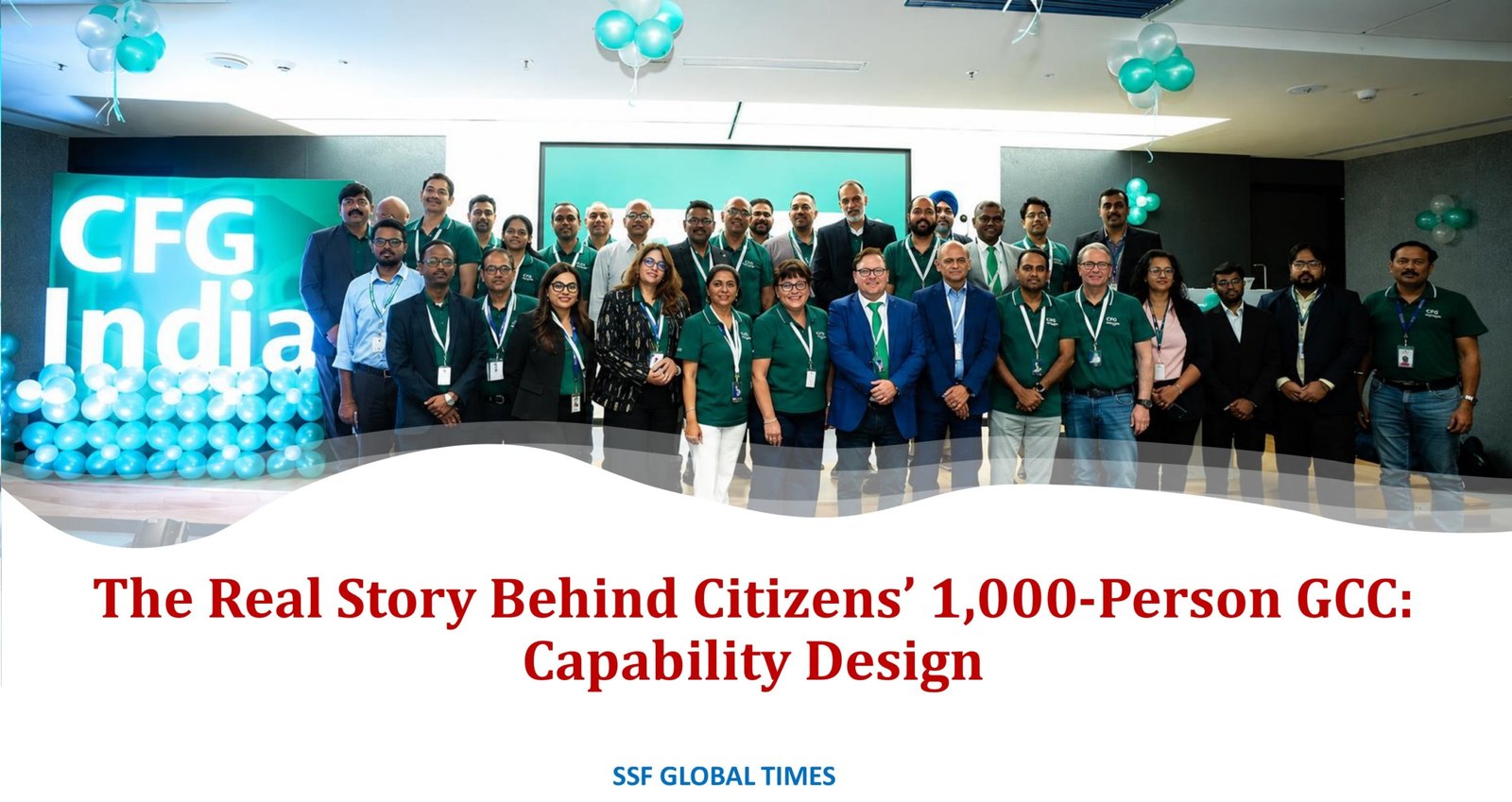
HYDERABAD | May 18, 2026: Citizens Financial Group and Cognizant marked the first anniversary of their Hyderabad Global Capability Center (GCC) by crossing the 1,000-hire threshold. In a market where headcount is often used as a vanity metric, this number demands a different analytical lens. For the seasoned practitioner, this isn’t a story of HR recruitment speed; it is a measure of work-depth density.
The center, which launched on April 15, 2025, serves as the operational heart for Citizens’ “Next Generation Technology” (NGT) strategy. The velocity of scaling to 1,000 people in twelve months suggests that the foundational trust between the bank and its partner was not built on pilot projects, but on high-stakes engineering mandates. When an organization with $217.5 billion in assets moves its mobile engineering and middleware API development outside the U.S. for the first time, the hiring milestone becomes a proxy for architectural integration. It indicates that the “setup friction” typically associated with year-one operations was bypassed in favor of immediate technical contribution.
A Tripartite Institution
While the standard industry practice usually involves a two-party relationship – the enterprise and the operator, Citizens’ GCC is modeled on a three-party governance structure involving Citizens, Cognizant, and BCG as an independent program governance layer. This is an unusual and deliberate choice resulting into a high level of operational maturity. By inserting an independent third party, Citizens have created a conflict-free governance model. In a typical Build-Operate-Transfer (BOT) setup, the operator is often tasked with grading its own performance. By bringing in BCG, Citizens ensure that the strategic direction and operational execution are held to an objective standard. This structure addresses a common anxiety among CIOs: how to maintain sovereignty over outcomes when the physical operations are in someone else’s hands.
- Strategic Signal: The presence of a third-party governor suggests that Citizens view this GCC as a mission-critical engine, where the cost of a “blind spot” in partner performance is far higher than the cost of an extra governance layer.
The BOT Paradox: Building Vendor Independence Through a Vendor
There is a glaring paradox in Citizens’ press materials: the GCC was established to “reduce reliance on vendor partners,” yet it is being built and operated by Cognizant, one of the world’s largest vendors. To the uninitiated, this sounds contradictory. To the GCC leader, it is a masterclass in the Build-Operate-Transfer (BOT) model.
The BOT framework resolves this paradox by treating the vendor as an accelerator rather than a permanent fixture. Citizens are not looking for a traditional outsourcing relationship; they are hiring a temporary operational architect. The end goal is sovereignty. By utilizing Cognizant’s local infrastructure and talent access, Citizens reaches a state of operational readiness years faster than a “DIY” approach would allow. The “transfer” phase is the goal planned exit from dependency that allows the bank to eventually own its own capability.
- The Shift: This is the transition from transactional delivery to capability acquisition. You use the vendor’s muscle to build the muscle you eventually intend to own.
Inside the “Integrated Global Model”
We often hear the phrase “integrated model,” but the Citizens Hyderabad center provides a concrete definition through its work profile. This is not a “back-office” or a “support hub.” The teams in Hyderabad are working side-by-side with U.S. teams, effectively creating a 24/7 engineering engine.
The depth of work being handled in India is unprecedented for a regional U.S. bank:
- Middleware APIs: Developing the critical connective tissue for mainframe modernization.
- Mobile Engineering: The first time Citizens has moved this core competency outside the U.S..
Full Cloud Migration: Supporting the target of becoming the first U.S. regional bank to be 100% cloud-based by the end of 2025.
The GCC is a core part of our global engineering engine, with teams in India working side-by-side with our US teams to build and scale AI-driven solutions, modernize our technology platforms, and shape the future of banking.
The Platform Question: When the Technology Layer Belongs to Your Partner
One of the most critical elements of this partnership is the technology stack. Cognizant is not just providing people; they are bringing in their Neuro® AI and FlowSource™ platforms as the underlying technology rails. This raises a vital question for GCC leaders: what happens to platform dependency during the “Transfer” stage?
When a GCC is built on a partner’s proprietary AI and delivery platforms, the eventual transfer of ownership becomes complex. Does the enterprise license the platforms indefinitely? Or do they face a technical debt event when they move to their own systems?
- Note: The Citizens-Cognizant model suggests that the technology layer is now as important as the talent layer. Leaders must negotiate the exit rights to the technology as carefully as they negotiate the transfer of the employees.
Strategic Talent Pipelines: Sourcing as Supply Chain Planning
There is a final element of the Citizens framework that warrants serious executive analysis: their investment in the Mahatma Jyotiba Phule Residential Degree College for Women in Telangana, providing technical infrastructure and AI training for over 700 female students from underserved communities.
While many observers might view this through a standard corporate social responsibility lens, the more accurate assessment is that this is a highly pragmatic talent pipeline strategy with a five-year horizon.
Primary tech hubs are deep, but finite. The centers experiencing the most acute margin pressures today are those that continuously source from the same institutional pools using identical playbooks. By investing early in non-traditional talent communities outside the typical top-tier campus networks, organizations are broadening the base of the talent ecosystem. This is not corporate idealism; it is long-term supply chain planning to secure advanced technical skills before the market faces structural shortages.
The Path Forward
The collaboration between Citizens and Cognizant demonstrates that when a capability center is built with tight integration from inception and backed by the right operational partner, it can achieve meaningful scale at unprecedented speed. Over the next twenty-four months, the key metric to watch will not be headcount growth, but the complexity and ownership of the portfolios managed out of Hyderabad.
Speed of scale earns near-term attention, but depth of integration earns long-term relevance. The organizations that will define the next decade of enterprise services are those that figure out how to build both simultaneously.
The Citizens-Cognizant model challenges the notion that speed and sovereignty are mutually exclusive. As more regional banks look toward India, the question remains: are you building a center to save costs today, or are you building an engine to own your technology future?