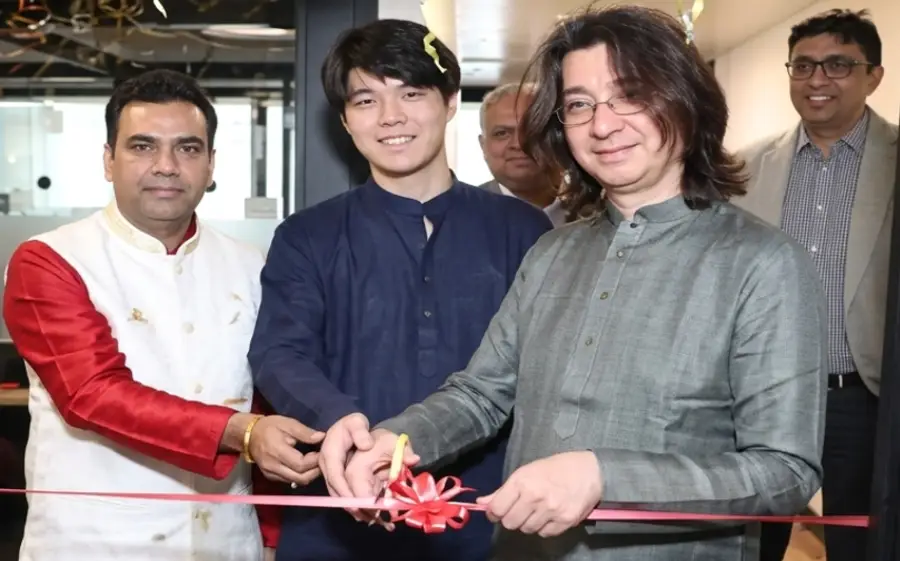




Bengaluru | 1 May 2026: Marking a profound departure from conventional large-scale offshoring models, Japanese multi-service platform company, Raksul Inc., has launched a highly specialized Global Capability Centre (GCC) in Bengaluru. Operating out of Manyata Embassy Business Park, the company is adopting a distinctive “Nano GCC” model, capping its local headcount at approximately 100 employees – a paradigm shift in offshore strategy from scaling headcount to high-density, AI-driven engineering.

Raksul operates on a three-location model, where Tokyo handles product strategy, Vietnam focuses on development execution, and Bengaluru acts as the core hub for architecture and platform engineering, notes. Raksul intends to build an integrated AI-powered platform to support small and mid-sized businesses (SMBs). This highlights a broader trend where startups and mid-sized companies are using “nano” models to establish deep technical expertise in India without the overhead of massive, traditional GCC structures. Sujit Kulkarni, Site Leader of Raksul India GCC, highlighted the broader shift in GCC strategy.

It’s not about building capacity anymore. It’s about building capabilities.…Traditional pyramid-like structures are going away. We are focusing on highly qualified engineers who can work with AI agents as colleagues. Any task which is repetitive in nature should be reduced… this is not what we expect from humans.

Sujit Kulkarni, Site Leader, Raksul India

RakSul: Democratizing Legacy B2B Markets

Founded in 2009, RakSul operates at the intersection of deep-tech and traditional industries. The unicorn (valued over $1 billion) builds powerful digital marketplaces that “Uberise” inefficient sectors like commercial printing, logistics, and TV commercial production. Key enterprise markers include:

  • Financial Resilience: Delivered annual revenue of JPY 61.95 billion for the fiscal year ending July 2025.
  • Lean Global Presence: Maintains a highly optimized worldwide workforce of just 791 employees.
  • New Product Lines: Expanding its ecosystem with “Josys,” an IT device and SaaS management platform built entirely from India to address global corporate security vulnerabilities

Raksul is showing very rapid growth momentum, and this has increased our system complexity… To support this, we are seeking very good engineering talent…India will focus on deep expertise in platform engineering, shared infrastructure, and identity systems, these systems interact with multiple Raksul businesses.

Toshiharu Takeuchi, CTO, Raksul

The Strategic Pivot: The Nano GCC Philosophy

The center’s strategy is defined by precision rather than scale:

  • Hyper-Concentrated Workforce: The company is deliberately capping its local headcount to approximately 100 elite professionals.
  • Agile Infrastructure: Utilizing flexible, managed workspaces avoids the bureaucratic drag and capital expenditure of massive corporate campuses.
  • AI-Integrated Execution: Fusing experienced engineers with advanced AI tools drastically accelerates product innovation and decision-making cycles.

The Bengaluru Calculus and Ecosystem Synergy

RakSul selected Bengaluru specifically for its unparalleled density of specialized engineers capable of executing an “AI-first” mandate. Before finalizing the launch, the leadership utilized market intelligence from prominent advisory firm Zinnov to map out the optimal entry strategy.

Furthermore, this move perfectly aligns with proactive state initiatives. The Karnataka GCC Policy 2024-2029 officially codifies the “Nano GCC” category (5-100 employees), offering streamlined compliance and incentives that actively encourage high-value, specialized R&D hubs over basic back-office processing.

SSF Insight Box: Key Aspects of the Nano GCC Model

  1. “Nano” Scale, High Impact: Unlike traditional GCCs that grow by hiring thousands, Raksul limits its Bengaluru team to ~100 members. The goal is to build a compact, high-impact team rather than massive operational capacity.
  2. AI-First Workflow: The center embeds AI across the entire software development lifecycle (SDLC), from coding to testing and reviews, utilizing AI-assisted workflows to enhance productivity.
  3. Strategic Focus over Support: Raksul’s Indian team is not just for back-office work; it acts as a strategic hub focused on platform engineering, shared infrastructure, and identity systems. The Bengaluru team will lead technical guidance and decision-making for Raksul’s global operations.
  4. Talent Strategy: The approach emphasizes hiring senior, high-density engineering talent over large-scale, junior-level hiring
  5. Capability Density Over Volume: Prioritizing domain-specific expertise to execute complex mandates rather than building massive transactional teams.
  6. Unprecedented Speed to Market: While traditional mega-centers take 12 to 18 months to operationalize, agile Nano GCCs leverage managed infrastructure to become fully functional within 8 to 12 weeks.
  7. Mitigating ‘Key-Person’ Risk: Nano GCCs counter high attrition rates by offering elite engineers’ global visibility, flat hierarchies, and deep product ownership from day one.

Industry Standpoint: Redefining Offshore Strategy

The emergence of the Nano GCC fundamentally is transforming India’s $64B Global Business Services (GBS) Industry:

  • Democratized Access: The model significantly lowers the capital barrier to entry, allowing mid-tier enterprises and fast-growing startups to tap into India’s premier talent pool.
  • Capability over Capacity: The shift from “building capacity” to “building capabilities” means using fewer people to achieve higher-quality, complex outcomes through automation and artificial intelligence. The value proposition has entirely evolved. These sub-100 employee centers are designed exclusively to drive strategic IP creation and autonomous platform development, completely abandoning the old cost-arbitrage playbook.
  • Speed and Agility: By utilizing a smaller team paired with AI, nano GCCs accelerate their innovation cycles and decision-making, which is crucial for their expansion in e-commerce, fintech, and marketing services.
  • Changing Office Dynamics: The model reflects a shift toward smaller, managed, high-quality office spaces in Bengaluru, moving away from large, sprawling corporate campuses.

Conclusion

RakSul’s strategic launch in Bengaluru serves as a definitive blueprint for the future of global capability models. By prioritizing an AI-first architecture, installing seasoned deep-tech leadership, and capitalizing on progressive state policies, the Japanese unicorn proves that organizational agility is the ultimate competitive advantage. In 2026, the capacity to innovate is determined by the density of intelligence, not the size of the workforce.

Curated by SSF Global

Tracking the shifts shaping GCCs, enterprise ecosystems, and the future of global business.

Share on      

SSF Global is a pioneering practitioner-led platform for GCC/GBS leadership. We track, publish, and interpret the shifts reshaping enterprise capability centers, and partner with organizations globally to design GCCs that deliver trust, intelligence, and sustainable enterprise value.

If you are exploring a GCC strategy, designing a future-ready operating model, or looking to scale digital capabilities, SSF Global enables end-to-end solutions, from research and benchmarking to strategy, design, and operationalization.