



 Ask an Expert


Executive Summary
India’s commercial real estate system is undergoing a once-in-a-generation transformation, one that mirrors, and in many ways accelerates, the evolution of the Global Capability Centre (GCC) ecosystem. The GCC model has shifted from cost optimization and labour arbitrage to becoming an indispensable engine of global innovation, digital acceleration, AI adoption, and cross-market operational leadership. As GCCs have evolved, so has the expectation from real estate: what was once a capital-intensive, static, location-bound infrastructural decision is now a strategic, capability-first, and deeply integrated enterprise lever.
India achieved a historic 83.3 million square feet of gross leasing in 2025, with GCCs accounting for nearly 40% of Grade A office absorption. The significance of this number lies not only in the sheer magnitude of space occupied, but in the kind of space global enterprises are now demanding. Traditional long-term leases and CapEx-heavy office buildouts are rapidly giving way to flexible, fully serviced, consumption-based workspace models that prioritize speed, scalability, elasticity, compliance integration, and operational resilience.
Key Implications:
- For Enterprises: Real estate is no longer a static infrastructural need; it is an agile lever for talent acquisition, risk mitigation, and rapid market entry into emerging hubs.
- For Developers: The market is transitioning from pure asset leasing to service-led real estate, requiring developers to integrate hospitality, compliance and enterprise-grade technology.
- For Investors: The surge in enterprise demand for managed spaces is compressing yields in Grade A assets, creating highly stable, institutional-grade investment opportunities.
Simultaneously, India is experiencing a geographic rebalancing unlike any period before. More than 94% of India’s GCCs remain concentrated in six Tier-1 cities, a concentration that has created structural constraints – wage escalation, urban congestion, infrastructure saturation, and rising real estate costs. As documented in SSF Global’s 2026 knowledge paper, “The Great GCC Rebalancing – North India’s Moment,” enterprises are now building distributed, multi-hub operating models anchored in Tier-2 cities for risk diversification, deeper talent access, and sustainable cost structures. This shift marks the emergence of India’s new strategic real estate and capability corridor.
This paper aims to examine the evolving contours of India’s commercial real estate market, its deepening connection to the GCC operating model, and the strategic choices that will determine which enterprises gain the strongest competitive advantage in the coming decade. It offers grounded insights, validated trends, sector examples, and SSF-developed perspectives for global CXOs navigating this complex but opportunity-rich landscape.
India’s Commercial Real Estate Evolution: A Market Pulling Ahead of Global Headwinds
India’s commercial real estate sector has decoupled from the sluggish trends observed in several India has significantly decoupled from global real estate stagnation. As major Western economies continue to grapple with office vacancy rates ranging from 18% to 22% due to hybrid adoption and corporate downsizing, India’s office markets – particularly Bengaluru, Hyderabad, Pune, Chennai, and NCR, have remained on a steep growth trajectory. This divergence is powered principally by the structural rise of GCCs, the expansion of global engineering centres, and the demand for high-quality, technology-integrated, ESG-compliant Grade A workspaces.
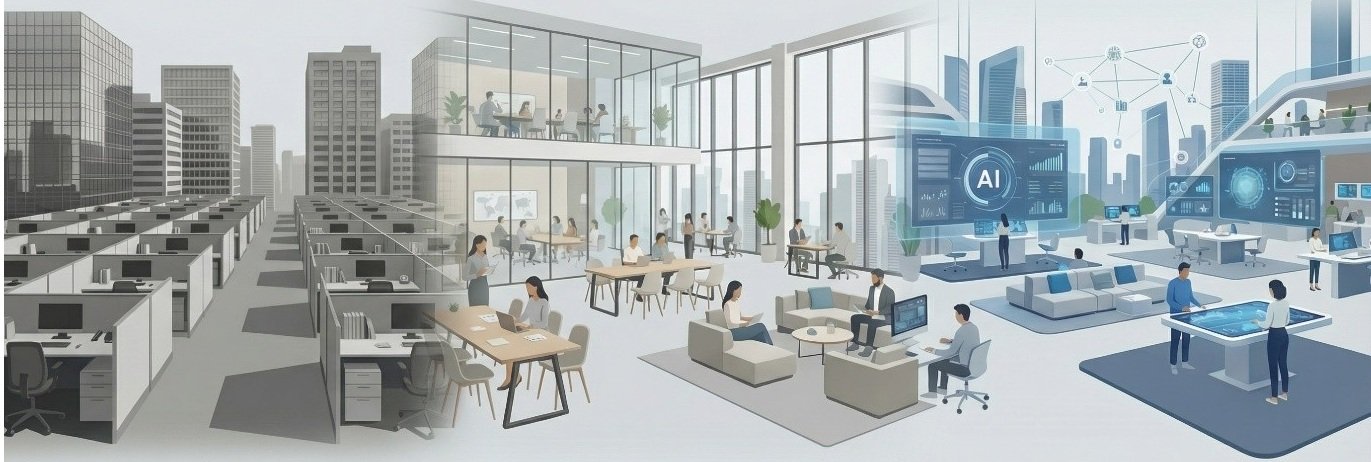
The transformation is not only quantitative but qualitative. Between 2017 and 2025, flexible and service-led workspace transactions expanded from 2.2 million sq. ft. to 18.6 million sq. ft., an 8.4-fold increase. Flex penetration rose from 5% to 21%, making India the second-largest flexible workspace market globally. This surge demonstrates that enterprises are no longer evaluating workspaces as real estate assets – they are evaluating them as operational infrastructure, parallel to cloud computing and digital platforms.
The rise of REITs has also played a critical role. The Embassy, Mindspace, and Brookfield REITs have institutionalized India’s office asset class, injecting patient capital and raising governance standards. As a result, enterprise-grade building<s today offer advanced features – smart building technology, 24/7 security integration, ESG readiness, multimodal connectivity, and high-density digital infrastructure – making them suitable for AI-driven, data-intensive GCC operations.
From an SSF standpoint, the market has fundamentally moved from “real estate availability” to “capability readiness.” Enterprises no longer ask whether space exists; they ask whether the space can support global transformation programs, cybersecurity protocols, hybrid operational footprints, and AI-intense workloads. This shift is at the heart of the new GCC operating architecture in India.