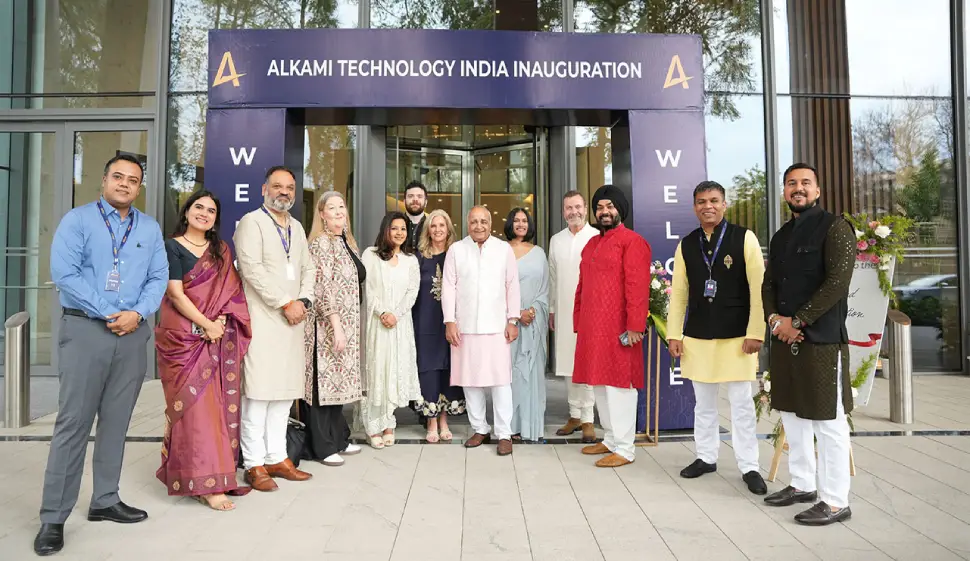




Delhi NCR | 26 March 2026: Alkami Technology’s entry into India with a Global Capability Centre (GCC) in NCR, supported by Summit (an ANSR company), reflects more than geographic expansion, it marks a shift in how digital banking platforms are being built and scaled.

Headquartered in Texas, Alkami operates at the intersection of fintech infrastructure and customer experience, offering a unified Digital Sales & Service Platform (DSSP) that combines onboarding (MANTL), digital banking, and data-driven marketing. Its core proposition “anticipatory banking” moves beyond reactive interfaces, using behavioral data and AI to predict user needs and guide next-best actions.

The India centre is being positioned to build the data, engineering, and security layers required to operationalize that premise at scale.

NCR Fits into a Data-Heavy Product Strategy

The NCR hub is structured around platform engineering, data intelligence, and cloud architecture, with a focus on translating behavioral data into usable product outcomes.

This includes:

  • Designing systems that convert user activity into predictive signals
  • Building pipelines that allow data to move from capture to decision without delay
  • Embedding zero-trust security protocols into every layer of the platform

Alkami was very intentional in selecting the National Capital Region for our technology hub in India. Its location offers a remarkable concentration of bank and fintech engineering skill, technical depth, and operational talent befitting to accelerate innovation and development across the Alkami Digital Sales & Service Platform”

– Alex Shootman, CEO of Alkami

The Gap Between Data Availability and Actionability

Most digital banking platforms today have access to large volumes of user data. The constraint lies in using that data effectively within the flow of interaction.

Typical limitations include:

  • Data being processed after the event rather than during it
  • Recommendations that are generic rather than context-specific
  • Systems that require explicit user input before triggering actions

A Different Engineering Model

Building anticipatory systems introduces a different set of requirements compared to traditional digital banking platforms:

  • Tight integration between data engineering and product logic
  • Systems that can update decisions dynamically as new inputs arrive
  • Infrastructure that supports high-frequency, low-latency processing

The India GCC is structured to support this model, where engineering is not separated from product outcomes, but directly responsible for how the system behaves in real-world scenarios.

The depth of engineering talent and the strength of the technical ecosystem in this region of India will help us scale our platform, advance our AI-driven capabilities, and deliver secure, reliable banking experiences for our customers”

– Deep Varma, Chief Technology Officer at Alkami

From Onboarding Speed to Lifecycle Intelligence

Alkami’s platform already enables measurable improvements, such as opening retail accounts 3x faster and business accounts 20x faster, while automating most of onboarding workflows.

The next phase extends beyond onboarding into lifecycle-level intelligence, where the platform:

  • Identifies when a user is likely to need a product
  • Surfaces actions at the point of relevance
  • Aligns marketing, servicing, and transactions into a single flow

This moves the system from process efficiency to behavioral alignment.

Insight Box: What “Anticipatory Banking” Requires at a System Level

The concept of anticipatory banking is often framed as a user experience upgrade. In practice, it is a systems challenge.

  1. Continuous Data Interpretation – User behavior must be analyzed as it occurs, not after it is recorded.
  2. Decision Logic Within the Workflow – Recommendations need to be generated inside the interaction flow, not as separate outputs.
  3. Unified Data and Product Layers – Fragmented systems limit responsiveness; anticipatory models require integrated architecture.
  4. Low-Latency Execution – The value of prediction depends on timing—systems must act within the moment of relevance.

SSF Perspective

Alkami’s India expansion reflects a shift in fintech architecture from systems that record and respond to systems that continuously interpret and act.

As digital banking platforms mature, differentiation will depend on how effectively they can connect data signals to real-time decisions without introducing delay or inconsistency.

In that environment, the core challenge is no longer access to data, but the ability to operate it within the product itself.

Curated by SSF Global

Tracking the shifts shaping GCCs, enterprise ecosystems, and the future of global business.

Share on      

Exploring a GCC strategy or scaling an existing centre?

SSF Global partners with enterprises to design and operationalize future-ready Global Capability Centres, spanning location strategy, talent architecture, operating model design, AI integration, and infrastructure.

Connect with us to build a GCC that delivers long-term strategic value, not just operational efficiency.

About SSF Global
SSF Global is a Global Community for Enterprise Function Leaders and serves as a research & advisory platform focused on Global Business Services (GBS), Global Capability Centres (GCCs), and the evolution of enterprise innovation in India and beyond. We track, publish, and partner in narratives that shape how capability centres transform into hubs of trust, intelligence, and sustainable growth. We also evaluate, assess and benchmark the GCCs for their performance, maturity and other parameters using our proprietary tools built from the knowledge gained from direct interaction with our members (GCCs & GBS).