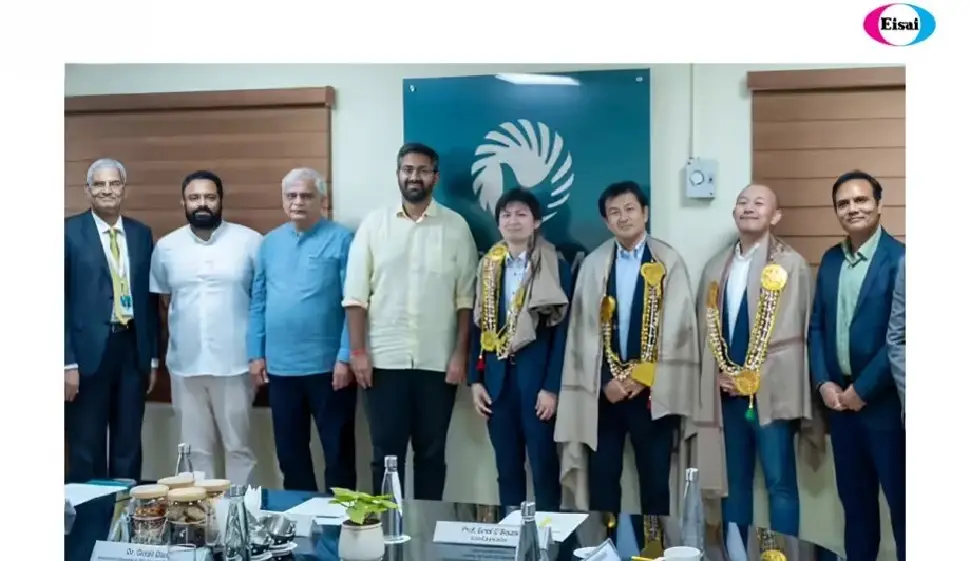




Visakhapatnam | 17 March 2026: Eisai Co.’s launch of its Global Capability Centre (EGCC) in Visakhapatnam marks a deliberate shift in how global pharmaceutical enterprises are structuring and governing their IT backbone. More than a geographic expansion, the move reflects a strategic transition toward centralized, insourced, and tightly governed digital infrastructure.

Located within the existing Eisai Knowledge Centre, the EGCC builds on over a decade of the company’s presence in India, evolving from a support base into a core node of global IT operations.

From Distributed IT to Centralized Control

Eisai Co. is a Japanese research-based pharmaceutical company headquartered in Tokyo, specializing in human health care (hhc) with a focus on neurology and oncology. Founded in 1941, it develops key products for Alzheimer’s, cancer, and insomnia. Eisai operates globally, employing over 10,000 people, among them about 1,500 are in research.

Headquartered in Tokyo, Japan, Eisai has significant operations in the U.S., Europe, India, and China. The company reported over ¥789 billion in revenue for FY2024, reflecting its strong position in global pharmaceutical markets. Eisai is listed on the Tokyo Stock Exchange and is a member of the Topix 100 and Nikkei 225 stock indices.

Eisai’s decision to consolidate global IT infrastructure operations within the EGCC signals a broader enterprise priority: reducing fragmentation across regional systems while strengthening control, consistency, and governance.

In its initial phase, the centre will anchor:

  • Global IT infrastructure management
  • System standardization across markets
  • Centralized governance frameworks

This shift away from regionally managed IT toward a unified operating model reflects a growing need for resilience, security, and execution speed in globally distributed organizations.

A Phased Capability Build-Out

Eisai’s approach follows a structured sequencing strategy, prioritizing operational stability before capability expansion.

Over time, the EGCC is expected to scale into:

  • Cybersecurity and risk management
  • Data and advanced analytics
  • Enterprise applications and digital platforms

This phased model reflects a risk-calibrated approach to GCC maturity, where infrastructure consolidation forms the foundation for higher-order capabilities.

Redesigning the Global IT Operating Model

The establishment of the EGCC is likely to reshape Eisai’s global IT structure into a hub-and-spoke model, with Visakhapatnam as the central control node.

Implications include:

  • Regional IT teams shifting toward business-facing transformation initiatives
  • Centralized decision-making for infrastructure and core systems
  • Improved alignment between global standards and local execution

This redistribution of responsibilities allows enterprises to separate core system control from market-facing agility, a critical design principle in modern operating models.

Location Strategy: The Rise of Tier-2 Capability Hubs

Eisai’s choice of Visakhapatnam reflects a broader shift toward Tier-2 cities as viable destinations for global capability centres. Key drivers include:

  • Access to skilled technical talent at optimized cost structures
  • Lower operational congestion compared to metro hubs
  • Increasing state-led investments in digital and IT infrastructure

The Andhra Pradesh government’s focus on developing Vizag as a technology and data ecosystem further strengthens its positioning as an emerging GCC destination.

GCCs as Operational Anchors in Regulated Industries

In highly regulated sectors such as pharmaceuticals, the role of GCCs is expanding rapidly. The need for data integrity, compliance, and secure infrastructure is driving organizations to centralize and internalize critical IT functions.

Eisai’s EGCC reflects this shift, positioning the centre not just as a delivery unit, but as an operational anchor supporting global enterprise resilience.

As the centre scales, its effectiveness will be defined by:

  • System reliability and uptime
  • Speed and consistency of execution

Ability to enable enterprise-wide digital transformation

SSF INSIGHT BOX: What Eisai’s GCC Signals for the Industry

  1. Centralization Over FragmentationEnterprises are moving toward unified IT architectures to improve control, consistency, and governance.
  2. Phased Capability MaturityInfrastructure-led entry followed by analytics and cybersecurity reflects a structured, low-risk scaling model.
  3. Insourcing as a Strategic LeverReducing vendor dependence signals a shift toward owning critical digital capabilities in-house.
  4. GCCs as Core Operational SystemsGCCs are evolving beyond cost centres into enterprise-critical nodes within the operating architecture.
  5. Tier-2 Cities Gaining Strategic RelevanceLocations like Visakhapatnam are emerging as credible hubs for complex, global roles.

The Strategic Signal

Eisai’s GCC strategy reiterates a broader industry transition:

A shift from distributed, vendor-led IT models to centrally governed, internally owned capability systems.

For global enterprises, the implication is clear – control over digital infrastructure is becoming central to competitiveness, not just efficiency.

Curated by SSF Global to track developments shaping the future of GCCs, enterprise ecosystems, and India’s commercial real estate landscape.

Share on      

Exploring a GCC strategy or scaling an existing centre?

SSF Global partners with enterprises to design and operationalize future-ready Global Capability Centres, spanning location strategy, talent architecture, operating model design, AI integration, and infrastructure.

Connect with us to build a GCC that delivers long-term strategic value, not just operational efficiency.

About SSF Global
SSF Global is a Global Community for Enterprise Function Leaders and serves as a research & advisory platform focused on Global Business Services (GBS), Global Capability Centres (GCCs), and the evolution of enterprise innovation in India and beyond. We track, publish, and partner in narratives that shape how capability centres transform into hubs of trust, intelligence, and sustainable growth. We also evaluate, assess and benchmark the GCCs for their performance, maturity and other parameters using our proprietary tools built from the knowledge gained from direct interaction with our members (GCCs & GBS).