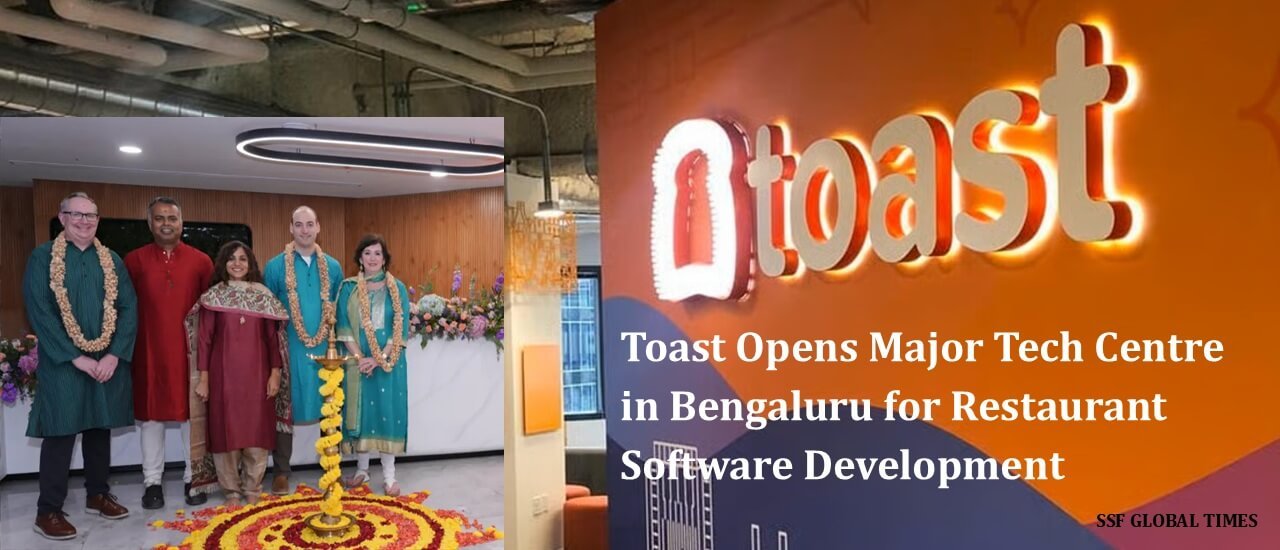




Bengaluru | 29 January 2026: Toast just opened a 64,000-square-foot technology hub at RMZ Ecoworld on Bengaluru’s Outer Ring Road, and it is a significant upgrade from their previous setup. The restaurant tech enabled platform is betting big on India, turning what started as a small office in 2022 into a full-scale GCC.

Strategic Scale: From Local Presence to Global Powerhouse

The numbers tell the story. Toast’s India headcount grew 4x times over since 2022 across Bengaluru and Chennai. The new facility has nearly triple the seating capacity of the old one. This is a fundamental shift in how Toast views India’s role in their operations.

“India plays a critical role for Toast in how we build and scale our products globally, and Bengaluru’s strong concentration of tech talent and vibrant food and beverage technology ecosystem make it an ideal location for us to expand our regional presence. Our talent idea is to employ the best people we can. Bengaluru is the most mature tech ecosystem in India. Execution and talent go hand in hand.”

– Steve Fredette, President and Co-founder of Toast

Driving the Next Generation of Hospitality Tech

What is cooking?

  1. Fintech and AI/ML solutions: Payment processing technology and predictive analytics. Restaurant payments are complex, split checks, tips, different payment methods, and integration with kitchen systems. Getting that right at scale requires serious engineering.
  2. Product innovation: R&D for point-of-sale systems, online ordering platforms, and team management tools. This is core product work, not peripheral features.
  3. Operational excellence: Scaling customer care, finance, and people operations to support Toast’s global customer base.
    “Toast’s units in India are contributing directly to core product and tech initiatives. The new hub in Bengaluru gives us the scale, flexibility, and environment needed to support long-term growth while fostering a strong culture of collaboration.”

    – Kavita Viswanath, Senior Vice President and India Site Lead

She also noted that between 2025 and 2026, “the number of roles in product and leadership have doubled over.”

Experience-Led Innovation and Sustainability

Here is something genuinely useful: Toast built a Customer Experience Centre inside the facility. It is a full restaurant-style environment where their products are deployed exactly as they would be in an actual restaurant.

Engineers & developers can examine solutions in real-life scenarios before shipping them to customers. When you’re building software that needs to work during a Friday night dinner rush with a full house and impatient customers, testing in simulated conditions matters.

The facility is LEED-certified, meeting energy efficiency and sustainability standards. Beyond the tech work, the centre will also house Toast.org, the company’s social impact arm, and run leadership training and employee resource programs.

The Broader GCC Narrative

What has changed is the sophistication of work these centres handle. Toast’s India teams aren’t doing basic IT support they’re building the core product that generates over $2 billion in annual revenue. That’s the shift: from cost centres to actual engineering hubs that drive product innovation.

For Bengaluru specifically, this reinforces the city’s position as the default choice for companies that need serious engineering talent. Despite rising costs and competition, the ecosystem’s depth keeps companies choosing Bengaluru for critical technical work.

Speed as Strategic Advantage – Our Perspective

  1. 4x in four years crushes the industry norm: Most GCCs take 7-10 years to earn HQ trust for core product work. Toast compressed that to under four years. That speed means they solve quality and coordination problems immediately. When execution works, you scale fast. Toast did.
  2. The restaurant lab is operationally brilliant: Building a full restaurant environment inside the tech centre costs money but eliminates the “works in dev, breaks in production” disaster. Engineers experience actual restaurant chaos order volumes, payment failures, timing pressure before code ships. That feedback loop is worth more than any testing framework.
  3. Leadership roles doubled = real empowerment: Adding engineers is easy. Doubling leadership means product managers and engineering leaders now sit in Bengaluru making decisions. Teams don’t wait for time zone-delayed approvals from Boston. When authority moves locally, velocity compounds.
  4. $2B revenue on India-built code: Toast’s entire platform generates over $2 billion annually, and Bengaluru contributes directly to core product. HQ doesn’t let questionable teams touch revenue-critical code. The fact that they do settle the quality debate permanently.

Looking Ahead

Toast’s revenue rate already exceeds $2 billion annually. The Bengaluru expansion is designed to accelerate advancement cycles and expand global scalability as they continue growing.

For the restaurant industry, this signals where innovation is happening. Indian engineering groups are building the software that defines how modern restaurants operate from payment processing to kitchen management to customer ordering systems. For other hospitality tech companies watching this, the message is clear: if you are serious about product development at scale, India’s tech hubs can deliver. Toast proved the model works by growing 4x in less than four years.

Curated by SSF Global to track developments shaping the future of GCCs, enterprise ecosystems, and India’s commercial real estate landscape.

Share on   

Are you looking to set-up a GCC or expand an already existing one. Write to us and we will help you by providing the blueprint/ roadmap and SETUP solution – we are a one stop solution including end-to-end requirement for a GCC – Location, People, Process, Technology (AI) and Infrastructure.

Considering the launch or expansion of a Global Capability Centre?
Quintes Global supports enterprises with end-to-end GCC strategy and execution—from location selection and operating-model design to talent, process, AI-led technology, and infrastructure—delivering a structured blueprint for scalable, future-ready centres.

About SSF Global
SSF Global is a Global Community for Enterprise Function Leaders and serves as a research & advisory platform focused on Global Business Services (GBS), Global Capability Centres (GCCs), and the evolution of enterprise innovation in India and beyond. We track, publish, and partner in narratives that shape how capability centres transform into hubs of trust, intelligence, and sustainable growth. We also evaluate, assess and benchmark the GCCs for their performance, maturity and other parameters using our proprietary tools built from the knowledge gained from direct interaction with our members (GCCs & GBS).